
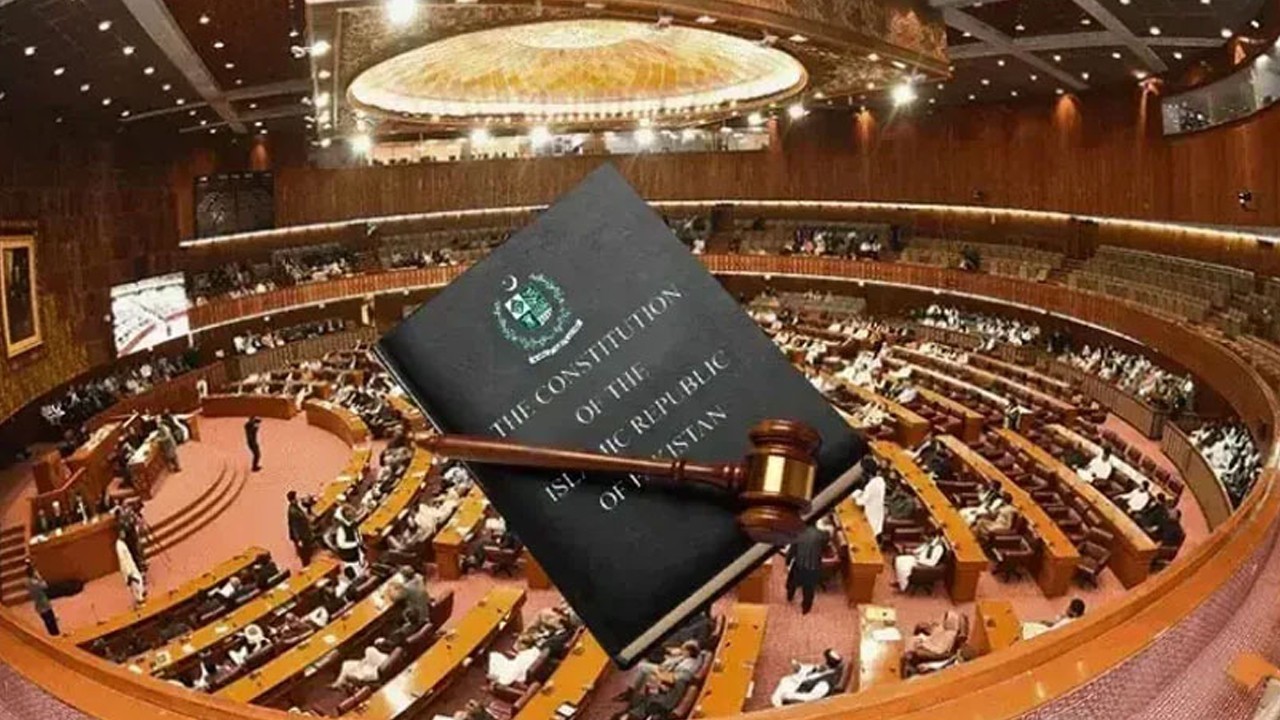


The Upper House on Thursday once again approved the 27th Constitutional Amendment Bill with tweaks made by the Lower House on Wednesday.
According to reports, Federal Minister for Law Azam Nazeer Tarar presented the constitutional amendment bill in the National Assembly with the changes made to the draft earlier approved by the Senate. The amendment received the 64 votes (two-thirds majority in the 96-member House) in favour and four against amid ruckus due to protest by opposition members.
Earlier, the session kicked off with Senate Chairman Yousuf Raza Gilani in the chair.
Pakistan Tehreek-e-Insaf (PTI) Senator Ali Zafar maintained that his party and Jamiat Ulema-e-Islam-Fazl (JUI-F) defectors were disqualified under Article 63-A of the Constitution as they, in the previous session, claimed on the floor of the house that they had resigned.
“If they have indeed resigned and the article applies, I request that the votes of these two members not be counted [during the re-voting]. Otherwise, we will challenge the entire process,” he added.
JUI-F’s Kamran Murtaza said that if someone voted against party lines and a resignation was sought from them under Article 63-A, those who wished to vote against the party should follow proper procedures.
Tarar, however, disagreed, saying that the objection of PTI and JUI-F that a member was automatically disqualified under Article 63-A for voting against party lines was incorrect.
He explained that the party head could submit a reference to the presiding officer or speaker under the Constitution. “We shouldn’t twist the Constitution for political point scoring,” he added.
He further explained the process, saying that the presiding officer has two days to examine a written reference submitted by the party head and forward it to the Election Commission.
The party head must also conduct a hearing with the defector for voting against party directives, as sometimes instructions are not properly communicated. The matter is then sent to the Election Commission, where a formal hearing is conducted. The member concerned can appeal a deseating decision in the Supreme Court.
On Wednesday, the National Assembly passed the amendment bill that seeks to change the judicial structure and military command, with 234 votes in favour and four against amid opposition's walkout. It included eight amendments aimed at clarifying the chief justice’s position, due to which the bill was sent back to the Upper House before the president’ ascent.
Clauses 4, 19, 51, and 55, which collectively proposed to modify the wording of oaths administered to a range of constitutional officeholders, were also removed from the final text.
'%3e%3crect%20y='0.445312'%20width='48'%20height='48'%20rx='24'%20fill='white'%20fill-opacity='0.5'/%3e%3crect%20x='0.5'%20y='0.945312'%20width='47'%20height='47'%20rx='23.5'%20stroke='%23808080'/%3e%3cpath%20d='M34.625%2024.4453L14%2024.4453'%20stroke='%23808080'%20stroke-width='0.920053'/%3e%3cpath%20d='M23.375%2034.4453L13.375%2024.4453L23.375%2014.4453'%20stroke='%23808080'%20stroke-width='0.920053'/%3e%3c/g%3e%3cdefs%3e%3cfilter%20id='filter0_b_489_44344'%20x='-12'%20y='-11.5547'%20width='72'%20height='72'%20filterUnits='userSpaceOnUse'%20color-interpolation-filters='sRGB'%3e%3cfeFlood%20flood-opacity='0'%20result='BackgroundImageFix'/%3e%3cfeGaussianBlur%20in='BackgroundImageFix'%20stdDeviation='6'/%3e%3cfeComposite%20in2='SourceAlpha'%20operator='in'%20result='effect1_backgroundBlur_489_44344'/%3e%3cfeBlend%20mode='normal'%20in='SourceGraphic'%20in2='effect1_backgroundBlur_489_44344'%20result='shape'/%3e%3c/filter%3e%3c/defs%3e%3c/svg%3e)
'%3e%3crect%20y='0.445312'%20width='48'%20height='48'%20rx='24'%20fill='white'%20fill-opacity='0.5'/%3e%3crect%20x='0.5'%20y='0.945312'%20width='47'%20height='47'%20rx='23.5'%20stroke='%23808080'/%3e%3cpath%20d='M13.375%2024.4453L34%2024.4453'%20stroke='%23808080'%20stroke-width='0.920053'/%3e%3cpath%20d='M24.625%2014.4453L34.625%2024.4453L24.625%2034.4453'%20stroke='%23808080'%20stroke-width='0.920053'/%3e%3c/g%3e%3cdefs%3e%3cfilter%20id='filter0_b_489_44344'%20x='-12'%20y='-11.5547'%20width='72'%20height='72'%20filterUnits='userSpaceOnUse'%20color-interpolation-filters='sRGB'%3e%3cfeFlood%20flood-opacity='0'%20result='BackgroundImageFix'/%3e%3cfeGaussianBlur%20in='BackgroundImageFix'%20stdDeviation='6'/%3e%3cfeComposite%20in2='SourceAlpha'%20operator='in'%20result='effect1_backgroundBlur_489_44344'/%3e%3cfeBlend%20mode='normal'%20in='SourceGraphic'%20in2='effect1_backgroundBlur_489_44344'%20result='shape'/%3e%3c/filter%3e%3c/defs%3e%3c/svg%3e)