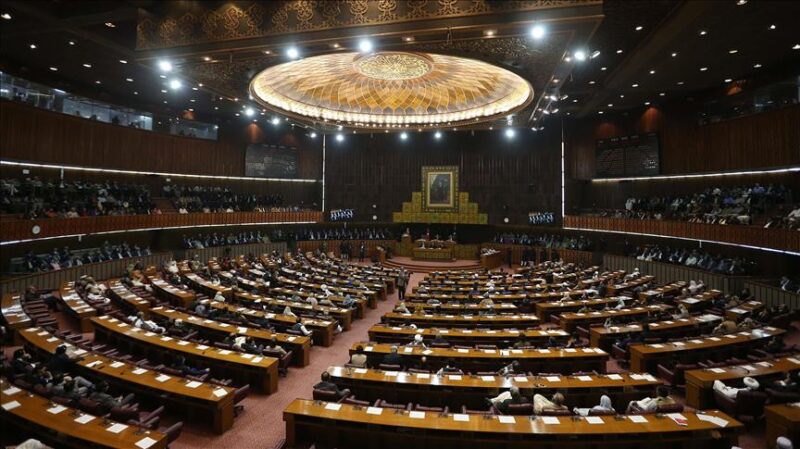
As part of the upcoming 28th Constitutional Amendment, the government is considering a proposal to raise the minimum voting age from 18 to 25, drawing criticism from opposition parties, legal experts and members of the civil society, all of who term it an “attempt to disenfranchise millions of young voters”.
The discussion came to light after Rana Sanaullah, adviser to the prime minister (PM) on political and public affairs, confirmed to Geo News that the proposal is under deliberation. He said that the change aims to align the voting age with the minimum age required to contest elections.
“If an individual cannot contest an election before the age of 25, then either the age to contest elections should be reduced to 18, or the voting age should be increased,” Sanaullah said, adding that 25 is the age at which an individual attains the maturity required for representation.
He clarified, however, that this is currently a discussion and does not represent an official policy or formal party support.
The proposal has met resistance from Pakistan Tehreek-e-Insaf (PTI) as its information secretary, Sheikh Waqas Akram, questioned the rationale behind the move, pointing out that 18-year-olds were permitted to marry, work and join the military.
“How extraordinarily convenient that the same ruling elite which happily recruits 18-year-olds to defend Pakistan’s borders… suddenly discovers these very citizens are far too immature to choose their government,” Akram said.
He added that the youth would continue to support PTI regardless of age restrictions.
Data from the Pakistan Bureau of Statistics shows that the 18-24 age bracket comprises 30.1 million people.
The voting age was previously lowered from 21 to 18 in 2002 under military ruler Pervez Musharraf through an amendment to Article 106(2) of the Constitution. Any reversal would require a two-thirds majority in Parliament.
Beyond the voting age proposal, the legislative package under the 28th Amendment is expected to target provincial autonomy and financial distribution, potentially altering key components of the 18th Amendment passed in 2010.
While Law Minister Azam Nazeer Tarar stated that any amendment would only proceed after consultation with coalition partners, and Pakistan Peoples Party (PPP) Chairman Bilawal Bhutto-Zardari has denied receiving a formal proposal, insiders within the ruling coalition confirm that significant constitutional shifts are on the table.
According to PPP sources, the proposed legislation may roll back provincial control over curriculum, population welfare, as well as mines and minerals.
There are also indications that the federal government intends to shift the financial burden of the Benazir Income Support Programme (BISP) onto the provinces.
A central point of contention is the National Finance Commission (NFC) Award. Under the 18th Amendment, Article 160(3A) guarantees that the provinces’ share of federal resources cannot drop below 57.5 percent.
PML-N leadership reportedly views the current resource distribution as financially unsustainable for Centre.
Ahmed Bilal Mehboob, president of the Pakistan Institute of Legislative Development and Transparency (Pildat), noted that the federal government might seek flexibility in Clause 3A to alter the provincial share based on federal resource availability.
Meanwhile, the MQM-Pakistan (MQM-P) is pushing for constitutional guarantees to empower the local government system.