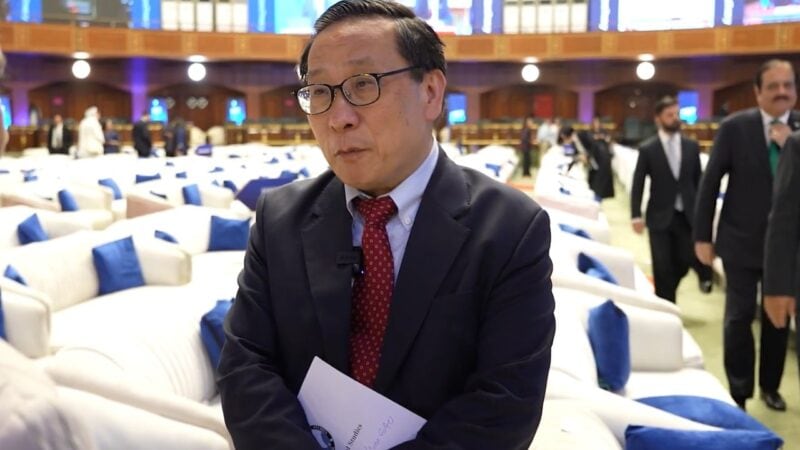
Victor Zhikai Gao, famous Chinese scholar, analyst and lawyer, has warned that any unilateral attempt by India to block or divert the Indus River water supply to Pakistan would constitute a crime against humanity in peacetime and a war crime during active conflict.
Speaking at a high-profile summit in Islamabad titled “Indus Waters Treaty: An Instrument of Peace and Regional Stability,” Gao cautioned New Delhi against violating the decades-old water-sharing agreement, noting that India does not hold the ultimate geographic leverage in the region.
“India is not the real upstream country as far as the Indus River is concerned,” Gao stated. “China is the real upstream country for the Indus River because the Indus River originates from the Himalayas in China.”
The summit follows New Delhi’s decision to place the 1960 World Bank-brokered treaty “in abeyance” for over a year, a move instituted after the 2025 conflict between Pakistan and India.
Gao criticized this unilateral suspension, stating that the mechanism is completely unauthorized under the explicit provisions of the pact. He referenced past political rhetoric from New Delhi, including threats by Indian Prime Minister (PM) Narendra Modi to halt the flow of water entirely.
“I talked to the Indians on the major television in India that in times of war to deny water to the hundreds of millions of people in the lower reaches of the Indus River will be a war crime,” Gao said, adding that doing so during peacetime is a crime against humanity that the international community cannot tolerate.
He added, “There is a saying, don’t do unto others what you do not want others do onto you,” to caution the Indian government to avoid pursuing water diversion strategies.
The analyst urged Beijing and Islamabad to deepen corporate and strategic cooperation to preempt and deter Indian actions.
He pointed out that India’s own water security depends on rivers originating outside its borders, noting that key water systems like the Brahmaputra and the Ganges also originate in China.
“The situation can be very serious if India dares to do what they threaten to do and to violate the Indus Water Treaty,” Gao warned, indicating that China would fully support Pakistan if India blocks the downstream flow.
Addressing Pakistan’s current strategy, Gao suggested that relying solely on international legal disputes may not be enough if physical infrastructure changes are already underway across the border. He highlighted ongoing Indian efforts to construct dams and canals aimed at water diversion.
“If Pakistan only goes through the legal framework while India has already been doing things which seem to be corroborating their effort to build dams, to build canals, try to divert the water… then maybe in my personal view, Pakistan may need to think about alternative things in addition to exhausting everything within the framework of the IWT Treaty,” Gao stated.
He added that waiting too long risks allowing India to implement changes that cause severe long-term harm to downstream populations.
The Islamabad conference brought together local and international experts on water and international law to reinforce Pakistan’s legal and diplomatic case against India’s recent policy shifts. Information Minister Attaullah Tarar also addressed the seminar, underscoring the critical nature of the river systems to the state. “We are talking about our lifeline, not a treaty,” Tarar stated.