
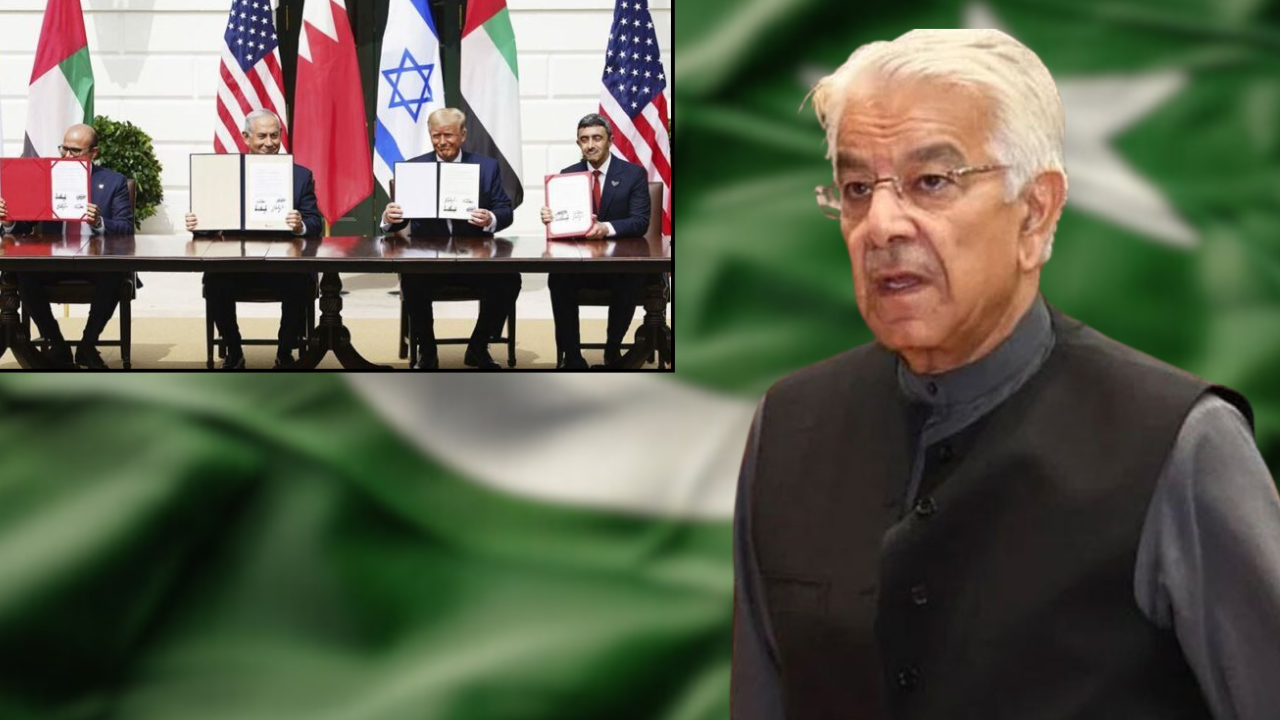


Defence Minister Khawaja Asif has stated that Pakistan will prioritise its national interests if pressured to join the Abraham Accords, a series of agreements aimed at normalising diplomatic ties between Israel and Arab states.
In September 2020, the United States (US) mediated an agreement between the United Arab Emirates (UAE), Bahrain and Israel, vowing to normalise ties between the signatories and Israel. This move was later followed by Morocco and Sudan, who also joined the Accords in the following months.
This year, in May, addressing a summit of the Gulf Cooperation Council in Riyadh, US President Donald Trump said that he would “continue to add more countries” to the Abraham Accords
During an interview on a political talk show on Monday, the defence minister was asked what the response of the incumbent government would be if Pakistan were pressured to join the Abraham Accords.
In response, Asif said, “We will look at our interests,” adding that Pakistan would only respond if the country were formally proposed to be part of the accords. “We will not be part of any US policy that harms Pakistan,” he stressed.
The defence minister’s remarks come days after Deputy Prime Minister and Foreign Minister Ishaq Dar ruled out the possibility of Pakistan joining the Abraham Accords, stating that such a move would effectively mean abandoning the country’s longstanding support for a two-state solution to the Palestinian conflict and recognising Israel.
Speaking at a news conference at the Foreign Office last week, Dar reiterated Islamabad’s firm support for a two-state solution to the Israeli-Palestinian conflict.
“We are not ready to recognise Israel until the two-state solution to the Palestine conflict is accepted,” the foreign minister said, clarifying, “There is no change in our stated policy on the Palestine issue.”
Dar maintained that signing the Abraham Accords would be tantamount to abandoning Pakistan’s long-standing demand for a Palestinian state with Al-Quds Al-Sharif as its capital, based on pre-1967 borders. “Let it be clear to everyone that our seven-decades-long policy remains unchanged,” he said.
'%3e%3crect%20y='0.445312'%20width='48'%20height='48'%20rx='24'%20fill='white'%20fill-opacity='0.5'/%3e%3crect%20x='0.5'%20y='0.945312'%20width='47'%20height='47'%20rx='23.5'%20stroke='%23808080'/%3e%3cpath%20d='M34.625%2024.4453L14%2024.4453'%20stroke='%23808080'%20stroke-width='0.920053'/%3e%3cpath%20d='M23.375%2034.4453L13.375%2024.4453L23.375%2014.4453'%20stroke='%23808080'%20stroke-width='0.920053'/%3e%3c/g%3e%3cdefs%3e%3cfilter%20id='filter0_b_489_44344'%20x='-12'%20y='-11.5547'%20width='72'%20height='72'%20filterUnits='userSpaceOnUse'%20color-interpolation-filters='sRGB'%3e%3cfeFlood%20flood-opacity='0'%20result='BackgroundImageFix'/%3e%3cfeGaussianBlur%20in='BackgroundImageFix'%20stdDeviation='6'/%3e%3cfeComposite%20in2='SourceAlpha'%20operator='in'%20result='effect1_backgroundBlur_489_44344'/%3e%3cfeBlend%20mode='normal'%20in='SourceGraphic'%20in2='effect1_backgroundBlur_489_44344'%20result='shape'/%3e%3c/filter%3e%3c/defs%3e%3c/svg%3e)
'%3e%3crect%20y='0.445312'%20width='48'%20height='48'%20rx='24'%20fill='white'%20fill-opacity='0.5'/%3e%3crect%20x='0.5'%20y='0.945312'%20width='47'%20height='47'%20rx='23.5'%20stroke='%23808080'/%3e%3cpath%20d='M13.375%2024.4453L34%2024.4453'%20stroke='%23808080'%20stroke-width='0.920053'/%3e%3cpath%20d='M24.625%2014.4453L34.625%2024.4453L24.625%2034.4453'%20stroke='%23808080'%20stroke-width='0.920053'/%3e%3c/g%3e%3cdefs%3e%3cfilter%20id='filter0_b_489_44344'%20x='-12'%20y='-11.5547'%20width='72'%20height='72'%20filterUnits='userSpaceOnUse'%20color-interpolation-filters='sRGB'%3e%3cfeFlood%20flood-opacity='0'%20result='BackgroundImageFix'/%3e%3cfeGaussianBlur%20in='BackgroundImageFix'%20stdDeviation='6'/%3e%3cfeComposite%20in2='SourceAlpha'%20operator='in'%20result='effect1_backgroundBlur_489_44344'/%3e%3cfeBlend%20mode='normal'%20in='SourceGraphic'%20in2='effect1_backgroundBlur_489_44344'%20result='shape'/%3e%3c/filter%3e%3c/defs%3e%3c/svg%3e)