
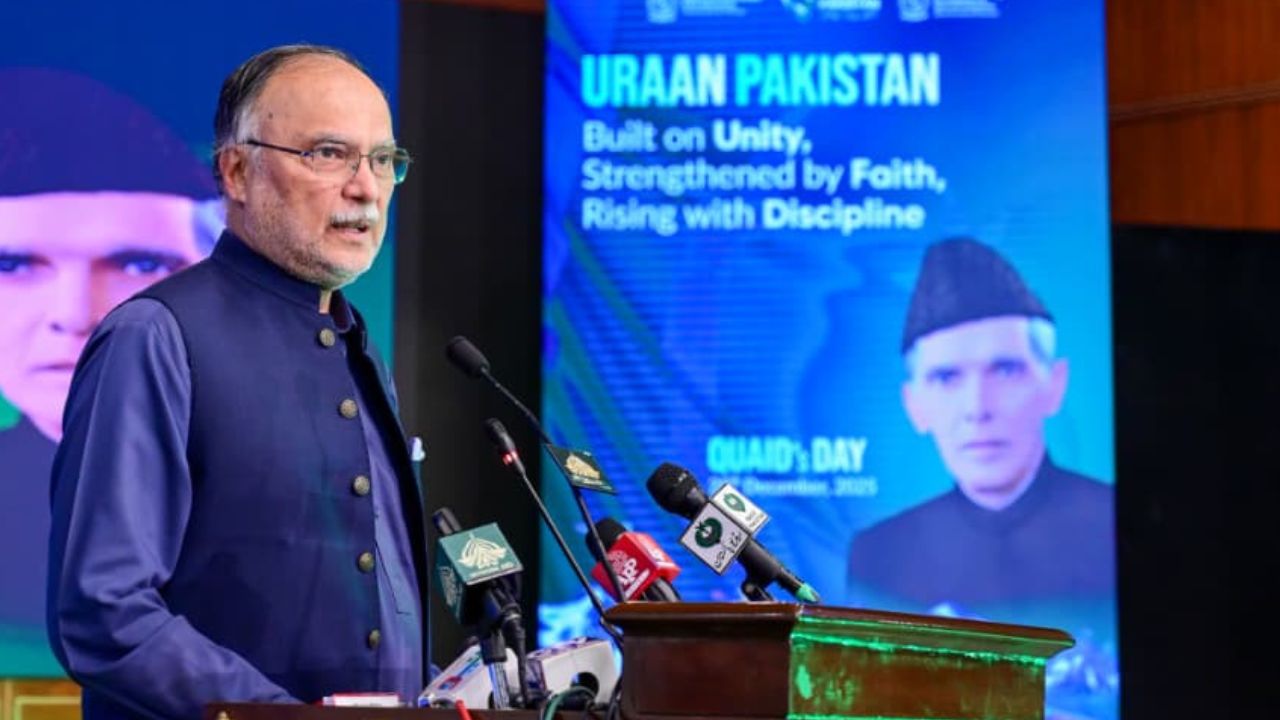


Federal Minister Ahsan Iqbal hosted what became Islamabad's sole comprehensive commemoration of Quaid-e-Azam Muhammad Ali Jinnah's birth anniversary, presenting URAAN Pakistan as the practical manifestation of the founder's vision for the nation.
The event distinguished itself from routine ceremonial observances by systematically connecting Jinnah's foundational principles to Pakistan's current developmental challenges.
The keynote address rejected hollow nostalgia in favor of actionable national renewal. "Quaid-e-Azam gave us Pakistan. Now history asks us: Can we give Pakistan the future he dreamed of?" the speaker challenged, establishing honest assessment as the evening's foundation.
Unlike typical commemorations, the speech confronted Pakistan's unrealized potential: "We did not lag because of lack of resources—we lagged because of lack of discipline, continuity, unity, and vision."
Minister Iqbal emphasized aspects of the Quaid's vision often absent from public discourse:
Women's Empowerment: Jinnah understood no nation progresses with half its population marginalized—a message critically relevant as Pakistan's female labor participation remains among the world's lowest.
Youth as Nation-Builders: With 64% of Pakistan's population under 30, the Quaid's faith in youth as "nation-builders of tomorrow" transforms from historical sentiment to urgent imperative.
Knowledge Economy: Jinnah wanted Pakistan self-reliant through export-oriented growth based on industry, science, and modern skills—not dependent on loans or raw material exports.
Character Over Chaos: The founder achieved Pakistan through disciplined organization and constitutional politics, not mobs or noise. "Great nations are not built on noise—they are built on discipline, sacrifice, and hard work," the speaker reminded attendees.
URAAN as Policy Translation
The event's central argument positioned URAAN Pakistan's five pillars as systematic translation of Jinnah's vision:
-
Exports address his vision of economic self-reliance
-
E-Pakistan modernizes his emphasis on modern skills for the knowledge economy
-
Equity and Empowerment fulfill his commitment to women and youth
-
Environment and Food Security ensure sustainable development
-
Energy and Infrastructure build foundations for competitive growth
"URAAN Pakistan converts Quaid's dream into a development strategy. It calls for merit over sifarish, productivity over rhetoric, exports over dependency, unity over division," the speaker declared.
The event's composition reflected its message. Celebrities attended as nation-building stakeholders. Quaid scholars provided historical context demonstrating that Jinnah's principles regarding governance, social justice, education, and healthcare remain directly applicable to contemporary challenges.
Minister Iqbal emphasized Jinnah's personal journey—his solitary dedication when few believed Pakistan possible, his ability to unify the Muslim League, his resilience through opposition. "We must learn from his determination and resilience," Iqbal stressed, connecting historical example to contemporary necessity.
The event concluded with calls for Pakistanis to pledge: unity above division, institutional strength, merit-based systems, universal education, women and youth empowerment, and economic self-reliance.
"With faith, discipline, unity, and URAAN Pakistan's vision, the answer must be: Yes—Pakistan will rise. Yes—Pakistan will prosper. Yes—Quaid's dream will be fulfilled."
That this remained Islamabad's only substantial Quaid-e-Azam birthday celebration underscores its unique approach. Rather than perfunctory observances, Minister Iqbal's leadership demonstrated that genuine tribute requires connecting foundational principles to contemporary solutions.
The gathering proved that Jinnah's message about development, governance, socioeconomic transformation, youth empowerment, and resilience carries greater relevance today than ever—if Pakistan has the courage to implement it.
'%3e%3crect%20y='0.445312'%20width='48'%20height='48'%20rx='24'%20fill='white'%20fill-opacity='0.5'/%3e%3crect%20x='0.5'%20y='0.945312'%20width='47'%20height='47'%20rx='23.5'%20stroke='%23808080'/%3e%3cpath%20d='M34.625%2024.4453L14%2024.4453'%20stroke='%23808080'%20stroke-width='0.920053'/%3e%3cpath%20d='M23.375%2034.4453L13.375%2024.4453L23.375%2014.4453'%20stroke='%23808080'%20stroke-width='0.920053'/%3e%3c/g%3e%3cdefs%3e%3cfilter%20id='filter0_b_489_44344'%20x='-12'%20y='-11.5547'%20width='72'%20height='72'%20filterUnits='userSpaceOnUse'%20color-interpolation-filters='sRGB'%3e%3cfeFlood%20flood-opacity='0'%20result='BackgroundImageFix'/%3e%3cfeGaussianBlur%20in='BackgroundImageFix'%20stdDeviation='6'/%3e%3cfeComposite%20in2='SourceAlpha'%20operator='in'%20result='effect1_backgroundBlur_489_44344'/%3e%3cfeBlend%20mode='normal'%20in='SourceGraphic'%20in2='effect1_backgroundBlur_489_44344'%20result='shape'/%3e%3c/filter%3e%3c/defs%3e%3c/svg%3e)
'%3e%3crect%20y='0.445312'%20width='48'%20height='48'%20rx='24'%20fill='white'%20fill-opacity='0.5'/%3e%3crect%20x='0.5'%20y='0.945312'%20width='47'%20height='47'%20rx='23.5'%20stroke='%23808080'/%3e%3cpath%20d='M13.375%2024.4453L34%2024.4453'%20stroke='%23808080'%20stroke-width='0.920053'/%3e%3cpath%20d='M24.625%2014.4453L34.625%2024.4453L24.625%2034.4453'%20stroke='%23808080'%20stroke-width='0.920053'/%3e%3c/g%3e%3cdefs%3e%3cfilter%20id='filter0_b_489_44344'%20x='-12'%20y='-11.5547'%20width='72'%20height='72'%20filterUnits='userSpaceOnUse'%20color-interpolation-filters='sRGB'%3e%3cfeFlood%20flood-opacity='0'%20result='BackgroundImageFix'/%3e%3cfeGaussianBlur%20in='BackgroundImageFix'%20stdDeviation='6'/%3e%3cfeComposite%20in2='SourceAlpha'%20operator='in'%20result='effect1_backgroundBlur_489_44344'/%3e%3cfeBlend%20mode='normal'%20in='SourceGraphic'%20in2='effect1_backgroundBlur_489_44344'%20result='shape'/%3e%3c/filter%3e%3c/defs%3e%3c/svg%3e)