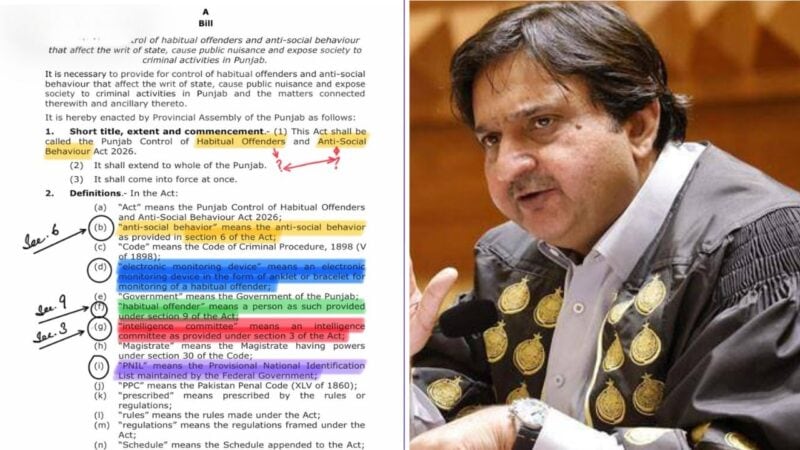
A proposed legislation named Punjab Control of Habitual Offenders and Anti-Social Behaviour Bill, 2026, has ignited a fierce national debate, with critics decrying the legislation as a chilling remnant of the colonial era.
The bill empowers non-judicial bodies to impose severe administrative penalties. The draft legislation marks a stark departure from established legal norms, effectively shifting judicial authority into the hands of the executive branch.
Under the new proposal, District Intelligence Committees [which constitutes of Deputy Commissioner (Head), District Police Officer (DPO), representatives from the Special Branch, representative from Counter Terrorism Department (CTD) and federal agency representatives] are being given massive power to investigate people and punish them before they have a chance to go to trial, including demanding money for bail, blocking national ID cards, freezing bank accounts, and even seizing properties just based on their own judgment.
Legal experts have been left deeply worried that the setup is a recipe for political bullying and makes it far too easy for the government to overreach its authority.
The bill uses a very vague term called “anti-social behaviour” to cover a huge range of activities, from spreading misinformation online to animal cruelty or even running a gambling house. Because the definition is quite broad and unclear, the police can ask for people to be put under electronic monitoring, like being forced to wear a tracking anklet, without a judge ever finding them guilty of a crime.
The offenses are classified as serious and non-bailable, which means for any accused under this law a fair trial would be near to impossible. Even though there is a process to appeal these decisions, it will all be handled by government officials rather than an independent judge, which completely removes the usual protections people rely on for the fairness in the system.
The bill has faced significant scrutiny from political and media circles. Punjab Assembly Speaker Malik Muhammad Ahmad Khan expressed visible shock upon learning the legislation had progressed through the relevant committee without his knowledge. During the session, he remarked: “It’s not possible to introduce a law reminiscent of the colonial era … There could be some misunderstanding on this.”
Analyst Athar Kazmi, having reviewed the 11-page document extensively, noted on a recent broadcast: “It contains administrative clauses that grant excessive powers to intelligence committees, police officers, and officials, potentially compromising civil liberties.”
Senior journalist Najam Sethi suggested the move is rooted in electoral anxiety, stating: “The reason for the turmoil in Punjab is that the opposition party has a strong hold there, and it hasn’t been completely dismantled yet. They are afraid that if they hold local body elections, they might lose, and they are trying to prevent that.”
Former Finance Minister Miftah Ismail echoed the concerns, cautioning: “The senior leadership of PMLN must know how draconian is this proposed Punjab law, where a person can be punished by a committee of bureaucrats without any conviction.”
Journalists have been equally scathing in their assessment. Umar Daraz Gondal remarked sardonically, “Since the Punjab government officials have now completed the service delivery, they will now administer justice and hold courts by becoming judges!”
Asad Ali Toor questioned the democratic credentials of the ruling party, asking, “What sort of draconian law is this where the public would be deprived of fundamental human rights?”
The sentiments were reinforced by Kiran Naz, who reminded the government that “They need to realize that they are not going to remain in power forever.”
Matiullah Jan suggested that the move reflects a broader trend of institutional consolidation, observing: “After placing the reins of the 27th Amendment on the Supreme Court, some have assumed that Parliament and the provincial assemblies can be reined in the same way.”