
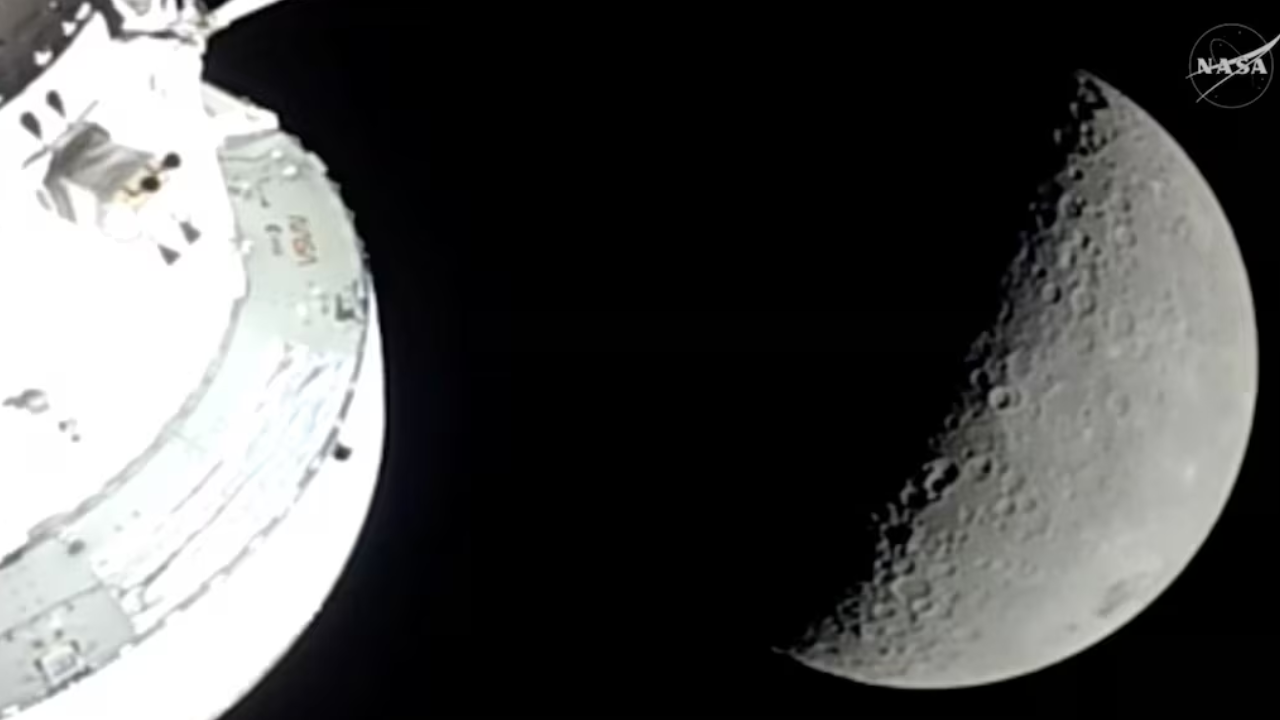


Four astronauts on NASA’s Artemis II mission reached the furthest distance from Earth ever recorded by a human crew on Monday, as their spacecraft moved along a trajectory within the Moon’s gravitational influence.
The crew, travelling aboard the Orion capsule after launching from Florida last week, began their sixth day in space with a recorded message from former Apollo 8 and 13 astronaut Jim Lovell.
“Welcome to my old neighbourhood,” Lovell said in the message. “It’s a historic day, and I know how busy you’ll be, but don’t forget to enjoy the view. Good luck and godspeed.”
The Artemis II mission is a crewed test flight lasting nearly 10 days and is part of NASA’s Artemis programme, which aims to return astronauts to the Moon’s surface by 2028 and establish a long-term presence. The programme also includes plans for a lunar base to support future missions to Mars.
During the flyby, the spacecraft will enter periods of darkness and temporary communication loss as the Moon blocks signals between the crew and NASA’s Deep Space Network. The flyby is expected to last about six hours, during which the astronauts will capture images of the Moon using onboard cameras.
Images transmitted from the spacecraft showed the Orientale basin, a large crater that had previously only been observed through uncrewed missions.
American astronauts Reid Wiseman, Victor Glover and Christina Koch, along with Canadian astronaut Jeremy Hansen, reached a maximum distance of 406,777 kilometres from Earth. This places them 6,606 kilometres beyond the previous record set in 1970 by Lovell and the Apollo 13 crew.
The mission will now take the astronauts around the Moon’s far side, where they are expected to pass approximately 6,400 kilometres above the surface. From this position, the Earth will appear smaller in the background as the spacecraft moves behind the Moon.
Speaking during a live interaction with children in Canada, astronaut Christina Koch said that the crew had been looking forward to viewing the feature. “It’s very distinctive and no human eyes previously had seen this crater until today, really, when we were privileged enough to see it,” she said.
The crew is also expected to observe a solar eclipse near the end of the flyby, when the Moon will block the Sun from their line of sight.
'%3e%3crect%20y='0.445312'%20width='48'%20height='48'%20rx='24'%20fill='white'%20fill-opacity='0.5'/%3e%3crect%20x='0.5'%20y='0.945312'%20width='47'%20height='47'%20rx='23.5'%20stroke='%23808080'/%3e%3cpath%20d='M34.625%2024.4453L14%2024.4453'%20stroke='%23808080'%20stroke-width='0.920053'/%3e%3cpath%20d='M23.375%2034.4453L13.375%2024.4453L23.375%2014.4453'%20stroke='%23808080'%20stroke-width='0.920053'/%3e%3c/g%3e%3cdefs%3e%3cfilter%20id='filter0_b_489_44344'%20x='-12'%20y='-11.5547'%20width='72'%20height='72'%20filterUnits='userSpaceOnUse'%20color-interpolation-filters='sRGB'%3e%3cfeFlood%20flood-opacity='0'%20result='BackgroundImageFix'/%3e%3cfeGaussianBlur%20in='BackgroundImageFix'%20stdDeviation='6'/%3e%3cfeComposite%20in2='SourceAlpha'%20operator='in'%20result='effect1_backgroundBlur_489_44344'/%3e%3cfeBlend%20mode='normal'%20in='SourceGraphic'%20in2='effect1_backgroundBlur_489_44344'%20result='shape'/%3e%3c/filter%3e%3c/defs%3e%3c/svg%3e)
'%3e%3crect%20y='0.445312'%20width='48'%20height='48'%20rx='24'%20fill='white'%20fill-opacity='0.5'/%3e%3crect%20x='0.5'%20y='0.945312'%20width='47'%20height='47'%20rx='23.5'%20stroke='%23808080'/%3e%3cpath%20d='M13.375%2024.4453L34%2024.4453'%20stroke='%23808080'%20stroke-width='0.920053'/%3e%3cpath%20d='M24.625%2014.4453L34.625%2024.4453L24.625%2034.4453'%20stroke='%23808080'%20stroke-width='0.920053'/%3e%3c/g%3e%3cdefs%3e%3cfilter%20id='filter0_b_489_44344'%20x='-12'%20y='-11.5547'%20width='72'%20height='72'%20filterUnits='userSpaceOnUse'%20color-interpolation-filters='sRGB'%3e%3cfeFlood%20flood-opacity='0'%20result='BackgroundImageFix'/%3e%3cfeGaussianBlur%20in='BackgroundImageFix'%20stdDeviation='6'/%3e%3cfeComposite%20in2='SourceAlpha'%20operator='in'%20result='effect1_backgroundBlur_489_44344'/%3e%3cfeBlend%20mode='normal'%20in='SourceGraphic'%20in2='effect1_backgroundBlur_489_44344'%20result='shape'/%3e%3c/filter%3e%3c/defs%3e%3c/svg%3e)