
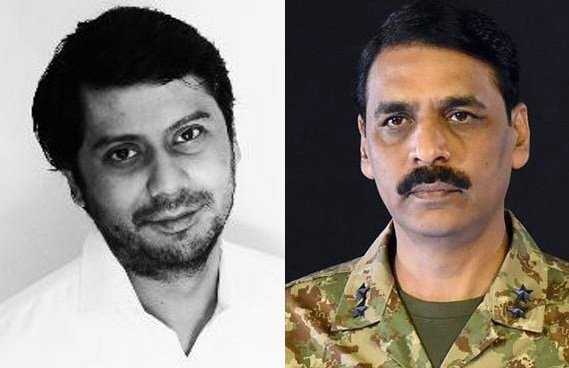


Reacting to journalist and former Dawn assistant editor Cyril Almeida’s tweet, Inter-Services Public Relations (ISPR) chief Major General Asif Ghafoor has called him out over his “unwarranted assertion”.
“RIP ISPR, PTI [Pakistan Tehreek-e-Insaf], etc…” Almeida tweeted Thursday while quoting a statement by Twitter Chief Executive Officer (CEO) Jack Dorsey, who had announced the microblogging website’s decision to block political advertisements all across the globe.
https://twitter.com/cyalm/status/1189640211493478403
Retweeting the journalist with a comment, the ISPR director general (DG) challenged him to prove his claims pertaining to alleged adverts by the military’s media wing.
https://twitter.com/peaceforchange/status/1189771746251071488
“Dear @cyalm [Almeida], quote one such instance by ISPR [so as] to validate your unwarranted assertion. In case you fail, I wishfully expect a moral obligation from you. Should you succeed, I will take your advice,” Maj Gen Asif Ghafoor tweeted.
It wasn’t later that the journalist responded to the ISPR chief.
https://twitter.com/cyalm/status/1189784213194715136
“Was a joke, Gen sb… a bit of (apparently failed) humour in this space where we are all prisoners of Twitter and its policies… maybe @jack [Dorsey] will turn his attention to the trend wars next… [sic],” Almeida said.
TWITTER BANS POLITICAL ADS:
Earlier, CEO Jack Dorsey tweeted that the social networking site will be banning all political advertisements — albeit with “a few exceptions” like voter registration.
“We believe political message reach should be earned, not bought,” Dorsey said.
We’ve made the decision to stop all political advertising on Twitter globally. We believe political message reach should be earned, not bought. Why? A few reasons…🧵
— jack (@jack) October 30, 2019
While it’s not totally clear how broad those exceptions will be, it sounds like the ban will apply to both ads endorsing candidates and ads advocating a position on political issues.
Dorsey said the company will share the final policy by November 15, and that it will start enforcing the same on November 22.
We’ll share the final policy by 11/15, including a few exceptions (ads in support of voter registration will still be allowed, for instance). We’ll start enforcing our new policy on 11/22 to provide current advertisers a notice period before this change goes into effect.
— jack (@jack) October 30, 2019
“Internet political ads present entirely new challenges to civic discourse: machine learning-based optimization of messaging and micro-targeting, unchecked misleading information, and deep fakes,” he wrote. “All at increasing velocity, sophistication, and overwhelming scale.”
Internet political ads present entirely new challenges to civic discourse: machine learning-based optimization of messaging and micro-targeting, unchecked misleading information, and deep fakes. All at increasing velocity, sophistication, and overwhelming scale.
— jack (@jack) October 30, 2019
This came after Facebook faced heavy criticism around its refusal to fact-check political advertising (even as it took steps to fight election-related misinformation elsewhere), with employees of the social media giant writing an open letter objecting to the company’s stance.
For instance, it‘s not credible for us to say: “We’re working hard to stop people from gaming our systems to spread misleading info, buuut if someone pays us to target and force people to see their political ad…well…they can say whatever they want! 😉”
— jack (@jack) October 30, 2019
Dorsey didn’t mention Facebook by name in his tweets, but he seemed to allude to the company’s position when he wrote, “For instance, it‘s not credible for us to say: ‘We’re working hard to stop people from gaming our systems to spread misleading info, buuut if someone pays us to target and force people to see their political ad…well…they can say whatever they want!  ‘ [sic].”
'%3e%3crect%20y='0.445312'%20width='48'%20height='48'%20rx='24'%20fill='white'%20fill-opacity='0.5'/%3e%3crect%20x='0.5'%20y='0.945312'%20width='47'%20height='47'%20rx='23.5'%20stroke='%23808080'/%3e%3cpath%20d='M34.625%2024.4453L14%2024.4453'%20stroke='%23808080'%20stroke-width='0.920053'/%3e%3cpath%20d='M23.375%2034.4453L13.375%2024.4453L23.375%2014.4453'%20stroke='%23808080'%20stroke-width='0.920053'/%3e%3c/g%3e%3cdefs%3e%3cfilter%20id='filter0_b_489_44344'%20x='-12'%20y='-11.5547'%20width='72'%20height='72'%20filterUnits='userSpaceOnUse'%20color-interpolation-filters='sRGB'%3e%3cfeFlood%20flood-opacity='0'%20result='BackgroundImageFix'/%3e%3cfeGaussianBlur%20in='BackgroundImageFix'%20stdDeviation='6'/%3e%3cfeComposite%20in2='SourceAlpha'%20operator='in'%20result='effect1_backgroundBlur_489_44344'/%3e%3cfeBlend%20mode='normal'%20in='SourceGraphic'%20in2='effect1_backgroundBlur_489_44344'%20result='shape'/%3e%3c/filter%3e%3c/defs%3e%3c/svg%3e)
'%3e%3crect%20y='0.445312'%20width='48'%20height='48'%20rx='24'%20fill='white'%20fill-opacity='0.5'/%3e%3crect%20x='0.5'%20y='0.945312'%20width='47'%20height='47'%20rx='23.5'%20stroke='%23808080'/%3e%3cpath%20d='M13.375%2024.4453L34%2024.4453'%20stroke='%23808080'%20stroke-width='0.920053'/%3e%3cpath%20d='M24.625%2014.4453L34.625%2024.4453L24.625%2034.4453'%20stroke='%23808080'%20stroke-width='0.920053'/%3e%3c/g%3e%3cdefs%3e%3cfilter%20id='filter0_b_489_44344'%20x='-12'%20y='-11.5547'%20width='72'%20height='72'%20filterUnits='userSpaceOnUse'%20color-interpolation-filters='sRGB'%3e%3cfeFlood%20flood-opacity='0'%20result='BackgroundImageFix'/%3e%3cfeGaussianBlur%20in='BackgroundImageFix'%20stdDeviation='6'/%3e%3cfeComposite%20in2='SourceAlpha'%20operator='in'%20result='effect1_backgroundBlur_489_44344'/%3e%3cfeBlend%20mode='normal'%20in='SourceGraphic'%20in2='effect1_backgroundBlur_489_44344'%20result='shape'/%3e%3c/filter%3e%3c/defs%3e%3c/svg%3e)