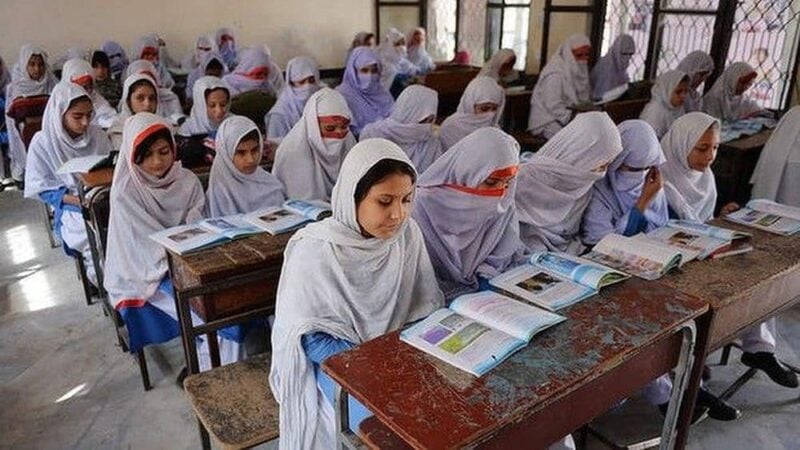
The Punjab government faces fresh pressure to overhaul school textbooks after a study revealed systemic biases and discriminatory content against minority groups.
The research, titled “Inclusive Education for a United and Harmonious Pakistan,” was conducted by Action for Impact (AFI) and the Weaving People to Grow Foundation (WPTGF). Covering the 2024–2025 period, the report analyzes primary-level textbooks in Punjab and identifies content that marginalizes faith-based communities.
Researchers found that while the Single National Curriculum (SNC) aimed for uniformity, it failed to address gaps in religious representation and critical thinking.
The study links educational content to real-world violence, citing the Jaranwala incident where mobs attacked over 85 Christian homes and 20 churches. According to the findings, the curriculum fuels a societal mindset that leads to the targeting of Ahmadi, Hindu, and other minority communities.
Data in the report shows a sharp decline in Pakistan’s non-Muslim population, which dropped from 23 percent in 1947 to four percent today.
During the report’s launch in Islamabad, CEO of Action for Impact Zartasha Niazi stated that child development starts at home and continues in schools. “Both spaces must promote tolerance, empathy, and respect for diversity,” Niazi said.
She noted that over 30 contributors, including teachers and students, participated in the research.
WPTGF Executive Director Kiran Peter highlighted that current textbooks contain discriminatory material and lack age-appropriate content. She called for teacher sensitization to stop biased practices in classrooms.
Amjad Nazeer, Executive Director of IDRAC, suggested that religious content should stay within relevant subjects, while other textbooks should focus on human values.
Punjab Minister for Minority Affairs Sardar Ramesh Singh Arora acknowledged the gaps. He pointed out that textbooks ignore the contributions of non-Muslim figures like Bhagat Singh, Ranjit Singh, and Guru Nanak.
Arora said the government is willing to support the recommendations. “This research is an important first step,” he remarked, adding that he would take the study to the Punjab Education Ministry for consideration.
The report concludes that the current system is fragmented across public, private, and missionary schools.
It urges the government to shift away from conflict-driven narratives and instead emphasize universal values like environmental responsibility and responsible citizenship.
Experts at the event warned that without immediate curriculum reform, biases will continue to take root early in life, making it difficult to reverse societal divides in the future.