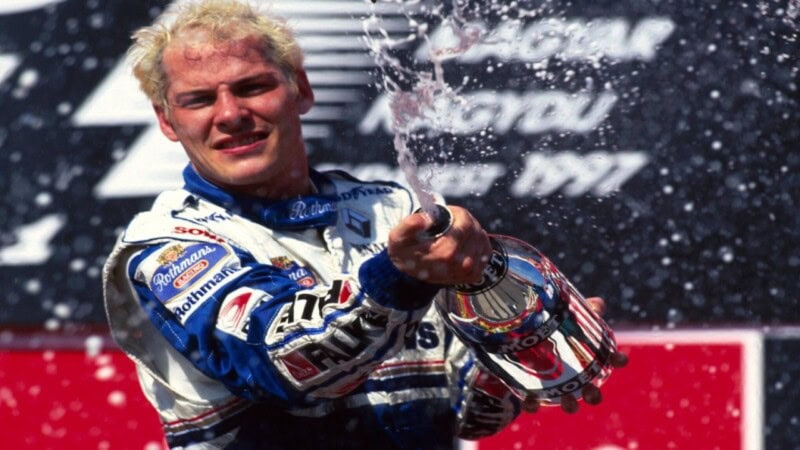
Jacques Villeneuve is a name that stands out in the world of motorsport. His career, filled with extraordinary highs and dramatic lows, has left an indelible mark on the sport of Formula 1 and beyond. Known for his daring style, rebellious personality, and undeniable talent, Villeneuve’s journey to racing glory and his subsequent decline have made him one of the most fascinating figures in motorsport history.
In this article, we’ll take a deep dive into the life and career of Jacques Villeneuve, exploring his rise to fame, his achievements, and the challenges he faced along the way.
Early Life: Born to Race
Jacques Villeneuve’s story starts in the racing world long before he took the wheel of a Formula 1 car. Born on April 9, 1971, in Saint-Jean-sur-Richelieu, Quebec, Canada, Jacques was the son of Gilles Villeneuve, a racing legend known for his thrilling and fearless driving style. Gilles made a name for himself in Formula 1, driving for Ferrari, and his intense passion for racing was something Jacques inherited early on.
Growing up, Jacques spent a lot of time around race cars and motorsport events. His family’s nomadic lifestyle, following his father’s career, meant that young Jacques was always surrounded by the excitement of the racing world. However, his childhood was tragically shaped by his father’s untimely death in 1982. Gilles Villeneuve died in a crash during practice for the Belgian Grand Prix at Zolder. Despite the heartbreaking loss, Jacques found solace in motorsport, and at a young age, he decided to follow in his father’s footsteps.
Early Racing Career: From Indy to Formula 1
Before Jacques Villeneuve made his mark in Formula 1, he established himself as a force to be reckoned with in other racing series. His journey began in Italy, where he competed in Formula Three from 1989 to 1991, followed by a successful stint in Japan’s Formula Three in 1992. Villeneuve’s natural talent was clear, and he went on to compete in Formula Atlantic and IndyCar racing in North America.
In 1995, at the age of 24, Villeneuve made history by becoming the youngest driver to win the Indianapolis 500, one of the most prestigious motorsport events in the world. He also clinched the IndyCar championship that year, solidifying his reputation as a rising star in the racing world. Villeneuve’s success in IndyCar was impressive, and it paved the way for his transition into Formula 1 in 1996.
The Breakthrough: Villeneuve’s Formula 1 Debut
Jacques Villeneuve’s entry into Formula 1 in 1996 was nothing short of spectacular. He joined the Williams team, one of the top teams in the sport, and immediately made an impression. Villeneuve started his F1 career with a bang, taking pole position in his very first race at the Australian Grand Prix and finishing second. This remarkable debut showcased his raw talent and set the stage for an exciting career.
Throughout the 1996 season, Villeneuve had a fierce battle for supremacy with his teammate, Damon Hill. Though Hill eventually won the championship with five victories to Villeneuve’s four, the Canadian’s impressive performances made it clear that he was destined for greatness. The racing world began to take notice of the young Canadian’s skill and fighting spirit.
1997: A Dream Come True – F1 World Champion
The year 1997 was when Jacques Villeneuve’s dream came true. He won the Formula 1 World Championship, becoming the champion after a thrilling and dramatic season. Villeneuve triumphed in seven of the 17 races that year, and his greatest moment came during the final race at the Jerez Grand Prix in Spain.
The title battle was intense, with Villeneuve and Michael Schumacher fighting for the championship. In the final race, Schumacher infamously tried to take Villeneuve out by crashing into him, but Villeneuve’s resilience and determination prevailed. Villeneuve’s refusal to be intimidated by Schumacher’s underhanded tactics won him the championship, and he became only the second Canadian after his father to win the prestigious title.
His 1997 victory remains one of the most iconic moments in Formula 1 history. Villeneuve’s fiery determination, coupled with his fearless driving style, made him a hero to fans around the world.
A Rise, Then a Fall: Struggles and Controversies
After his championship win in 1997, Villeneuve’s career took a downturn. In 1998, his performances at Williams began to decline. The car’s lack of competitiveness meant that Villeneuve was unable to repeat his earlier success, finishing the season in fifth place with no race wins.
In 1999, Villeneuve made a controversial move to the British American Racing (BAR) team, where he was offered a substantial salary. While some believed he was driven by money, Villeneuve maintained that he was chasing a dream and taking a risk by joining a new, unproven team. Unfortunately, BAR was unable to provide the competitive car that Villeneuve needed, and his performance continued to suffer.
For the next few years, Villeneuve’s career was marred by frustration and disappointment as he struggled with an uncompetitive car at BAR. The team’s inability to deliver results hurt his reputation, and many felt that the once-promising driver had lost his spark.
A Brief Resurgence: Villeneuve’s Return to Competitiveness
In 2004, Jacques Villeneuve made a brief return to the top tier of motorsport when Renault offered him a drive for three races. However, it was his move to Sauber in 2005 that brought him back to Formula 1 full-time. Villeneuve’s time at Sauber was marked by steady performances, but the small Swiss-based team lacked the resources to compete for podium finishes.
In 2006, Sauber became BMW Sauber, but Villeneuve’s stint with the team came to an abrupt end when he was demoted in favor of rising star Robert Kubica. Villeneuve, now 35 years old, saw the writing on the wall and chose to leave the sport, marking the end of his Formula 1 career.
Life After Formula 1: A Diverse Racing Career
Following his retirement from Formula 1, Jacques Villeneuve turned his attention to other forms of motorsport. He raced in various series, including stock-car racing in the United States and sports-car racing in Europe. In 2008, he won an endurance race in Belgium, his first major win in more than a decade. He also competed in the Le Mans 24-Hour Race, finishing second overall in 2008.
Villeneuve’s post-F1 career demonstrated his versatility as a driver, even though he never quite recaptured the same level of success he had in his prime.
Villeneuve’s Legacy: A Racing Icon
Jacques Villeneuve’s career may have had its ups and downs, but his impact on motorsport is undeniable. His daring driving style, fiery personality, and love for speed made him one of the most exciting and entertaining drivers in the history of Formula 1.
Villeneuve’s 1997 World Championship remains a highlight of his career and one of the most memorable moments in F1 history. His story is one of triumph, controversy, and resilience, and his unique personality made him a fan favorite around the world.
Though he may not have reached the same level of sustained success as some of his contemporaries, Jacques Villeneuve will always be remembered as one of the most colorful and charismatic figures in the world of motorsport.
Read More: Unforgettable Moments, Glamour, and Racing Thrills: Experience Ladies Day Aintree 2025