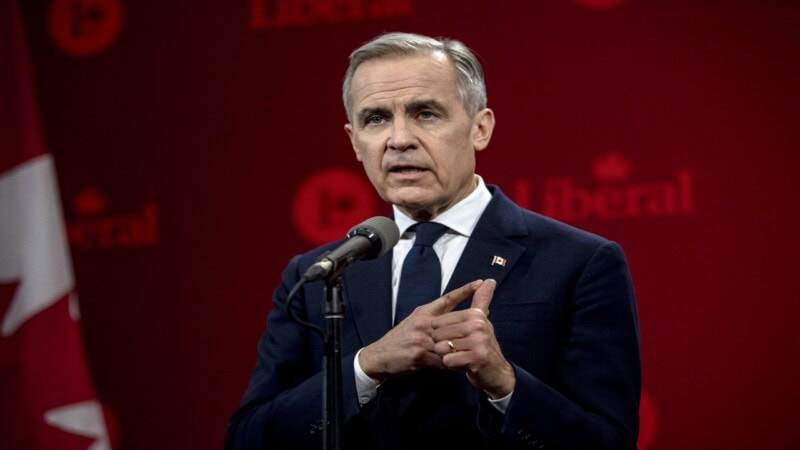
Mark Carney is the former central banker known for his leadership in North America and the UK during financial crises. He is set to become Canada’s next prime minister. He won the Liberal Party’s leadership race by a commanding margin, marking a pivotal moment in Canadian politics. Carney’s victory signals a new chapter for the country, especially amid tense relations with the United States and the ongoing trade war.
Mark Carney’s Path to Leadership
Carney’s journey to the prime ministership is unique. He is a distinguished economist and an outsider to traditional Canadian politics. Before entering the political arena, Carney served as the governor of the Bank of Canada (2008-2013) and the Bank of England (2013-2020). His expertise in managing financial crises made him a trusted figure on the global stage.
Though Carney has long been associated with the Liberal Party, his campaign for the leadership position focused on portraying himself as someone from outside the political system. This outsider image, paired with his years of experience in finance and international economics, resonated with many Liberal members. In a party that had been struggling politically, Carney’s win gave the Liberals a much-needed boost.
A Nation at a Crossroads
Carney assumes leadership during a critical time for Canada. The country is currently in a trade conflict with the United States, its closest ally and largest trading partner. Last week, U.S. President Donald Trump imposed a 25% tariff on all Canadian goods, sparking fears of a potential recession. In his victory speech, Carney boldly declared, “America is not Canada. And Canada never, ever, will be part of America in any way, shape or form.” These words resonated deeply with Canadians, who have watched the longstanding relationship with the U.S. grow increasingly strained under Trump’s presidency.
Carney’s response to this crisis is one of strength and resolve. He has vowed to keep the tariffs in place until the U.S. shows Canada the respect it deserves. His strong stance has made him popular, especially among Canadians who feel the economic pressure of the trade war. Given his deep economic knowledge and experience navigating global financial issues, Carney is widely seen as the leader best equipped to handle this crisis.
Mark Carney’s Leadership Victory
Carney’s decisive victory in the Liberal leadership race was a victory. He secured 85.9% of the vote, far ahead of his competitors, including former finance minister Chrystia Freeland and former government house leader Karina Gould. In his victory speech, he was optimistic and promised to unite the country and confront the challenges ahead.
Carney’s path to leadership has been anything but conventional. While no law prohibits someone without a seat in the House of Commons from becoming prime minister, convention suggests that Carney must secure a federal seat quickly. He will also be the first Liberal prime minister from western Canada, adding significant political importance to his leadership.
The Importance of Carney’s Economic Expertise
One key reason Mark Carney is seen as a strong leader for Canada is his vast economic background. As the former governor of the Bank of Canada and the Bank of England, he played a critical role in managing two of the world’s largest economies during times of financial upheaval. His handling of the 2008 financial crisis earned him international praise. Carney’s deep understanding of global financial markets and the Canadian economy gives him the tools to navigate the current trade conflict with the U.S.
As the new leader of the Liberal Party, Carney has pledged to address Canada’s economic challenges head-on. His leadership is expected to focus on revitalizing the economy, securing trade deals, and maintaining Canada’s sovereignty in the face of external pressures. The shift in the polls can partly be attributed to Carney’s ability to inspire confidence in Canadians that he will lead them through these turbulent times.
Mark Carney’s Life and Career
Mark Carney was born in 1965 in Fort Smith, Northwest Territories, Canada. He holds a bachelor’s degree in economics from Harvard University and a master’s in economics from the University of Oxford. Carney’s career began in the private sector, where he worked as an investment banker at Goldman Sachs before transitioning into public service.
In 2008, he was appointed governor of the Bank of Canada. He played a key role in guiding the country through the global financial crisis during his tenure. His actions helped Canada avoid the worst recession, earning him accolades for quick and effective decision-making. In 2013, Carney became the governor of the Bank of England, where he continued to gain recognition for his leadership during the Eurozone crisis.
Carney has also been involved in various international financial organizations, including the Financial Stability Board and the G20. His extensive experience in global economics makes him one of the most well-regarded figures in the financial world.
Challenges Ahead for Mark Carney
While Carney’s victory has invigorated the Liberal Party, his shift from finance to politics has not been without its challenges. Recently, Carney encountered scrutiny regarding his involvement with Brookfield Asset Management, a company that relocated its headquarters from Toronto to New York. This relocation occurred when the U.S. government urged Canadian businesses to move elsewhere.
Despite these challenges, Carney remains focused on his goal of leading Canada through a time of uncertainty. His pledge to place his assets in a blind trust and his resolve to focus on the nation’s welfare show his commitment to public service.
Read More: Trey Parker Net Worth: How Much Is the South Park Creator Really Worth?