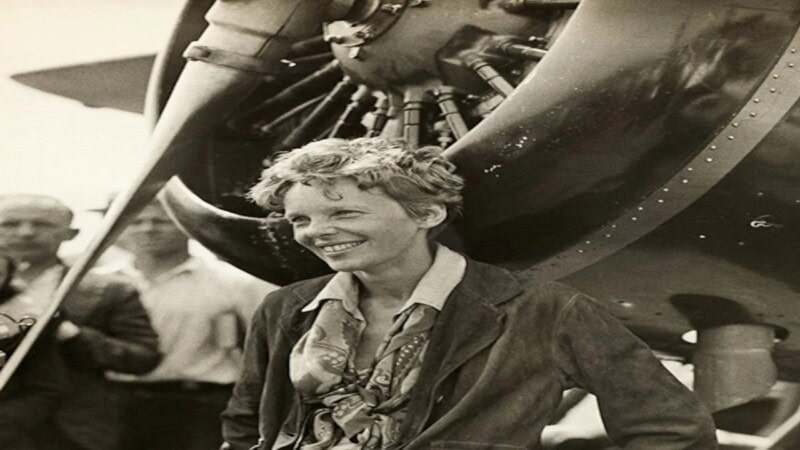
A new chapter is unfolding in one of the world’s greatest mysteries. On July 2, 2025, exactly 88 years after Amelia Earhart vanished, researchers launched a fresh expedition to find the missing aircraft of the legendary aviator. The effort is based on intriguing satellite images and supporting evidence that suggest Earhart may have crash-landed on Nikumaroro, a small, remote island in the South Pacific.
A satellite photo, first captured in 2015, seems to show parts of a plane under the sand on Nikumaroro’s lagoon, located in Kiribati. This image caught the attention of Richard Pettigrew, executive director of the nonprofit Archaeological Legacy Institute, who believes the object matches the size and structure of Earhart’s Lockheed Electra 10E. According to him, this location is close to Earhart’s last known flight path and to the area where radio signals believed to be from her originated.
Now, Purdue University, where Amelia Earhart once worked as a career counselor and aviation adviser, is joining the mission. The university plans to send a team to the island in November 2025 to uncover the buried object and, if confirmed, return the Electra to campus.
“We believe we owe it to Amelia and her legacy at Purdue to fulfill her wishes,” said Steve Schultz, Purdue’s general counsel. “She wanted the plane brought back to the university after the flight, and we still hope to do that.”
The Clue Hidden in the Sand
The satellite image only became noticeable after a 2014 tropical cyclone shifted sand on the island, potentially exposing a part of the wreckage. However, later images show that the object is once again hidden beneath the sand, making recovery a race against time and tide.
Pettigrew says the item in the photo “satisfies all the criteria” of the missing aircraft. He also notes that tools and American-made items found on the island, such as a medicine vial, add weight to the theory that Earhart may have lived on the island for some time after the crash.
In 2017, a team led by the International Group for Historic Aircraft Recovery (TIGHAR) and aided by forensic dogs even detected human remains. Yet, no hard proof has ever surfaced of what Pettigrew calls the “smoking gun evidence.”
A Divided Search Community
Not all researchers agree with the new theory. Ric Gillespie, head of TIGHAR, remains skeptical. Over the past 35 years, his team has carried out more than a dozen expeditions to Nikumaroro and believes that the aircraft is not buried in sand but instead under coral rubble. He argues that the object seen in the satellite image is more likely to be a tree root washed ashore during the cyclone.
“I understand the desire to find a piece of Amelia Earhart’s airplane,” Gillespie said. “But the data doesn’t support the theory.”
Despite the disagreement, Purdue is pushing forward. The university has allocated $500,000 for the first phase of the expedition. The team will travel by boat for six days and will then spend five days on the island searching for the object seen in the satellite image. If they find it and confirm it belongs to Earhart, they plan to bring it back for preservation and public display.
Amelia Earhart: A Trailblazer in the Sky
While the world remains captivated by the search for her plane, Amelia Earhart’s legacy soars far beyond her final flight. Born in 1897 in Atchison, Kansas, Earhart was a bold and ambitious woman at a time when aviation was a male-dominated field.
She became the first woman to fly solo across the Atlantic Ocean in 1932, a feat that made her an international icon. Her Lockheed Vega 5B from that flight is now housed at the Smithsonian Institution, a symbol of courage and determination.
Amelia wasn’t just a pilot; she was a voice for women’s rights and education. She worked at Purdue University from 1935 to 1937, serving as a career counselor for women and as a technical advisor in aeronautical engineering. Her mission was clear: inspire women to dream big and take on roles in science and aviation.
The Final Flight
Earhart’s last journey was meant to be her boldest. Along with her navigator, Fred Noonan, she aimed to fly around the world in her Lockheed Electra 10E. The trip began in June 1937 and went smoothly for most of the route.
But tragedy struck on July 2, 1937. Earhart’s last radio transmission placed her near Howland Island in the Pacific Ocean. Then, silence.
Despite extensive U.S. Navy and Coast Guard search missions, no trace of the plane was found. Theories about her disappearance range from crash-and-sink to capture by Japanese forces to survival on a deserted island.
The Nikumaroro theory has gained the most traction in recent years. The small island, previously called Gardner Island, lies about 1,000 miles from Fiji and was uninhabited at the time. Researchers believe it’s possible Earhart and Noonan landed there and survived for some time before eventually dying from starvation or exposure.
Why Her Legacy Still Matters
Amelia Earhart’s life was short but powerful. She challenged gender norms, conquered physical and social boundaries, and left behind a legacy of bravery and curiosity.
Her story continues to inspire new generations of pilots, engineers, and adventurers. Universities like Purdue honor her not just as an alumna and faculty member, but as a symbol of fearless ambition.
If the 2025 expedition does find her plane, it will mark a historic moment in aviation and archaeology. But even if they don’t, the search itself shows the profound impact Earhart had on the world — an impact strong enough to drive people to search the ocean and sift through sand nearly a century later.
What Comes Next?
The November expedition to Nikumaroro could bring long-awaited answers. The team will use advanced tools like ground-penetrating radar and metal detectors to locate the object buried under the sand.
If it is the Electra, its return to Purdue University will fulfill Earhart’s plan. She wanted the aircraft to be studied by future generations. Decades later, that wish might finally be granted.
Yet even if the object turns out to be something else, the renewed effort reflects our enduring fascination with Amelia Earhart. Her disappearance may remain one of history’s great mysteries, but her influence will never fade.
Conclusion
The 2025 mission to find Amelia Earhart’s plane reignites the global interest in a mystery that has haunted historians for nearly 90 years. With cutting-edge technology, passionate researchers, and new evidence, this expedition could finally uncover the truth.
But whether or not they find the Lockheed Electra 10E, one thing is sure: Amelia Earhart’s legacy continues to soar. She wasn’t just lost to time; she became timeless.
Read about Saqib Sumeer’s chilling jinn encounter that sparked social buzz.