


Sandy Cay Tensions: China Seizes Disputed Sandbank in South China Sea Amid Rising Regional Strains
In a bold and provocative move, China has reportedly seized Sandy Cay, a tiny yet symbolically significant sandbank in the disputed South China Sea, according to Chinese state media. This latest development marks a sharp escalation in the territorial standoff between Beijing and Manila, further inflaming tensions in one of the world’s most hotly contested maritime regions.
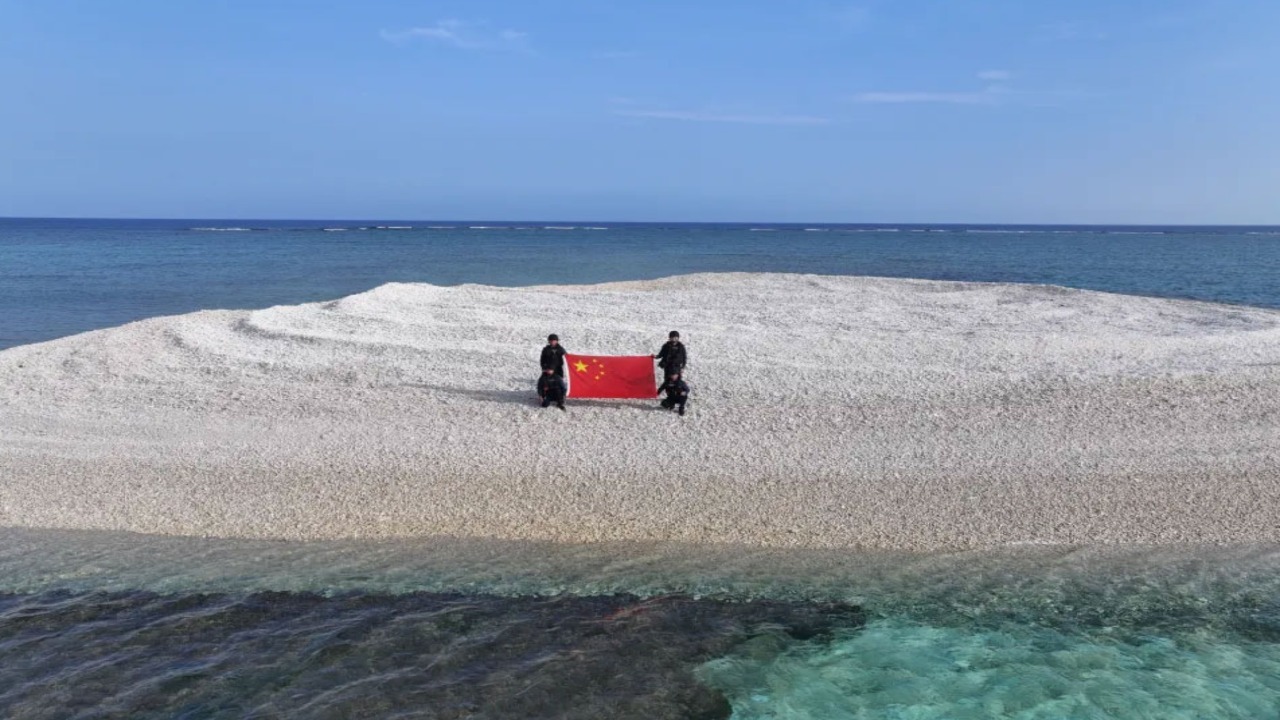
The Chinese state broadcaster CCTV released striking images of four Chinese coastguard officers in black uniforms planting the Chinese flag on Sandy Cay, located in the Spratly Islands. According to the report, the officers carried out a “maritime control operation” and exercised “sovereign jurisdiction” over the reef earlier in April, signaling Beijing’s continued assertiveness in claiming disputed territories in the region.
Strategic Location and Symbolism
Sandy Cay is a small, 200-square-meter sandbank situated near Thitu Island (known in the Philippines as Pag-asa Island), which serves as a major Philippine military outpost in the South China Sea. Despite its minuscule size, Sandy Cay’s strategic location makes it a valuable observation point and a geopolitical flashpoint.
The Philippines has long maintained that this reef falls within its Exclusive Economic Zone (EEZ), and Philippine forces have been tracking Chinese movements in the area from nearby Thitu. As China and the Philippines continue to contest overlapping maritime claims, even a tiny outcrop like Sandy Cay can become a powerful symbol of sovereignty.
A Rapid Response from the Philippines
In a swift countermove, Philippine security personnel were deployed to three sandbanks possibly including Sandy Cay where they were photographed holding their national flag in a pose that mirrored the Chinese coastguard’s photo. This symbolic gesture was intended to assert the Philippines’ own claim to the territory and to challenge China’s growing presence.
The Philippines’ National Task Force for the West Philippine Sea (NTF-WPS) released a statement condemning the “illegal presence” of the Chinese Coastguard and Chinese militia vessels, reportedly spotted just 1,000 yards from one of the sandbanks. According to the task force, seven militia vessels were also seen loitering in the vicinity, adding to concerns about militarization and illegal occupation.
An Escalating Dispute
This confrontation at Sandy Cay is just the latest in a series of increasingly aggressive maritime encounters between the two nations. In recent months, there have been reports of vessel collisions, blocking maneuvers, and water cannon attacks by Chinese ships targeting Philippine supply boats. Each incident ratchets up the risk of a broader conflict, especially as both countries refuse to back down from their territorial claims.
China justifies its actions in the South China Sea through the controversial "nine-dash line," a sweeping territorial claim that cuts deep into the EEZs of other countries such as Vietnam, Malaysia, Taiwan, Brunei, and the Philippines. International rulings, including the 2016 decision by the Permanent Court of Arbitration in The Hague, have rejected China's expansive claims. However, Beijing has largely ignored these decisions and continued with its island-building, patrols, and symbolic sovereignty demonstrations like the one seen at Sandy Cay.
U.S. and Regional Implications
The Sandy Cay incident also coincides with the annual U.S.-Philippines Balikatan military drills, which involve over 17,000 personnel. The exercises, designed to enhance interoperability and readiness, include live-fire drills and the deployment of advanced missile systems like the U.S. Marine Air Defense Integrated System and NMESIS (Navy Marine Expeditionary Ship Interdiction System).
China has criticized the drills as provocative and destabilizing, even as U.S. officials reaffirm their commitment to supporting the Philippines under the Mutual Defense Treaty. National Security Council spokesperson James Hewitt called China’s actions “deeply concerning” and warned that such provocations "threaten regional stability and violate international law."
What’s Next?
While China’s coastguard is reported to have left Sandy Cay after their symbolic flag-raising, the act itself is viewed as a challenge to the Philippines' territorial integrity and a broader test of regional resolve. Though the sandbank remains unoccupied for now, the message from Beijing is clear: China intends to assert control over what it sees as its rightful territory, regardless of international pushback.
This standoff serves as a stark reminder of the fragility of peace in the South China Sea. As military maneuvers, legal arguments, and diplomatic pressure mount, the question remains whether diplomacy can prevail over territorial ambitions.
The world will be watching closely, especially as alliances strengthen and strategic posturing intensifies. The Sandy Cay incident, while small in scale, could prove to be a watershed moment in the larger geopolitical contest in the Asia-Pacific. Read more: Umar Akmal is disappointed with former teammates’ behaviour
'%3e%3crect%20y='0.445312'%20width='48'%20height='48'%20rx='24'%20fill='white'%20fill-opacity='0.5'/%3e%3crect%20x='0.5'%20y='0.945312'%20width='47'%20height='47'%20rx='23.5'%20stroke='%23808080'/%3e%3cpath%20d='M34.625%2024.4453L14%2024.4453'%20stroke='%23808080'%20stroke-width='0.920053'/%3e%3cpath%20d='M23.375%2034.4453L13.375%2024.4453L23.375%2014.4453'%20stroke='%23808080'%20stroke-width='0.920053'/%3e%3c/g%3e%3cdefs%3e%3cfilter%20id='filter0_b_489_44344'%20x='-12'%20y='-11.5547'%20width='72'%20height='72'%20filterUnits='userSpaceOnUse'%20color-interpolation-filters='sRGB'%3e%3cfeFlood%20flood-opacity='0'%20result='BackgroundImageFix'/%3e%3cfeGaussianBlur%20in='BackgroundImageFix'%20stdDeviation='6'/%3e%3cfeComposite%20in2='SourceAlpha'%20operator='in'%20result='effect1_backgroundBlur_489_44344'/%3e%3cfeBlend%20mode='normal'%20in='SourceGraphic'%20in2='effect1_backgroundBlur_489_44344'%20result='shape'/%3e%3c/filter%3e%3c/defs%3e%3c/svg%3e)
'%3e%3crect%20y='0.445312'%20width='48'%20height='48'%20rx='24'%20fill='white'%20fill-opacity='0.5'/%3e%3crect%20x='0.5'%20y='0.945312'%20width='47'%20height='47'%20rx='23.5'%20stroke='%23808080'/%3e%3cpath%20d='M13.375%2024.4453L34%2024.4453'%20stroke='%23808080'%20stroke-width='0.920053'/%3e%3cpath%20d='M24.625%2014.4453L34.625%2024.4453L24.625%2034.4453'%20stroke='%23808080'%20stroke-width='0.920053'/%3e%3c/g%3e%3cdefs%3e%3cfilter%20id='filter0_b_489_44344'%20x='-12'%20y='-11.5547'%20width='72'%20height='72'%20filterUnits='userSpaceOnUse'%20color-interpolation-filters='sRGB'%3e%3cfeFlood%20flood-opacity='0'%20result='BackgroundImageFix'/%3e%3cfeGaussianBlur%20in='BackgroundImageFix'%20stdDeviation='6'/%3e%3cfeComposite%20in2='SourceAlpha'%20operator='in'%20result='effect1_backgroundBlur_489_44344'/%3e%3cfeBlend%20mode='normal'%20in='SourceGraphic'%20in2='effect1_backgroundBlur_489_44344'%20result='shape'/%3e%3c/filter%3e%3c/defs%3e%3c/svg%3e)