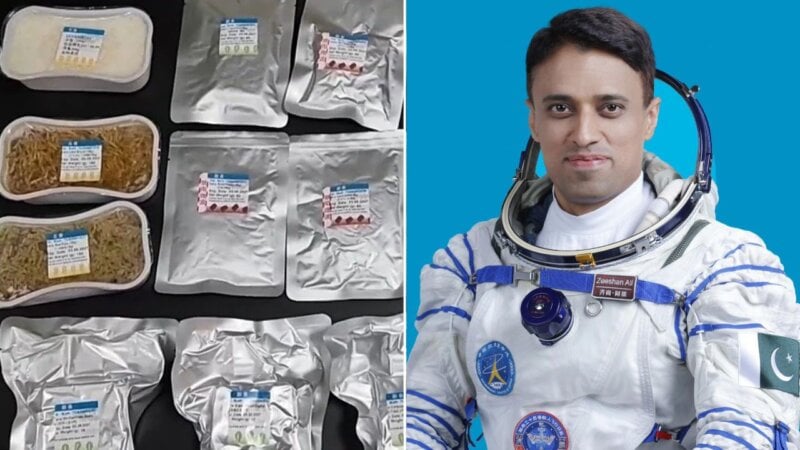
Pakistan’s first astronaut Muhammad Zeeshan Ali has a special menu waiting for him aboard China’s Tiangong space station, featuring some familiar favourites, including butter chicken, beef nihari, lamb korma and curried chickpeas.
China has prepared a dedicated halal food selection featuring more than 100 varieties to accommodate the Pakistani astronaut’s dietary requirements and cultural preferences during his historic space mission.
According to Chinese state media, research teams at the China Astronaut Centre developed the menu after studying Pakistani food culture, halal requirements and nutritional preferences.
The selection includes seven specially developed Pakistani-style space foods, with beef nihari, lamb korma, butter chicken and curried chickpeas among the dishes.
The entire production process follows halal food preparation requirements. Researchers also tested the meals repeatedly and refined their recipes to maintain their taste and nutritional value while making them suitable for consumption in space.
Chen Junli, a researcher at the China Astronaut Centre, said that the team considered Pakistani preferences for spices such as turmeric and curry while developing the menu.
Researchers also took Ali’s personal preferences into account. Although the original menu included traditional Pakistani spiced milk tea, the astronaut requested more Chinese tea and rice after developing a liking for them during his stay in China.
The customised menu will also feature at a special dinner involving six astronauts from China’s Shenzhou-23 and Shenzhou-24 missions, who are sharing the space station during the crew rotation period.
The meal brings together dishes enjoyed by Chinese and Pakistani crew members while accommodating their different dietary preferences.
Ali travelled aboard the Shenzhou-24 spacecraft on November 25 alongside Chinese astronauts Tang Hongbo and Wu Yi, becoming the first Pakistani and first foreign astronaut to visit China’s Tiangong space station.
The spacecraft successfully docked with the orbital laboratory following its launch from the Jiuquan Satellite Launch Centre.
Ali is expected to spend approximately five to 10 days in space, conducting scientific experiments before returning to Earth aboard the Shenzhou-23 spacecraft.