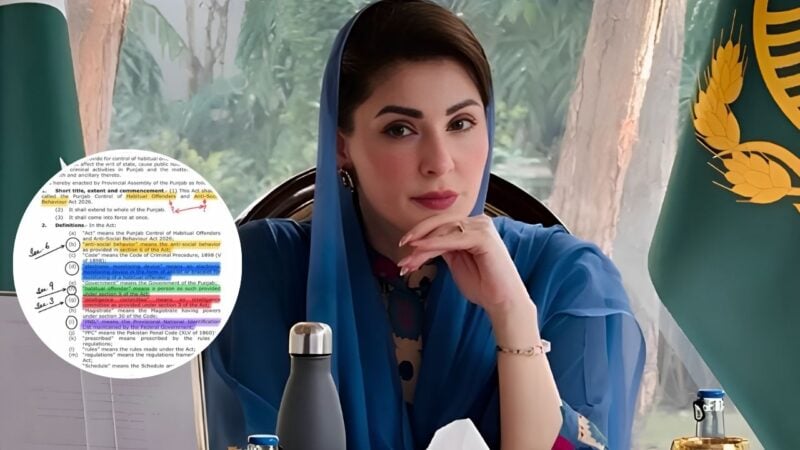
In a significant legislative retreat, Chief Minister Maryam Nawaz has ordered a complete overhaul and redrafting of the proposed Punjab Control of Habitual Offenders and Anti-Social Behaviour Bill 2026, following fierce opposition from public, media and her own party ranks.
Announcing the decision during a delayed session on Tuesday, Speaker Malik Muhammad Ahmad Khan confirmed that the Assembly Secretariat will return the bill to the law department. It will then be referred back to the provincial cabinet for thorough amendments before being redesigned and re-presented to the House for approval.
The withdrawal comes as the controversial draft ignited a fierce national debate, with critics decrying the legislation as a chilling remnant of the colonial era. Legal experts argue that the bill marks a stark departure from established legal norms by effectively shifting judicial authority directly into the hands of the executive branch.
Under the proposal, District Intelligence Committees composed of the deputy commissioner, police officials, and intelligence agencies, are empowered to investigate and penalise citizens before they ever reach trial.
The administrative bodies would hold massive powers to demand bail bonds, block national identity cards, freeze bank accounts, and seize property based purely on their own administrative judgment, creating what experts warn is a recipe for political bullying and state overreach.
Furthermore, the bill relies on an incredibly vague definition of “anti-social behaviour” to cover a massive range of activities, stretching from spreading online misinformation to animal cruelty. The ambiguity allows authorities to impose severe electronic monitoring, such as tracking anklets, without any prior judicial conviction. Because the offences are classified as non-bailable, legal observers warn that a fair trial would be nearly impossible, particularly as the subsequent appeal process is handled by government officials rather than independent judges.
The legislation has faced immense scrutiny across political and media circles. Highlighting the institutional shock surrounding the development, Speaker Khan previously revealed that the bill had progressed through the relevant standing committee entirely without his knowledge, flatly remarking: “It’s not possible to introduce a law reminiscent of the colonial era… There could be some misunderstanding on this.”