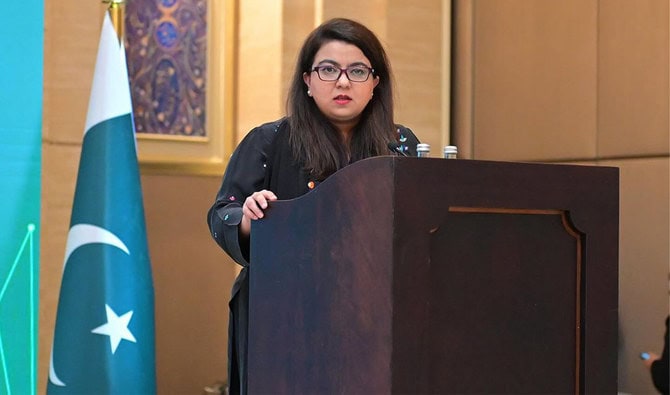
Federal Minister for Information Technology (IT) and Telecommunication Shaza Fatima Khawaja has acknowledged that the Pakistan Telecommunication Reorganisation (Amendment) Bill 2026 contains language that requires clarification but stopped short of accepting that the bill, as written, poses a threat to private property rights.
The controversy centres on Section 27-B of the amendment bill, passed by the National Assembly and currently under Senate scrutiny, which allows licensed telecom operators to install towers on private property following a notice period.
Any failure or refusal to grant right-of-way access attracts a fine of up to Rs50 million.
Senate Standing Committee Chairperson Senator Palwasha Khan has already said that the draft restricts constitutional property rights and was finalised without sufficient consultation.
Appearing on Shahzeb Khanzada’s programme, Fatima argued the Rs5 crore fine is not triggered the moment a homeowner refuses a telecom company access. “It does not mean that if someone comes to my house and says, ‘I want to pass a cable through your house or install a tower,’ and I say no, then I will immediately be fined. It is not like that,” she said, insisting the clause only kicks in after a lawful, mutually agreed contract is already in place and one party violates it.
Khanzada challenged her reading of the bill, pointing out that Section 27-B does not say that.
Under Section 27, which governs the entire right-of-way procedure for all categories of property government, collective private such as housing societies and cantonments, and individual private the fine applies to anyone who obstructs or delays the grant of right-of-way.
There is no language in the bill that limits the clause to post-contract disputes. “You will have to change the language because this language should not have been there,” Khanzada told her.
Fatima’s response was to concede the point without fully owning it. “I am saying that there is confusion in the language and it should be clarified. We have no objection to that,” she said.
She then returned to defending the bill’s intent that the ministry identified right-of-way blockages in private housing societies as a key obstacle to fibre rollout without addressing why language this open-ended made it through the National Assembly, a standing committee that deliberated for five months, and the Law Ministry’s review.
On the PPP’s shifting position, Fatima said the bill cleared the National Assembly after full consultation, with PPP’s senior member Naveed Qamar presenting amendments on the record and voting in favour.
The party then moved to stall the bill in the Senate, with Fatima saying that it was ultimately the collective wisdom of the house, including PPP members, that sent it to committee framing what looked like a political reversal as a routine democratic process.
Khanzada also raised a more fundamental concern about the power imbalance baked into the procedure: under the current language, if a company approaches a homeowner, sends reminders, and the matter escalates to a government authority, the individual is left navigating state institutions that are more likely to favour the operator.
Fatima’s answer was that government entities cannot bypass constitutional rights and that both parties would have to agree to any decision a guarantee that the bill’s text, as currently written, does not appear to make explicit.
She committed to bringing amendments. “Wherever wording needs improvement or an amendment is required, we will do that,” she said, adding that the ministry will consult an external third party again before any revised draft moves forward. The bill will not be passed in its current form, she said.