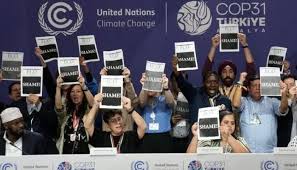
The COP31 climate conference in Antalya, Türkiye, ended without an overarching agreement on Sunday after more than two weeks of negotiations, as countries failed to reach consensus on including a commitment to move away from fossil fuels in the final text.
The negotiations, which continued beyond their scheduled deadline over the weekend, marked the longest COP conference in history and the first major breakdown in climate talks since COP15 in Copenhagen in 2009, CNN reported.
The proposed Antalya Pact faced opposition over several issues, including the removal of references to fossil fuels and the lack of financial commitments to help developing countries deal with climate-related disasters.
At the final meeting to approve the agreement, COP31 President Murat Kurum acknowledged that delegates lacked the consensus needed to adopt the text.
“We have done our utmost,” Kurum said, adding that some countries in the room opposed the document and there was no agreement on its adoption.
More than 190 countries participated in the negotiations, although the United States (US) did not attend after President of US Donald Trump withdrew the country from international climate action.
The European Union, Panama, the Marshall Islands and Norway were among the countries and groups that rejected the proposed agreement over its failure to mention fossil fuels.
Ireland’s climate minister Darragh O’Brien, who helped lead negotiations for the EU, said that the bloc could not endorse an agreement “that does not even mention fossil fuels”.
“This COP, I believe, was hijacked by some oil states,” he later told Reuters.
Saudi Arabia and other oil-producing countries have opposed including references to fossil fuels in climate agreements.
The first draft of the conference’s overarching agreement, published on Monday, called for “the immediate transition away from fossil fuels in energy systems”. However, subsequent drafts removed all references to fossil fuels despite more than 100 countries pushing to retain the language.
At COP28 in Dubai in 2023, countries agreed to a commitment to “transition away from fossil fuels”. However, oil-producing countries have resisted repeating or expanding that commitment in subsequent climate negotiations.
The failure to retain the language drew criticism from climate negotiators and organisations. Britain’s lead climate negotiator Kate Hughes said that the proposed agreement “moves us backwards”, while Harjeet Singh, founding director of Satat Sampada Climate Foundation, said that countries could not address the fossil fuel crisis by avoiding commitments to phase out fossil fuels.
Another point of disagreement concerned carbon capture technology, which allows industries to capture carbon emissions before they enter the atmosphere. Critics argued that relying on the technology without reducing fossil fuel use risks allowing continued production.
Matt Webb, associate director for global clean power diplomacy at climate think tank E3G, compared the approach to “trying to quit smoking without putting down the cigarettes”.
Climate finance also remained unresolved. Developing countries sought additional funding to prepare for and recover from climate disasters, which they face disproportionately despite contributing less to the causes of climate change.
The draft agreement called for efforts to at least triple adaptation finance by 2035 but did not establish a baseline or specify funding amounts.
China, the world’s largest climate polluter and a major clean energy producer, described the lack of consensus as a “deep disappointment”. Its delegation head, Li Gao, said that the outcome should not undermine confidence in countries’ ability to work together on climate change, according to Chinese state media Xinhua.
Despite the failure to reach an agreement, more than 90 countries signed a pledge to increase the electrification of their economies.
COP31 negotiations president Chris Bowen said that the outcome was disappointing but pointed to the commitments made during the conference.
Former Irish president and COP veteran Mary Robinson said that the failure to respond to the risks of global warming showed a lack of urgency and leadership at the conference.