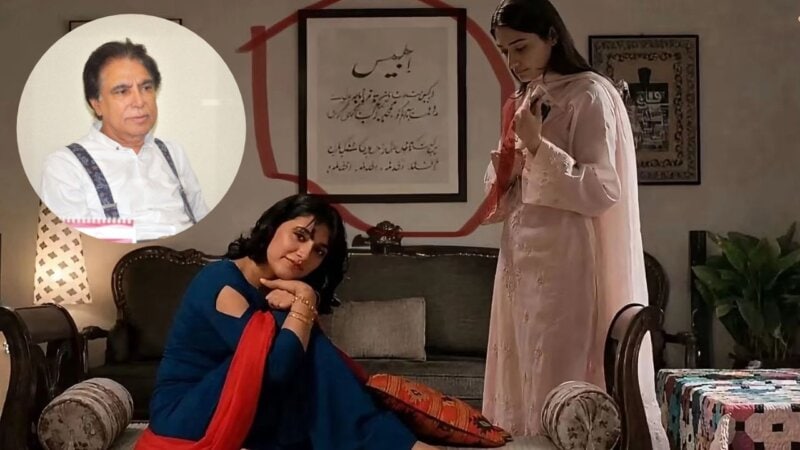
Dar-e-Nijaat director Saqib Khan has revealed how his former teacher, veteran actor Rahat Kazmi, inspired one of the drama’s most talked-about scenes featuring poetry by Allama Muhammad Iqbal.
The director shared the story behind the scene after receiving numerous messages and comments from viewers who noticed verses of Iqbal’s poem “Iblees-o-Jibreel” displayed on the wall of Khushbakht’s living area in the drama’s recent episode.
In a detailed Facebook post, Saqib credited Rahat Kazmi, whom he described as his teacher, mentor and guru, for introducing him to the deeper meaning of drama and the importance of conflict in storytelling.
Recalling his days as a drama student, Saqib said that Rahat once entered their classroom and asked students what drama meant. After listening to their interpretations, he walked to the whiteboard and wrote one word: “Conflict.”
Saqib recalled how Rahat explained different forms of conflict, including the struggle between ideas, individuals and society, humans and God, and individuals with themselves.
During the same lecture, Rahat wrote verses from Iqbal’s “Iblees-o-Jibreel” on the whiteboard and remarked, “Bhuee yeh Iblees kambakht na hota toh shayad drama bhi na hota [This wretched Iblees, if he did not exist, perhaps drama would not exist either].”
The director said that the lesson stayed with him over the years and eventually influenced his creative decisions while making Dar-e-Nijaat.
Explaining the thinking behind the scene, Saqib said that he wanted the verses to represent the conflict and contradictions that shape human experiences and dramatic storytelling.
He also praised writer Umera Ahmed for leaving room for directors, actors and other creative professionals to bring their own interpretations to a script.
Saqib explained that the scene marked a transition from one woman’s story to another, involving two different lives, circumstances and perspectives. He felt Iqbal’s poetry naturally belonged at that point in the narrative.
The director also thanked viewers for noticing the detail and sharing their interpretations. He said their responses encouraged him to revisit the scene and appreciate it from different perspectives.
Actor Sanam Saeed appreciated his work, writing, “Brilliant. I will ask Ali Kazmi to share this with his father Rahat Kazmi.”
Dar-e-Nijaat has become a major international hit, with viewers from Pakistan,India, Bangladesh, Nepal and UAE praising its performances, storytelling and attention to detail.
The drama follows three characters from different backgrounds. Durefishan Saleem plays Zaryab, Sheheryar Munawar portrays Abu Bakar, and Nameer Nawaz Khan plays Zamil.
Zaryab and Zamil are childhood friends who plan to get engaged. However, Zamil grows envious of Abu Bakar and eventually tells Zaryab that he wants a practical, religious wife rather than a modern woman. He later marries Hamna, played by Romaisa Khan.
Zaryab eventually decides to marry Abu Bakar, whose worldview reflects the teachings of his mother, Khushbakht, played by Sania Saeed. However, she initially struggles to move beyond her past behaviour and often acts arrogantly towards him as she begins working on herself.