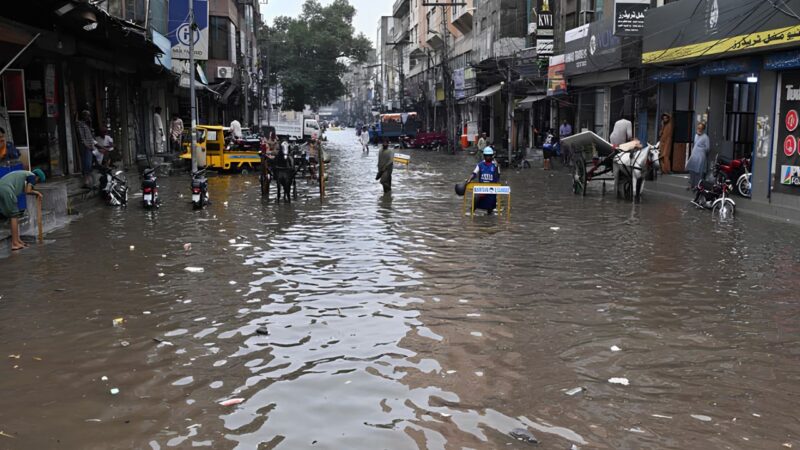
Persistent monsoon downpours across Pakistan have taken the nationwide death toll to 81. The National Disaster Management Authority (NDMA) has confirmed that continuous severe weather conditions and urban flooding are severely disrupting civic life.
Heavy downpours over the preceding 24 hours claimed nine lives and left 54 people injured nationwide. Total fatalities since June 26 climbed to 81, comprising 35 children, 27 men, and 19 women, alongside 241 injuries.
Khyber Pakhtunkhwa (KP) recorded 47 deaths, Punjab registered 21, Azad Jammu and Kashmir reported 7, and Balochistan documented six. Furthermore, severe weather damaged 387 houses, killed 207 animals, and disrupted 6.7 kilometres of roadways.
Several areas of Karachi received rain and drizzle on Friday night, with heavy downpours lashing Shahrah-e-Faisal, Sohrab Goth, and DHA Phase 6, while Surjani Town recorded the highest precipitation at 5.5 millimetre.
Meanwhile, the Pakistan Meteorological Department (PMD) warned of widespread rain, windstorms, and thundershowers across southern and central regions through July 27, prompting alerts for urban flooding in Lahore, Gujranwala, Faisalabad, Hyderabad, and Sukkur.
In Lahore, rising wastewater flows in the cross-border Hudiara Drain overtopped natural creeks and inundated Kanghawala village near the Sundar Industrial Estate. District administration faced severe criticism after failing to evacuate residents or establish timely relief camps, leaving local populations alone deal with floodwaters entering homes and fields independently.
Meanwhile, the Flood Forecasting Division (FFD) has reported that River Chenab remained in high flood at Chiniot, while River Ravi entered a medium flood state, with multiple nullahs such as Husri, Nikki Deg, and Main Deg surpassing their maximum capacities.
Local administration established relief camps across vulnerable settlements of Ravi, while launching drone monitoring for flood early warnings in Punjab for the first time. Floodwaters submerged agricultural crops in multiple areas including Mil Fatiana, Khan Da Chak, and Basti Pipalwala. Irrigation officials directed residents living along the river belt to relocate to safer places immediately.