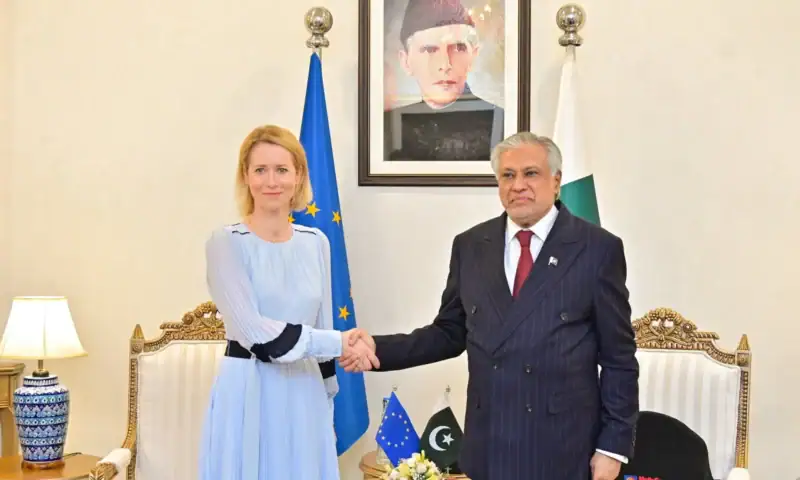
Following a high-level strategic dialogue in Islamabad, European Union (EU) top diplomat Kaja Kallas, who serves as vice-president of the European Commission and the EU high representative for foreign affairs and security policy, has termed Pakistan a major regional power and a vital partner for the bloc.
Taking to X, Kallas detailed her meetings with the country’s top political and military leadership, directly linking the visit to a push for stronger ties. “Today in Islamabad, I met with Prime Minister @CMShehbaz and Deputy PM and Foreign Minister for talks on further strengthening EU–Pakistan ties. I also met Chief of Defence Forces Syed Asim Munir in the Army HQ in Rawalpindi. I commended Pakistan for its key role in facilitating US-Iran talks,” Kallas posted, adding that the country remains the world’s leading beneficiary of EU trade preferences under the GSP+ (Generalised Scheme of Preferences Plus) framework.
Addressing a joint press conference alongside Deputy Prime Minister (DPM) and Foreign Minister Ishaq Dar, Kallas explicitly validated Islamabad’s ongoing geopolitical value but paired the praise with clear domestic expectations.
While acknowledging that the EU remains Pakistan’s largest export destination surpassing the market sizes of the United States (US) and China combined she made it clear that continued duty-free access is strictly conditional.
“But GSP+ has clear conditions. Continued preferential access to the EU market depends on progress in implementing the international conventions underpinning the scheme. This includes good governance, environmental protection and particularly, labour and human rights. We look to Pakistan to demonstrate tangible progress on these issues,” Kallas said.
The dialogue follows previous compliance assessments from the EU, including explicit remarks from EU Ambassador Raimundas Karoblis highlighting required improvements in minority rights, blasphemy laws, and enforced disappearances.
While the EU recently welcomed preliminary structural steps taken by Pakistan, EU continues to pressure Islamabad for deep, long-term legislative reforms.
Beyond the trade dynamic, Kallas focused heavily on Pakistan’s role as an intermediary in the Gulf conflict, noting that Islamabad’s diplomatic intervention has actively prevented regional escalation between Washington and Tehran.
“Your diplomatic efforts have helped prevent a return to full-blown war on several occasions and these efforts are much recognised and appreciated across Europe. With your support, there is now a tenuous diplomatic opening to extend the ceasefire and reopen the Strait of Hormuz,” she stated.
Prime Minister (PM) Shehbaz Sharif, during a separate meeting at the PM House, expressed satisfaction with the eighth round of the EU-Pakistan Strategic Dialogue, reiterating Pakistan’s commitment to enhancing cooperation in trade, investment, climate change, security, and migration.
Ishaq Dar described Kallas’s visit as a milestone, pointing out that the minimal gap between the November 2025 dialogue and the current session marks the shortest period between consecutive strategic sessions in the history of Pakistan-EU relations.
“We have been constantly in touch during the last year’s India-Pakistan war and so are we in touch during the regional conflict between the US and Iran,” Dar stated, adding that the frequency of these high-level meetings points to a growing momentum in the partnership.