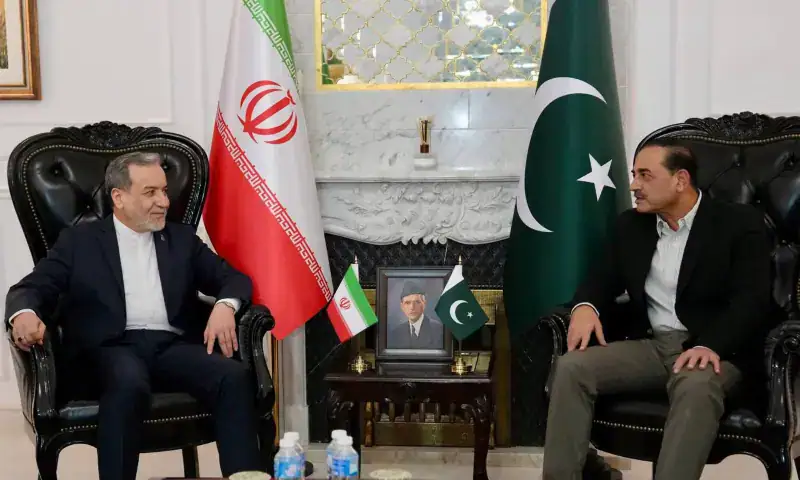
Iranian Foreign Minister Abbas Araghchi met with Chief of Defence Forces (CDF) Field Marshal Asim Munir in Islamabad on Saturday. Although he was received by Munir at the airbase, this meeting served as Araghchi’s first official engagement following his arrival in the capital on Friday night.
The Iranian delegation for the meeting included Deputy Foreign Minister Kazem Gharibabadi and Ambassador Reza Amiri Moghadam. On the Pakistani side, Interior Minister Mohsin Naqvi and other senior officials attended the discussions.
Araghchi is carrying Tehran’s formal response to proposals previously conveyed by the United States (US) through Pakistan. Before his arrival, the foreign minister held telephone conversations with Munir and Deputy Prime Minister Ishaq Dar to discuss ceasefire efforts and diplomatic tracks.
Pakistani officials stated that the primary objective of this visit is to deliver Tehran’s position following internal consultations.
Prior to leaving Tehran, Araghchi stated on X, “Purpose of my visits is to closely coordinate with our partners on bilateral matters and consult on regional developments. Our neighbours are our priority”.
Foreign Ministry Spokesperson Esmaeil Baqaei clarified that no direct meeting is scheduled between Iranian and American officials. He noted that Araghchi would consult with Pakistani leadership regarding their ongoing mediation and good offices for ending American-imposed war of aggression.
Diplomatic activity in Islamabad is set to increase as White House Press Secretary Karoline Leavitt confirmed that US Special Envoy Steve Witkoff and adviser Jared Kushner are traveling to Pakistan. They are expected to engage in a second round of talks mediated by Pakistan.
She added that the US leadership is waiting for updates and that the Vice President is on standby to travel to Pakistan if necessary.
Leavitt claimed that the Iranian side initiated the request for in-person conversations. This follows an initial round of direct talks held in Islamabad on April 11 and 12, which lasted 20 hours without reaching a final agreement.
Currently, an indefinitely extended ceasefire remains in place, though disputes regarding nuclear restrictions, naval blockades, and the sequencing of concessions are still not resolved.
Officials in Islamabad describe the mediation process as fluid, focusing on bridging the gap between US demands and Iranian conditions.