
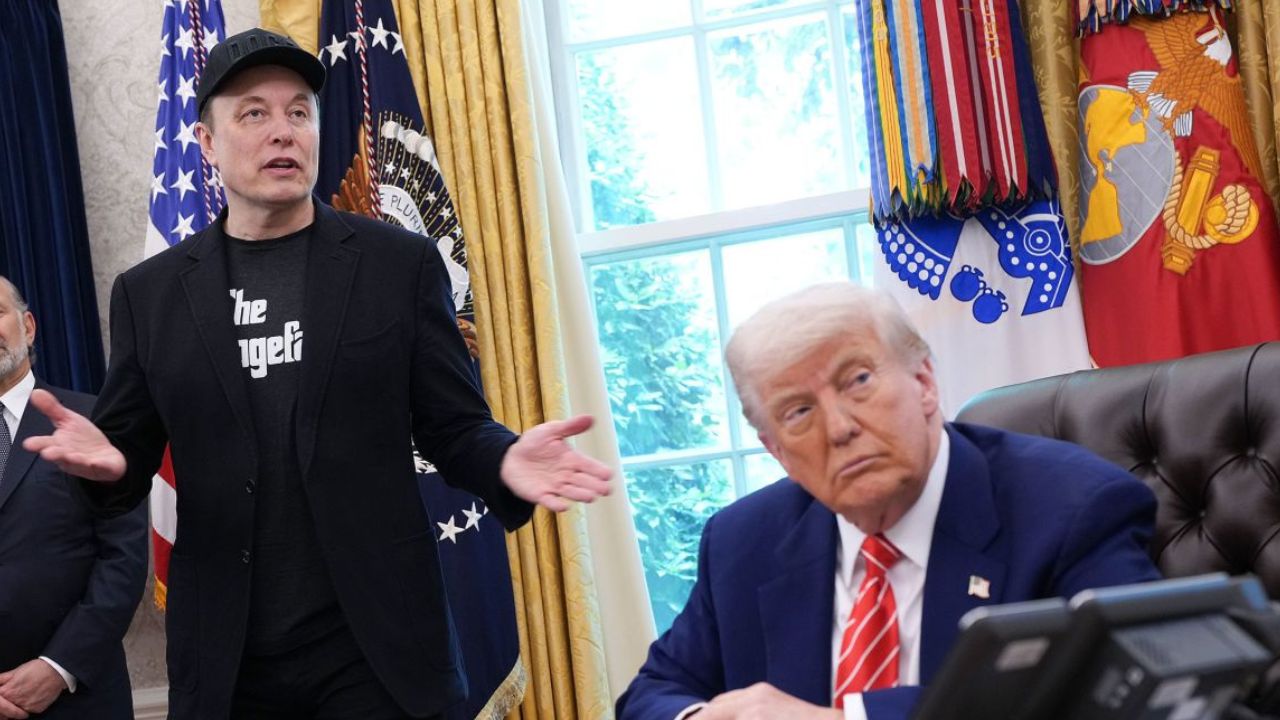


A public showdown between US President Donald Trump and Tesla CEO Elon Musk has escalated into a significant political and financial conflict, causing ripples throughout Washington and wiping billions off Tesla’s market value.
The turmoil began after Musk criticised Trump’s recent tax and spending legislation, which has been central to the administration’s domestic priorities. Musk labelled the bill a “disgusting abomination” on his platform X, accusing Republican lawmakers of irresponsible spending and urging his followers to pressure Congress into rejecting it.
President Trump, during a press conference with German Chancellor Friedrich Merz, expressed his “disappointment” with Musk’s comments and suggested that their long-standing partnership might be coming to an end. He questioned Musk’s motivations, implying that his criticism stemmed from the bill’s removal of electric vehicle incentives, a decision that could adversely affect Tesla.
Musk countered, stating that personal benefit was not his concern. In a post on X, he remarked, “Keep the EV/solar incentive cuts, even though oil & gas subsidies remain, but get rid of the mountain of disgusting pork in the bill,” referencing what he believes to be unnecessary expenditures aimed at buying votes.
The friction worsened on Thursday after Trump took to Truth Social to warn Musk against his government-associated ventures, stating, “The easiest way to save billions in our budget is to cancel Elon’s subsidies and contracts.” His threat specifically targeted companies like SpaceX and Starlink, which heavily depend on government financing.
Musk retaliated, dismissing the threats and revealing that SpaceX would start shutting down its Dragon spacecraft operations vital for US missions to the International Space Station. He also hinted at potentially financially supporting political challengers to Trump-aligned Republicans, stirring concerns about fractures within the party ahead of the upcoming election cycle.
Matters escalated further after Musk, without providing evidence, linked Trump to unreleased documents related to convicted sex offender Jeffrey Epstein. The White House dismissed the allegation, describing it as a distraction from Musk’s grievances regarding policy.
Meanwhile, Tesla shares plummeted, losing 14% of their value, equating to a $150 billion loss. Analysts labelled it one of the company’s most challenging days in recent times. Dan Ives of Wedbush Securities noted that the public dispute had shaken investor trust and created uncertainty regarding Tesla’s regulatory outlook.
Musk, who had been part of Trump’s administration as the head of the Department of Government Efficiency (nicknamed “Doge”), resigned from his role last week after 129 days. During his time in office, he implemented significant cuts, disbanding agencies like USAID and claiming to have saved $180 billion — a figure that critics dispute.
The alliance between Trump and Musk began with Musk’s major financial support for Trump’s 2024 election campaign. Their partnership survived several controversies, including Musk’s unpredictable behaviour and clashes with top officials. But now, it has fallen apart, turning into mutual attacks and political fallout.
Trump has attempted to mitigate tensions by refraining from mentioning Musk during a public event, but his social media updates indicated otherwise: the bond is severed. “Elon and I had a great relationship,” he remarked noticeably in the past tense.
Some Republicans fear Musk’s rising influence and considerable wealth might encourage dissent within their party. Meanwhile, Democrats have largely kept quiet, seemingly pleased to observe two influential adversaries undermine each other.
Musk concluded the day by reminding Trump and the public that although a presidency lasts four years, his own impact could extend for decades. “Trump has 3.5 years left as president,” he tweeted. “But I’ll be around for 40-plus years.”
'%3e%3crect%20y='0.445312'%20width='48'%20height='48'%20rx='24'%20fill='white'%20fill-opacity='0.5'/%3e%3crect%20x='0.5'%20y='0.945312'%20width='47'%20height='47'%20rx='23.5'%20stroke='%23808080'/%3e%3cpath%20d='M34.625%2024.4453L14%2024.4453'%20stroke='%23808080'%20stroke-width='0.920053'/%3e%3cpath%20d='M23.375%2034.4453L13.375%2024.4453L23.375%2014.4453'%20stroke='%23808080'%20stroke-width='0.920053'/%3e%3c/g%3e%3cdefs%3e%3cfilter%20id='filter0_b_489_44344'%20x='-12'%20y='-11.5547'%20width='72'%20height='72'%20filterUnits='userSpaceOnUse'%20color-interpolation-filters='sRGB'%3e%3cfeFlood%20flood-opacity='0'%20result='BackgroundImageFix'/%3e%3cfeGaussianBlur%20in='BackgroundImageFix'%20stdDeviation='6'/%3e%3cfeComposite%20in2='SourceAlpha'%20operator='in'%20result='effect1_backgroundBlur_489_44344'/%3e%3cfeBlend%20mode='normal'%20in='SourceGraphic'%20in2='effect1_backgroundBlur_489_44344'%20result='shape'/%3e%3c/filter%3e%3c/defs%3e%3c/svg%3e)
'%3e%3crect%20y='0.445312'%20width='48'%20height='48'%20rx='24'%20fill='white'%20fill-opacity='0.5'/%3e%3crect%20x='0.5'%20y='0.945312'%20width='47'%20height='47'%20rx='23.5'%20stroke='%23808080'/%3e%3cpath%20d='M13.375%2024.4453L34%2024.4453'%20stroke='%23808080'%20stroke-width='0.920053'/%3e%3cpath%20d='M24.625%2014.4453L34.625%2024.4453L24.625%2034.4453'%20stroke='%23808080'%20stroke-width='0.920053'/%3e%3c/g%3e%3cdefs%3e%3cfilter%20id='filter0_b_489_44344'%20x='-12'%20y='-11.5547'%20width='72'%20height='72'%20filterUnits='userSpaceOnUse'%20color-interpolation-filters='sRGB'%3e%3cfeFlood%20flood-opacity='0'%20result='BackgroundImageFix'/%3e%3cfeGaussianBlur%20in='BackgroundImageFix'%20stdDeviation='6'/%3e%3cfeComposite%20in2='SourceAlpha'%20operator='in'%20result='effect1_backgroundBlur_489_44344'/%3e%3cfeBlend%20mode='normal'%20in='SourceGraphic'%20in2='effect1_backgroundBlur_489_44344'%20result='shape'/%3e%3c/filter%3e%3c/defs%3e%3c/svg%3e)