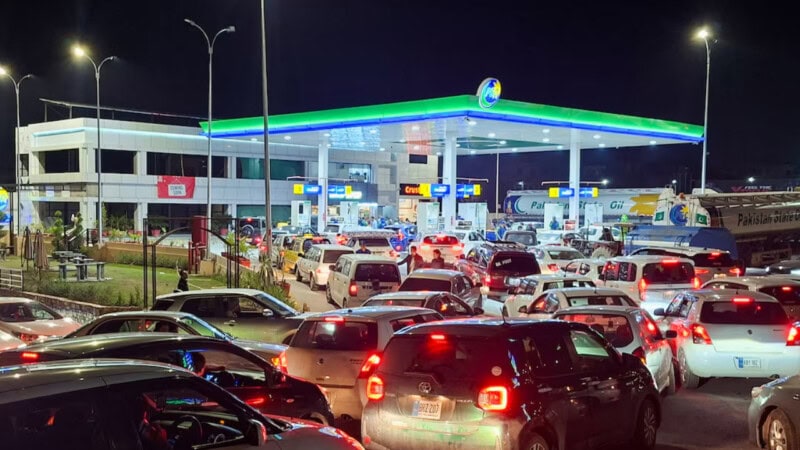
The federal government announced an increase in the prices of petroleum products on Thursday, raising petrol by 43 percent and high-speed diesel (HSD) by 55 percent.
Under the revised rates, petrol increased by Rs 137.23 to reach Rs 458.41 per litre, while HSD rose by Rs 184.49 to Rs 520.35. The price of kerosene was also adjusted to Rs 457.80.
While the government reduced the levy on diesel to zero, it increased the levy on petrol from Rs 105 to Rs 160 per litre. The government’s decision to sharply raise fuel prices has triggered widespread criticism, with public debate focusing on the increase in petroleum levy rather than global oil prices.
Former Sindh governer Muhammad Zubair questioned the fiscal move, asking, “What has petroleum levy got to do with international oil prices. Petroleum levy was Rs 80 when war started and is now double that amount at Rs 160. Why? Why more taxes on people?”
Journalist Nuzhat Nazar noted that the petrol levy has risen roughly 115 percent from its original position. “Petrol levy: Rs 75 → 105 → 161 — up ~115% from original. Diesel levy: Rs 80 → 0. Not market-driven. Pure revenue move and burden shifted to petrol consumers,” Nazar stated.
Petroleum Minister Ali Pervaiz Malik described the measures as “difficult and responsible” decisions taken to maintain fiscal discipline under the IMF program. He stated that the objective was to restrict subsidies to the most deserving segments.
Khawaja Saad Rafique contested the impact of the constraints on the public. “The sharp increase in the price of petroleum products has led to the worst wave of inflation, government constraints are in place, but how will the common man survive?” Rafique, a stalwart of the ruling PML-N, asked.
He added that “while fulfilling the IMF, the poor will die and the middle class will go below the poverty line,” further linking the economic state to “American and Zionist attacks on Iran”.
One reaction highlighted that at Rs 458 per litre, “Pakistan now has the 2nd most unaffordable petrol on earth relative to income. Only Ethiopia, with a $1.50 daily wage and $1.30/litre fuel ranks worse”.
Finance Minister Muhammad Aurangzeb has said that that the decisions were taken with consensus among national leadership to address energy and food security.
Critics of the move argued that internal economic management played a larger role than global factors. One observer stated, “Stop this crap of govt is taking difficult decisions. Yes the global price shock isn’t in our control, but the currency devaluation, bad economy, and a trash fiscal position was.”
Another reaction dismissed the government’s official justifications: “Each of them just wastes our time, deliriously vomiting economist jargons like they’re giving a power point presentation in some elite echo chamber. Absolute clowns”.
Regarding the long-term outlook of the hikes, one citizen asked, “Raise it to 700 or 800, but the question is will they lower it at the same rate when the war is over? No, never.”
To mitigate the impact, the government announced a Rs100 per litre subsidy for bikers capped at 20 litres, and a Rs1,500 per acre subsidy for small farmers. Goods transport trucks will receive Rs70,000 per month, while inter-city public service vehicles are allocated Rs100,000 to keep fares stable.





