
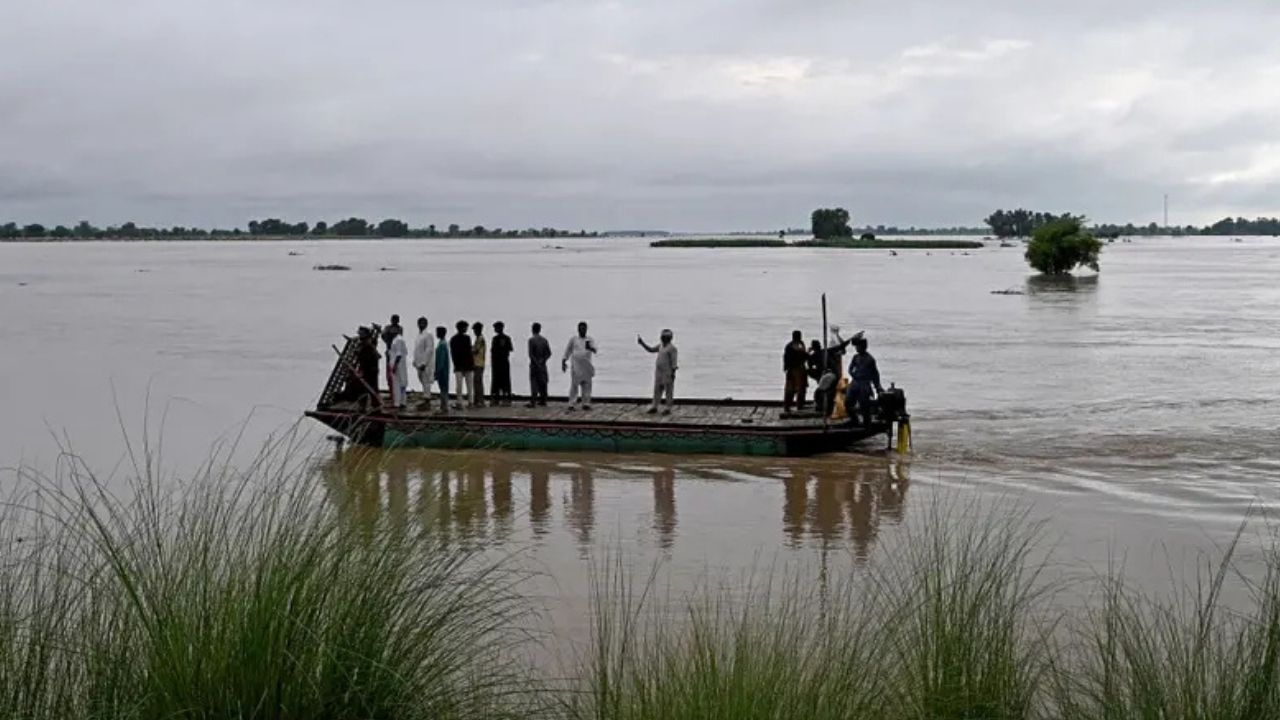


Punjab's Ganda Singh Wala on the Sutlej River continues to witness an “exceptionally high” flood, while Balloki on Ravi and Trimmu on the Chenab also record a “very high” flood level.
According to the Flood Forecasting Division’s (FFD) data, the outflows at Ganda Singh Wala were 253,068 cusecs and “steady”, while those at Trimmu were over 550,000 cusecs and “rising”.
Death toll rises to 33 due to flood in Punjab
As many as 33 people have lost their lives and eight others were injured, driven by high floods in the Chenab, Ravi and Sutlej rivers from Aug 23 to 31, said the Provincial Disaster Management Authority (PDMA).
According to the PDMA, 2,066,785 people of 2,222 mouzas were affected, and 506 relief camps were established to provide shelter to 10,654 people in the province. At least 352 medical camps were established, in which 17,853 people were treated.
The rescue teams evacuated 760,424 people and 516,258 animals and transported them to safe locations. Veterinary services are being provided through 331 camps.
Meanwhile, National Disaster Management Authority (NDMA) Chairman Lieutenant General Inam Haider Malik, while addressing the media alongside Climate Change Minister Dr. Musadik Malik, said that recent rains and flash floods have claimed 850 lives and left more than 1,150 people injured across the country.
The NDMA chief said that over 600,000 people were relocated to safer areas during the flooding, and thousands of livestock were also rescued across the country.
Malik further stated that the final monsoon spell is expected in the first 10 days of September, with heavy rainfall likely in eastern Punjab, Azad Kashmir and nearby regions
Sindh braces for ‘super flood’
Sindh Chief Minister (CM) Murad Ali Shah said the provincial government had devised a comprehensive plan to deal with the looming “super flood”.
Speaking to media on Sunday during his visit to Sukkur and Guddu barrages, he stated that inflows from Trimmu would reach Sindh in about five days via Panjnad.
Shah said that in 2010, inflows of 1.1 million cusecs had passed from the Guddu Barrage. “This time, even 900,000 to one million cusecs would be extremely challenging. If inflows remain limited, losses will be manageable, but crops may still not survive,” he added.
The chief minister maintained that the provincial government’s foremost priority was to protect human lives and livestock, followed by safeguarding the Guddu, Sukkur and Kotri barrages.
Highlighting that Sindh’s terrain poses greater risks than Punjab’s, he explained, “In Punjab, designated breaches allow water to return quickly to the river. But Sindh lies below river level, so once water spreads, it does not recede easily.”
'%3e%3crect%20y='0.445312'%20width='48'%20height='48'%20rx='24'%20fill='white'%20fill-opacity='0.5'/%3e%3crect%20x='0.5'%20y='0.945312'%20width='47'%20height='47'%20rx='23.5'%20stroke='%23808080'/%3e%3cpath%20d='M34.625%2024.4453L14%2024.4453'%20stroke='%23808080'%20stroke-width='0.920053'/%3e%3cpath%20d='M23.375%2034.4453L13.375%2024.4453L23.375%2014.4453'%20stroke='%23808080'%20stroke-width='0.920053'/%3e%3c/g%3e%3cdefs%3e%3cfilter%20id='filter0_b_489_44344'%20x='-12'%20y='-11.5547'%20width='72'%20height='72'%20filterUnits='userSpaceOnUse'%20color-interpolation-filters='sRGB'%3e%3cfeFlood%20flood-opacity='0'%20result='BackgroundImageFix'/%3e%3cfeGaussianBlur%20in='BackgroundImageFix'%20stdDeviation='6'/%3e%3cfeComposite%20in2='SourceAlpha'%20operator='in'%20result='effect1_backgroundBlur_489_44344'/%3e%3cfeBlend%20mode='normal'%20in='SourceGraphic'%20in2='effect1_backgroundBlur_489_44344'%20result='shape'/%3e%3c/filter%3e%3c/defs%3e%3c/svg%3e)
'%3e%3crect%20y='0.445312'%20width='48'%20height='48'%20rx='24'%20fill='white'%20fill-opacity='0.5'/%3e%3crect%20x='0.5'%20y='0.945312'%20width='47'%20height='47'%20rx='23.5'%20stroke='%23808080'/%3e%3cpath%20d='M13.375%2024.4453L34%2024.4453'%20stroke='%23808080'%20stroke-width='0.920053'/%3e%3cpath%20d='M24.625%2014.4453L34.625%2024.4453L24.625%2034.4453'%20stroke='%23808080'%20stroke-width='0.920053'/%3e%3c/g%3e%3cdefs%3e%3cfilter%20id='filter0_b_489_44344'%20x='-12'%20y='-11.5547'%20width='72'%20height='72'%20filterUnits='userSpaceOnUse'%20color-interpolation-filters='sRGB'%3e%3cfeFlood%20flood-opacity='0'%20result='BackgroundImageFix'/%3e%3cfeGaussianBlur%20in='BackgroundImageFix'%20stdDeviation='6'/%3e%3cfeComposite%20in2='SourceAlpha'%20operator='in'%20result='effect1_backgroundBlur_489_44344'/%3e%3cfeBlend%20mode='normal'%20in='SourceGraphic'%20in2='effect1_backgroundBlur_489_44344'%20result='shape'/%3e%3c/filter%3e%3c/defs%3e%3c/svg%3e)