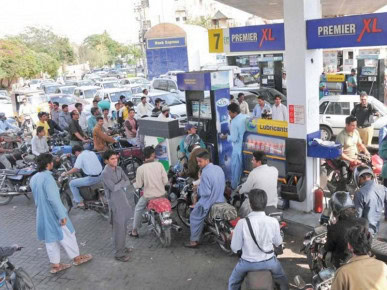
The federal government has reduced the price of petrol by Rs3.19 per litre and increased the rate of High-Speed Diesel (HSD) by Rs2.25, with the revised rates taking effect on Wednesday, October 28, as global oil prices rose more than one percent following an attack on a refinery in Saudi Arabia.
Petrol will now cost Rs376.06 per litre, while HSD will sell at Rs398.07 per litre, according to a notification issued by the Petroleum Division.
The government continues to charge Rs114 per litre in taxes and duties on petrol and Rs100 per litre on diesel.
International oil prices rose on Wednesday after an attack on a refinery in Saudi Arabia renewed concerns over supply risks from the major oil exporter. Brent crude futures gained $1.59, or 1.4 percent, to $115.47 a barrel, while United States (US) West Texas Intermediate (WTI) crude rose $1.43, or 1.4 percent, to $101.33.
The latest fuel price revision came as Jamaat-i-Islami (JI) chief Hafiz Naeemur Rehman met Prime Minister (PM) Shehbaz Sharif in Islamabad to discuss the removal of the petroleum levy and relief for consumers.
The two sides agreed to form a joint committee comprising representatives of the government and JI to examine ways to expand the existing fuel relief scheme. The scheme, introduced for owners of motorcycles, rickshaws and vehicles with engine capacities of up to 800cc, has been in place since September 17.
Rehman also announced that JI will march to Islamabad in mid-November to protest against the petroleum levy if the government fails to announce major relief by then.
Amid concerns over fuel availability, the Pakistan Petroleum Dealers Association urged consumers on Friday to avoid panic buying, warning that excessive purchases could create market distortions.
HSD prices have fallen from their peak of Rs520.35 per litre, recorded on April 3. The price had started climbing from Rs281 per litre after the US-Iran war broke out on February 28.
Petrol also reached a peak of Rs458.41 per litre on April 3, after rising from Rs266 in the first week of March.
The government has also reinstated austerity measures to conserve fuel amid the ongoing Middle East conflict. Under these measures, markets must close by 9pm, while fuel allocations for official vehicles have been reduced by 50 percent for three months.
Petrol primarily serves private transport, small vehicles, rickshaws and motorcycles, making price changes particularly relevant to middle- and lower-middle-income consumers. Diesel, meanwhile, powers heavy transport, power plants and large generators, linking its price to transport and energy costs.