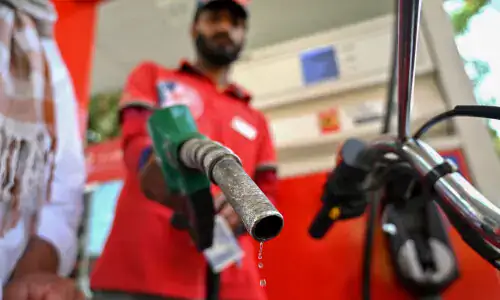
The federal government on Wednesday reduced the price of petrol by Rs7.06 per litre and High-Speed Diesel (HSD) by Rs3.71 per litre, bringing their prices to Rs362 and Rs387.81, respectively, from Thursday, November 5, according to a notification issued by the Oil and Gas Regulatory Authority (OGRA).
The latest revision marked the third consecutive reduction in petroleum prices as international oil prices continued to fall for a fourth day amid expectations that the losses suffered by United States (US) President Donald Trump’s Republican Party in congressional elections could reduce the risk of further escalation in the US-Israeli war on Iran.
Brent crude futures fell by 97 cents, or 1.03 percent, to $93.65 a barrel as of 7:11am Pakistan time, while US West Texas Intermediate (WTI) crude futures dropped by $1.14, or 1.29 percent, to $86.98 a barrel.
Despite the latest reduction, the government continues to charge Rs114 per litre in taxes and duties on petrol and Rs100 per litre on diesel.
The government also announced a 30-day arrangement under which oil refineries will contribute to the petroleum levy by bearing a cumulative impact of Rs15 billion.
Petroleum Minister Ali Pervaiz Malik said on Tuesday that the government was also working to introduce a similar arrangement for Liquefied Petroleum Gas (LPG).
The latest reduction came after HSD reached Rs520.35 per litre on April 3, having climbed from Rs281 per litre following the outbreak of the US-Iran war on February 28. Petrol also reached Rs458.41 per litre on April 3 after rising from Rs266 in the first week of March.
In response to rising fuel prices amid the Middle East conflict, the government reintroduced austerity measures requiring markets to close by 9pm and reducing fuel allocations for official vehicles by 50 percent for three months.
On September 13, Prime Minister (PM) Shehbaz Sharif announced a relief scheme for users of motorcycles, auto-rickshaws and vehicles with engine capacities of up to 800cc to address the impact of rising global oil prices.
Petrol is primarily used in private transport, small vehicles, auto-rickshaws and motorcycles, making its price relevant to middle- and lower-middle-income households. Diesel, meanwhile, is used in heavy transport, power plants and large generators, meaning changes in its price also affect the wider public.