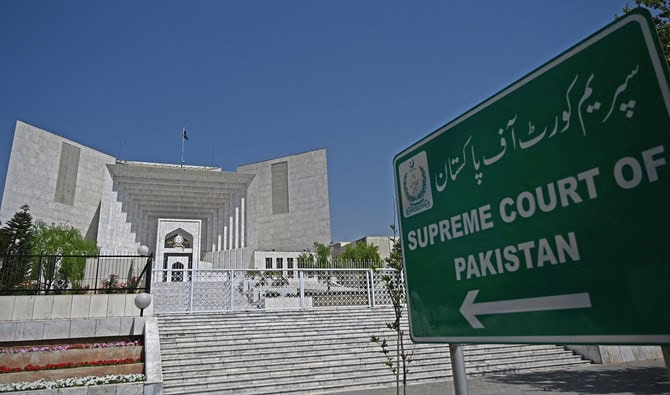
Supreme Court (SC) Judge Justice Malik Shahzad Ahmad Khan has issued a 14-page dissenting note raising concerns over the frequent false implication of innocent individuals, including opposition politicians, in narcotics cases.
The judge highlighted that individuals facing enmity with police officers or influential figures are often targeted, stressing the need to strictly interpret the Control of Narcotic Substances Act, 1997, to prevent these practices.
The dissenting note follows a May 13 ruling by a five-member SC bench, comprising Justices Jamal Khan Mandokhail, Malik Shahzad Ahmad Khan, Muhammad Hashim Khan Kakar, Salahuddin Panhwar, and Ishtiaq Ibrahim.
By a four-to-one majority, the bench decided that mentioning “full protocols” in forensic reports under the unamended Rule 6 of the Control of Narcotic Substances (Government Analysts) Rules, 2001, is directory rather than mandatory.
The majority judgement established that identifying and naming internationally recognised tests, as listed in clauses (i) to (vii) of Explanation II to amended Rule 6, constitutes “full and sufficient compliance.”
In contrast, Justice Shahzad argued that because the 1997 Act carries stringent punishments, the law and its rules must be followed in letter and spirit. He stated that a government analyst’s report must contain complete test protocols, and omitting them should invalidate the evidence.
The judge cited Articles 4 and 10-A of the Constitution, noting that every citizen possesses an inalienable right to a fair trial, due process, and legal treatment.
Quoting Article 4, he noted, “No action detrimental to the life, liberty, body, reputation or property of any person should be taken except in accordance with law.”
Justice Shahzad also referenced the legal principle that “the harsher the sentence, the stricter the standard of proof”. He observed, “Therefore, in my humble view, it will be highly risky to hold that non-mentioning of full protocols does not, of itself, invalidate the report of the government analyst and that merely mentioning the names of internationally recognised tests would amount to ‘full and sufficient compliance’ with the Rules, 2001”.
Concluding the note, the judge maintained that including full protocols remains mandatory under the unamended rules, and neither version of Rule 6 exceeds the scope of Section 36(2) of the parent 1997 Act.