
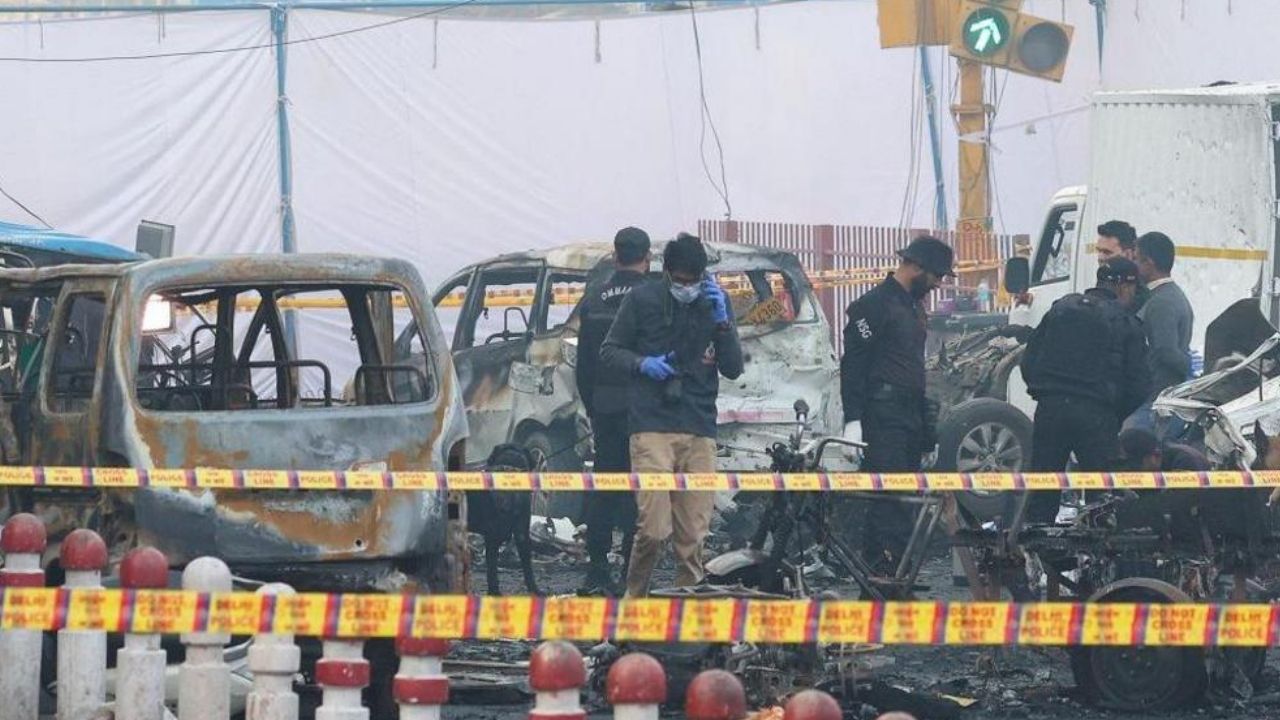


Authorities have traced calls from Pakistan and Turkiye near the site of the deadly New Delhi blast, Indian media reports have claimed.
Although no official statement has so far been released by the Indian government, a report by india.com said that police found 68 suspicious mobile numbers active near Sunheri Bagh’s parking and the blast site, with calls traced from Pakistan and Turkiye.
At least 15 people were killed and 20 others injured when a car exploded near the historic Red Fort in the Indian capital on Nov 10.
Amid conflicting reports on the nature of the explosion, Indian government on Nov 12 declared the incident a terrorist act, however, it refrained from its usual practice of directly blaming Pakistan.
Delhi Police said there were two to three people inside the car at the time of the explosion and preliminary police findings also indicated that the blast may have been a possible suicide attack.
As probe continues, the report by india.com claimed that data from nearby towers revealed unusual activity before the blast, and phone mapping showed 187 phones active within 30 meters of the car that exploded after remining parked for over three hours.
It merits a mention that this is not the first time India is reportedly linking a terror incident to neighbouring Pakistan, as earlier this year both countries engaged in military clashes after cross-border Indian aggression rooted in similar allegations following the Pahalgam attack.
Experts, however, believe that India has this time cautiously steered away from its earlier practice of immediately blaming Pakistan for any terror activities because of the thrashing it took in May.
“It took 48 hours for the Modi regime to admit that the Delhi blast that killed 10 was a terror attack. No more chest thumping, mo more crude jingoism, no more threats to Pakistan [sic],” Indian-Swedish Peace and Conflict expert Ashok Swain wrote in a post on X.
The cost might have been the loss of six or seven fighter jets “but at least some sanity has come to India’s Hindutva crowd”, he went on to add in reference to the clashes that erupted in response to India’s cross-border aggression after the Pahalgam attack.
At least six Indian jets were shot down by Pakistan on the night of May 7 in what was termed one of the biggest aerial confrontations since World War II. The beyond-visual-range battle had followed days of cross-border skirmishes that ended with a United States (US) brokered ceasefire as Pakistan destroyed several Indian military targets in retaliatory strikes.
'%3e%3crect%20y='0.445312'%20width='48'%20height='48'%20rx='24'%20fill='white'%20fill-opacity='0.5'/%3e%3crect%20x='0.5'%20y='0.945312'%20width='47'%20height='47'%20rx='23.5'%20stroke='%23808080'/%3e%3cpath%20d='M34.625%2024.4453L14%2024.4453'%20stroke='%23808080'%20stroke-width='0.920053'/%3e%3cpath%20d='M23.375%2034.4453L13.375%2024.4453L23.375%2014.4453'%20stroke='%23808080'%20stroke-width='0.920053'/%3e%3c/g%3e%3cdefs%3e%3cfilter%20id='filter0_b_489_44344'%20x='-12'%20y='-11.5547'%20width='72'%20height='72'%20filterUnits='userSpaceOnUse'%20color-interpolation-filters='sRGB'%3e%3cfeFlood%20flood-opacity='0'%20result='BackgroundImageFix'/%3e%3cfeGaussianBlur%20in='BackgroundImageFix'%20stdDeviation='6'/%3e%3cfeComposite%20in2='SourceAlpha'%20operator='in'%20result='effect1_backgroundBlur_489_44344'/%3e%3cfeBlend%20mode='normal'%20in='SourceGraphic'%20in2='effect1_backgroundBlur_489_44344'%20result='shape'/%3e%3c/filter%3e%3c/defs%3e%3c/svg%3e)
'%3e%3crect%20y='0.445312'%20width='48'%20height='48'%20rx='24'%20fill='white'%20fill-opacity='0.5'/%3e%3crect%20x='0.5'%20y='0.945312'%20width='47'%20height='47'%20rx='23.5'%20stroke='%23808080'/%3e%3cpath%20d='M13.375%2024.4453L34%2024.4453'%20stroke='%23808080'%20stroke-width='0.920053'/%3e%3cpath%20d='M24.625%2014.4453L34.625%2024.4453L24.625%2034.4453'%20stroke='%23808080'%20stroke-width='0.920053'/%3e%3c/g%3e%3cdefs%3e%3cfilter%20id='filter0_b_489_44344'%20x='-12'%20y='-11.5547'%20width='72'%20height='72'%20filterUnits='userSpaceOnUse'%20color-interpolation-filters='sRGB'%3e%3cfeFlood%20flood-opacity='0'%20result='BackgroundImageFix'/%3e%3cfeGaussianBlur%20in='BackgroundImageFix'%20stdDeviation='6'/%3e%3cfeComposite%20in2='SourceAlpha'%20operator='in'%20result='effect1_backgroundBlur_489_44344'/%3e%3cfeBlend%20mode='normal'%20in='SourceGraphic'%20in2='effect1_backgroundBlur_489_44344'%20result='shape'/%3e%3c/filter%3e%3c/defs%3e%3c/svg%3e)