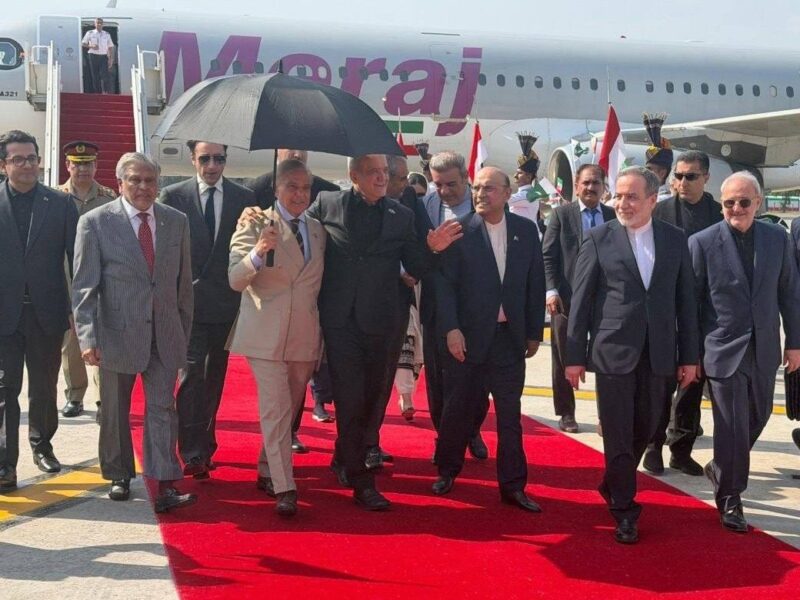
Iranian President Masoud Pezeshkian Tuesday arrived in Pakistan for a high-profile, one-day official visit on the invitation of Prime Minister (PM) Shehbaz Sharif.
The Iranian president landed at the Nur Khan Air Base on an aircraft, Minab 168 – named after the innocent children killed in United States (US) and Israeli strikes on a school in Minab.
The visit, which marks a pivotal moment in regional diplomacy as both Islamabad and Tehran look to solidify the gains made during the recent mediation talks in Switzerland, started with a grand welcome including a 21-gun salute and a flypast by the Pakistan Air Force (PAF).
The high-level reception committee present on the tarmac underscored the significance of the visit as Pezeshkian was received by President Asif Ali Zardari, PM Shehbaz Sharif, Foreign Minister (FM) Ishaq Dar and Interior Minister Mohsin Naqvi.
Iranian FM Abbas Araghchi, who had arrived ahead of the president to facilitate the day’s itinerary, was also present along with Pakistan People’s Party (PPP) Chairman Bilawal Bhutto-Zardari and First Lady Aseefa Bhutto-Zardari.
The primary objective of the visit is to acknowledge and build upon Pakistan’s successful mediation role in facilitating the 14-point Islamabad Memorandum of Understanding (MoU) and the Lucerne Summit between the US and Iran.
This breakthrough, which included a $12 billion release of frozen Iranian funds and a temporary easing of sanctions, has established a 60-day roadmap toward a comprehensive peace deal.
President Pezeshkian, who is on his second presidential visit to the country is accompanied by a senior delegation. He is scheduled to hold extensive consultations with President Zardari and PM Sharif, alongside meetings with Senate Chairman Yousaf Raza Gilani and National Assembly Speaker Ayaz Sadiq.
Discussions are set to cover the full spectrum of bilateral relations, with a specific focus on trade, energy security, border management and deepening regional connectivity.
As the peace process matures, Islamabad remains a critical architect in ensuring the recent agreements translate into lasting regional stability.