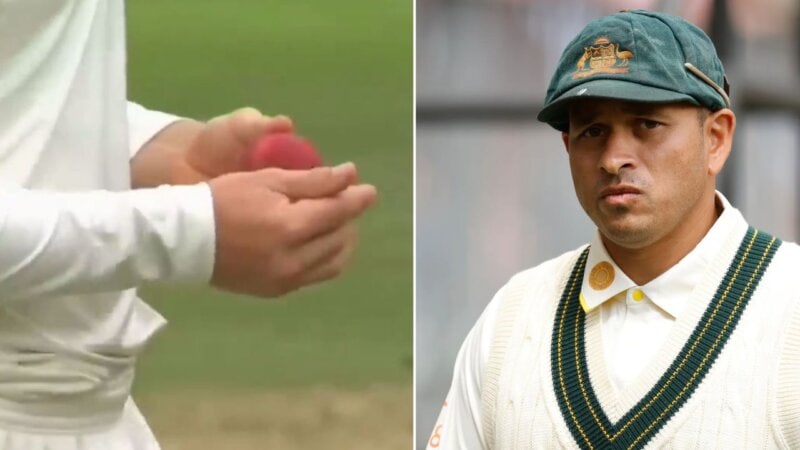
Former Australian cricketer Usman Khawaja has claimed that the entire team knew about the use of sandpaper to tamper with the ball in the final Test of their 2018 series against South Africa.
In extracts from his autobiography, Sabr, published in the Sydney Morning Herald, the former opening batter said that Australia also used the tactic in the Test before the match in Cape Town.
“It was all of us. Not the batters, not the bowlers, not the staff. All of us,” Khawaja, 39, told the newspaper.
The incident, nicknamed “sandpapergate”, drew wide condemnation and led to bans for captain Steve Smith, vice-captain David Warner and batter Cameron Bancroft.
Khawaja, who scored 6,229 runs in 88 Tests, said the talk about tampering started during the second Test of the series at St George’s Park in Port Elizabeth, now Gqeberha. He said open discussions in the dressing room led to the “discovery of sandpaper as an effective agent”.
“At this point Smith essentially threw his hands in the air and said he didn’t want to know,” Khawaja wrote.
Television cameras caught Bancroft using sandpaper on the ball to help generate reverse swing in the third Test.
Khawaja said that Cricket Australia did not ask him for any evidence during its investigation, which shocked him.
“In an ideal world, I don’t want to do this. I don’t want to be the one who comes out and talks about the truth,” he said. “The issue is that I genuinely thought after eight years the truth would have been out by now.”
The four Australia bowlers who played in the match, including current Test captain Pat Cummins, have consistently denied they knew about the plan.
Cummins, Mitchell Starc, Josh Hazlewood and Nathan Lyon issued a joint statement in 2021. They said they “did not know a foreign substance was taken on to the field”.
The statement came days after the Guardian published an interview with Bancroft. When the newspaper asked him whether the bowlers knew, he replied: “It’s pretty probably self-explanatory.”
The bowlers’ statement said they learned of the foreign substance only when they saw the images on the big screen at Newlands. It also said umpires Nigel Llong and Richard Illingworth inspected the ball after the images appeared on television and did not change it because they saw no sign of damage.
“We respectfully request an end to the rumour-mongering and innuendo,” the statement said. “It has gone on too long and it is time to move on.”
Smith, Warner and Bancroft all received punishments. Nobody has ever explained how Cummins, Starc, Hazlewood and Lyon did not notice a change in the state of the ball.
Cummins said on October 8 that Khawaja had told him about the book before Australia’s recent Test series in South Africa. The 33-year-old said he has no concerns about any revelations and felt the team dealt with the matter at the time and moved on.
“He didn’t go into too much detail, just basically gave me the heads-up that he is doing a book and, as always, no worries,” Cummins said. “Tell your story. It’s fine. It’s obviously a long time ago and all the investigations, everything was done back then and we answered every question a million times.”
Khawaja said he repeatedly argued that the team should take collective responsibility, including in the dressing room after the Cape Town Test.
“I said: ‘Take this as a team. We did this as a team. We knew what was going on, and we have to take it as a team’,” he wrote. “Obviously, it didn’t work that way, and those three guys got crucified.”
The title of his memoir comes from an Arabic term for resilience and endurance. Khawaja dedicated the book’s Cape Town chapter to Smith, Warner and Bancroft. He said he believes the trio “deserve” the “justice” of collective blame from the whole team.
“None of those three want to be the first to say anything. And rightly so, it will just be hearsay and ‘their word’ if they do. They needed someone else to say something,” he wrote. “But I’m not doing this for any other reason than I think it’s the right thing to do.”