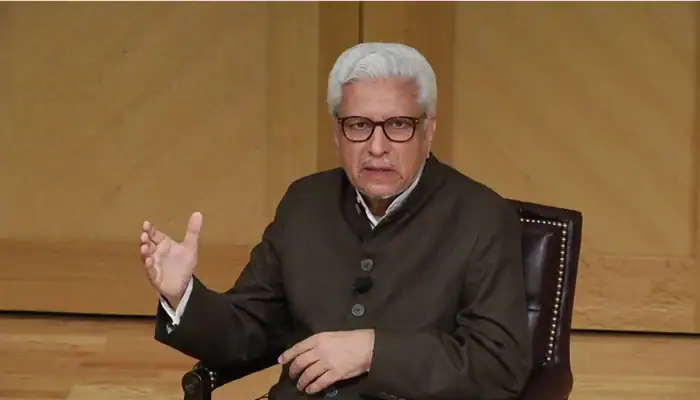
Islamic scholar Javed Ahmad Ghamidi has stated that Pakistan offers far more freedom of expression than many other Muslim countries, absolute monarchies, and authoritarian regimes across the globe.
Ghamidi responded to a question regarding the domestic political setup and public frustration by urging citizens to adopt a realistic view of global politics rather than chasing ideal scenarios. “In this world, political affairs are never in an ideal state,” Ghamidi said. “Understanding them in an ideal state or harbouring the illusion of achieving an ideal state makes a person ill.”
Ghamidi explained that power remains the decisive element in human political structures, stating that humanity developed concepts of order, tribes, and modern states to protect individuals from the misuse of authority.
“An ideal scenario, one pleasing to God and desired by human beings is that people enjoy full freedom, their life, property, and honour are respected, rule of law prevails, and all state affairs are decided through mutual consultation,” Ghamidi said. “In politics, this ideal situation is not easily attainable.”
Ghamidi contrasted the environment in Pakistan with conditions in monarchies, dictatorships, and other regional states, noting that he spent ten years living in Malaysia. “The level of freedom we enjoy in Pakistan cannot even be imagined in many Muslim countries,” Ghamidi said. “In many Arab nations, you cannot go and raise your voice; you cannot comment on anything.”
Ghamidi stated that authoritarian states enforce severe limitations on free speech and religious discourse. “Do you think if you go to China, there will be no suffocation? Will you be able to deliver speeches there? You cannot even imagine it,” he observed.
The scholar pointed out that Pakistan historically permitted public criticism, open press coverage, and oppositional discourse, even during military regimes. “Two of my speeches exist that I delivered in front of General Zia-ul-Haq,” Ghamidi pointed out.
While explaining that Islamic tradition and prophetic guidance offer individuals two distinct options when facing political dissatisfaction, he said, “In political affairs, there are only two paths: either migration, or if you do not find something acceptable, then migrate. If that is not the case, then whatever the situation is, study it where you are, try to understand it, and see how many opportunities exist within it.”
Ghamidi warned against emotional political movements and revolutionary rhetoric, noting that historical attempts to force rapid political shifts resulted in violence, extremism, and national setbacks.
He also acknowledged the practical reality of the political structure in Pakistan, describing it as a hybrid system.
Ghamidi advised citizens to reject emotional turmoil, focus on practical areas of work such as education, business, and social service, and seek gradual reform within existing boundaries.





