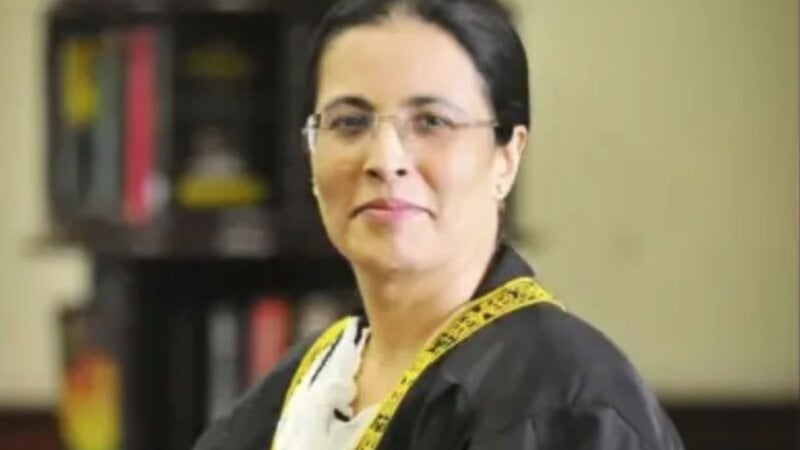
Supreme Court of Pakistan (SCP) Justice Ayesha Malik has called for a reassessment of attitudes that blame women for sexual violence, challenging the assumption that women “invite” rape.
She made the remarks on Tuesday while addressing the launch of a bench book for judges hearing rape cases in Gender-Based Violence (GBV) courts in Islamabad.
The Ministry of Human Rights (MoHR), the Legal Aid Society (LAS) and the United Nations Population Fund (UNFPA) jointly organised the event.
Delivering the keynote address, Justice Malik expressed concerns that sexual violence had become so common that it no longer provoked sufficient public outrage. She urged a fundamental review of the attitudes towards women that allow victim-blaming to persist.
The book aims to help judges conduct fair trials and deliver decisions based on law and evidence, according to the MoHR. Organisers launched it alongside a national study examining the low conviction rates in GBV cases.
Rabeea Hadi, director general of the ministry’s Child Protection Institute, presented the study, which the ministry prepared with the Senate’s Functional Committee on Human Rights.
It examines the stages at which cases falter, from the initial report and investigation to medico-legal examinations, prosecution and trial.
LAS Director of Gender, Inclusion and Development Advocate Maliha Zia outlined how judges can use the bench book during court proceedings.
The guide contains 10 chapters arranged in the order of a trial and brings together relevant laws and judicial guidance to help judges assess evidence, the ministry stated.
Senator Ayesha Raza Farooq, who chairs the Special Committee on the Anti-Rape (Investigation and Trial) Act 2021, highlighted the need to apply existing legislation in court.
“The bench book takes what Parliament enacted, together with what the superior courts have held, and places it within reach of the judge who has to apply it,” she said.
LAS chief executive Barrister Haya Emaan Zahid highlighted the pressures survivors face, including delayed reporting, gaps in medical evidence and family power dynamics.
UNFPA Pakistan representative Dr Luay Shabaneh said: “A judgment that is correctly reasoned protects everybody in and outside the courtroom.”
British High Commission Senior Governance Adviser Mary Kate Thomson noted that the handling of everyday cases influences public trust and whether survivors come forward.
Opening the event, Human Rights Secretary Abdul Khalique Shaikh said: “The honest position is that the word on paper and the practice on the ground have not yet converged.”
Sahil’s Six Months Cruel Numbers Report recorded 3,172 GBV cases across Pakistan from January to June 2026, including 18 involving transgender persons. The report documented 644 murders, 514 cases of torture, 462 abductions, 363 suicides, 280 rapes, 175 injuries, 132 honour killings and 21 other crimes, including harassment, gang rape and pornography.