
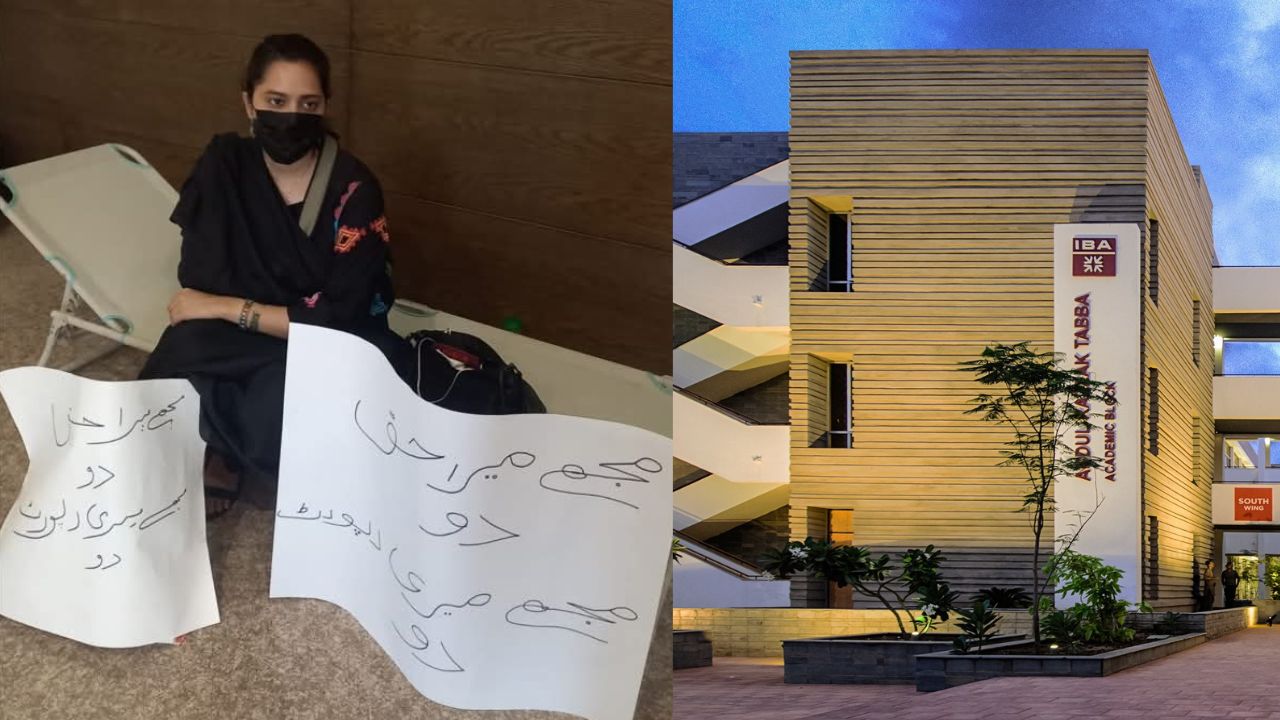


After 2.5 years of legal battle, humanities expert Zahra Sabri has won the gender discrimination case against Karachi’s Institute of Business Administration (IBA) for evicting the only two single female residents of the varsity’s Visiting Faculty Residence (VFR).
As per the details, Ombudsman Sindh on Jun 13 upheld the verdict of the institute’s Anti-Harassment Committee (AHC), mandating compensation, a formal apology and policy reforms over discrimination faced by the two women, including Zahra who, at the time, worked as a South Asian History and Literatures lecturer at IBA.
According to Zahra, in December 2022, she and her colleague were asked to vacate their accommodation on short notice of three days.
“No male or married faculty members were asked to evict,” she had stated in her complaint against the orders issued by Registrar Dr Mohammad Asad llyas and ratified by IBA’s Executive Director (ED) Dr Syed Akbar Zaidi.
She had also highlighted “unprofessional remarks” by the registrar who told Zahra and her colleague to “find a husband so that they also be allowed to stay at the VFR”.
While Zahra’s appeal against the move had led to an AHC ruling mandating compensation, apology and reforms, justice was denied following the Jan 2023 internal complaint under Pakistan’s Protection Against Harassment of Women at the Workplace Act of 2010 as IBA ED Dr Zaidi, who had been designated as the ‘competent authority’ under said act, dismissed the AHC’s rulings despite being legally obligated to implement the recommendations without alteration.
After being denied timely legal access to her AHC report, Zahra took her case to the Ombudsman Sindh. She also communally and individually wrote and reached out to a number of board members, formally bringing to their notice the on-campus violation of the law.
“They received my complaint, reviewed it, and their responses were not supportive or helpful towards me in any way at all,” Zahra tells The Current.
However, last week, the Ombudsman overturned the IBA ED’s refusal to implement the verdict as the assigned competent authority. According to the Ombudsman Sindh, Dr Zaidi, in capacity of competent authority, was obligated to implement the AHC’s recommendations within one week, with “no power to modify, alter, set-aside or refuse”, which he failed to implement, violating the rules under the Act.
According to the ruling, he also compromised his neutrality as competent authority after he appeared as a witness in the inquiry proceedings in support of the other respondent and accused, Registrar Dr Ilyas.
The Ombudsman further ruled that the IBA Board of Governors and its Human Resources (HR) committee had no legal standing to override the inquiry findings, as under the 2010 Act, only the Ombudsman has appellate authority over such decisions.
Overruling the IBA ED’s refusal from August 2023, the ombudsperson ordered varsity to appoint a new competent authority within a week to ensure the AHC’s findings were acted upon.
The order called for the implementation of AHC’s recommendations within a week, including the payment of Rs300,000 to Zahra for harassment, a written apology from IBA for gender-based discrimination, and the creation and consistent enforcement of clear, non-discriminatory housing policies.
In case of non-compliance, IBA can face contempt proceedings under Section 10(1)(vi) of the 2010 Act.
Meanwhile, the Sindh High Court (SHC) has issued notices to respondents on a petition filed by the IBA, challenging an order of the provincial ombudsman for protection against harassment of women at workplaces. The SHC has also directed that the compensation amount and apology letter not be handed over to the former lecturer until the petition is decided.
‘WEIGHT OF THE WAIT’
According to the Forum of Pakistan Ombudsman, it takes an average of 55 to 70 days to reach a decision in a case, but in practice, it can take longer — from months to even years.
It also states that no adverse action can be taken against the complainant or witnesses under Section 4(3)(d) of the Protection Against Harassment of Women at the Workplace Act, 2010.
Moreover, the employer is not allowed to create a hostile environment or pressurise the complainant, and the inquiry committee must ensure this, as outlined in Section 4(3)(e) of the same Act.
Zahra Sabri had joined IBA in Jun 2021, but her time on campus was made difficult. “I feel that the main challenge and burden of this [legal] process has been the waiting. I would call it the ‘weight of the wait,’” she says, adding that organisations often manage to create a very hostile work environment for harassment complainants in various subtle and unsubtle ways.
“It can be quite difficult for a harassment victim to have a normal and peaceful work life, as she awaits the judgment for her case,” Zahra tells The Current.
‘ZAHRA VS IBA’
In July 2023, Zahra resigned in protest against the administration's failure to support her in her legal battle. She recalls that at the time, “like all women,” she had two choices: to continue working with a “smile and bear it” or formally file a complaint against people in power, and risk retaliatory actions from senior management — even if it came at the expense of her successful career.
A male colleague publicly advised Zahra to “keep shining with charming smiles”, ignore “little things in professional life”, and focus on her “bright career path”. Others told her not to “make a noise”, lecturing her on being “patient”.
Amidst the pressure and knowing the strenuous procedure of a legal battle that was expected to affect professionally and financially, Zahra asked herself: “Would I have any right anymore to talk to students in my History/Literature classes about the importance of standing for women’s rights, when I had not even stood up for my own?”
“My choosing to stand up for the principle of women’s rights and gender equity somehow, and totally unnecessarily, made me the target of institutional retaliation,” she says.
Despite the situation becoming a “heavy burden”, Zahra refused to give up on her teaching and extracurricular educational activities on campus.
“I didn’t wish for any incident of harassment or discrimination by any male colleague to make me scale myself back as an educationist or professional in any way within the organisation.”
‘MORE THAN OP-EDS’
“Today, if we enjoy certain rights in academic workplaces, it is because certain people took time away from their academic commitments to take a stand for something right and just,” Zahra says.
She believes academia is more than just writing op-eds, books and research papers, or posting on social media about human rights. “If you don’t have what it takes to show support or action against workplace harassment and discrimination in your own work environment, then all your commentary and writings are totally worthless, not to mention hypocritical.”
According to the recently issued World Economic Forum’s (WEF) Global Gender Gap Report 2025, Pakistan ranks lowest among 148 countries with 56.7 percent gender parity. This is reportedly the highest since 2006.
“Clearly, Pakistan is a very difficult place for women to be in the workplace. It’s all the more important and urgent for our academics to be action-oriented, not just talk-oriented. It’s very, very hard, but this is what we need,” Zahra acknowledges.
The way forward, according to her, is not necessarily a deep structural reform but a more “effective implementation and oversight in the current system and structure”.
She believes that educational institutions like IBA play a crucial role in Pakistan’s public-sector institutions, having the “ability to cater to the needs of an immensely talented and promising middle-class demographic of students”.
“I believe that the university’s administrators should be putting their financial and intellectual resources to more effective and respectful use.”
'%3e%3crect%20y='0.445312'%20width='48'%20height='48'%20rx='24'%20fill='white'%20fill-opacity='0.5'/%3e%3crect%20x='0.5'%20y='0.945312'%20width='47'%20height='47'%20rx='23.5'%20stroke='%23808080'/%3e%3cpath%20d='M34.625%2024.4453L14%2024.4453'%20stroke='%23808080'%20stroke-width='0.920053'/%3e%3cpath%20d='M23.375%2034.4453L13.375%2024.4453L23.375%2014.4453'%20stroke='%23808080'%20stroke-width='0.920053'/%3e%3c/g%3e%3cdefs%3e%3cfilter%20id='filter0_b_489_44344'%20x='-12'%20y='-11.5547'%20width='72'%20height='72'%20filterUnits='userSpaceOnUse'%20color-interpolation-filters='sRGB'%3e%3cfeFlood%20flood-opacity='0'%20result='BackgroundImageFix'/%3e%3cfeGaussianBlur%20in='BackgroundImageFix'%20stdDeviation='6'/%3e%3cfeComposite%20in2='SourceAlpha'%20operator='in'%20result='effect1_backgroundBlur_489_44344'/%3e%3cfeBlend%20mode='normal'%20in='SourceGraphic'%20in2='effect1_backgroundBlur_489_44344'%20result='shape'/%3e%3c/filter%3e%3c/defs%3e%3c/svg%3e)
'%3e%3crect%20y='0.445312'%20width='48'%20height='48'%20rx='24'%20fill='white'%20fill-opacity='0.5'/%3e%3crect%20x='0.5'%20y='0.945312'%20width='47'%20height='47'%20rx='23.5'%20stroke='%23808080'/%3e%3cpath%20d='M13.375%2024.4453L34%2024.4453'%20stroke='%23808080'%20stroke-width='0.920053'/%3e%3cpath%20d='M24.625%2014.4453L34.625%2024.4453L24.625%2034.4453'%20stroke='%23808080'%20stroke-width='0.920053'/%3e%3c/g%3e%3cdefs%3e%3cfilter%20id='filter0_b_489_44344'%20x='-12'%20y='-11.5547'%20width='72'%20height='72'%20filterUnits='userSpaceOnUse'%20color-interpolation-filters='sRGB'%3e%3cfeFlood%20flood-opacity='0'%20result='BackgroundImageFix'/%3e%3cfeGaussianBlur%20in='BackgroundImageFix'%20stdDeviation='6'/%3e%3cfeComposite%20in2='SourceAlpha'%20operator='in'%20result='effect1_backgroundBlur_489_44344'/%3e%3cfeBlend%20mode='normal'%20in='SourceGraphic'%20in2='effect1_backgroundBlur_489_44344'%20result='shape'/%3e%3c/filter%3e%3c/defs%3e%3c/svg%3e)