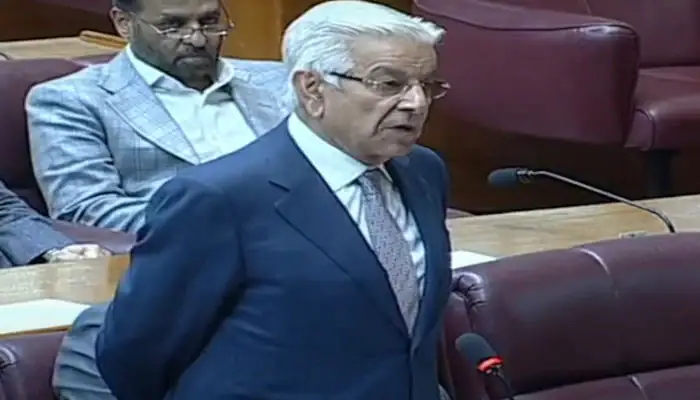
Defence Minister Khawaja Asif has stated that intelligence officials actively directed legislative discussions during the previous government’s tenure. Speaking in the National Assembly (NA), Asif claimed that meetings held at the residence of former National Assembly Speaker Asad Qaiser were monitored by personnel sent by the then-Director General of Inter-Services Intelligence (ISI), Lieutenant General (retd) Faiz Hameed.
Asif termed his disclosure a “confession by a political worker” aimed at easing his conscience. “I have great respect for Mr. Asad Qaiser. I have attended meetings at his house regarding legislation, where I personally sat there,” Asif stated. “Members of the Pakistan Peoples Party were also present, and it has come out that people sent by General Faiz were also sitting there, monitoring all our discussions, and wherever they wanted, they would steer our direction accordingly”.
According to the Defence Minister, the monitored sessions included discussions on the Anti-Money Laundering Bill alongside three or four other legislative pieces.
“This is a confession, a confession by a political worker. I am making this confession so that, at the very least, the burden on my conscience becomes a little lighter,” Asif remarked.
“But when you openly beat your chest and taunt us, do you forget that under the roof of your own house, parliamentarians, honourable parliamentarians were sitting there and discussing legislation… All of these matters were discussed under the watchful eyes of people sent by General Faiz during those days. In any case, this is a tragedy”.
Shifting to the state of the economy, Asif asserted that Pakistan has passed its financial crisis point.
“When we presented the first budget, we were insolvent. There was always the danger that we would default today or tomorrow,” he noted. “The International Monetary Fund (IMF) bailed us out with strict conditions, which we are now bearing but we have become solvent. Our economy is breathing; it has left the ICU”.
He projected a potential economic growth rate of six to seven percent within the next two years.
To sustain the trajectory, Asif called for a restructured taxation system, arguing that the elimination of “inbuilt taxes” and the implementation of lower, non-prohibitive tax rates would discourage tax evasion.
Asif also discussed Pakistan’s diplomatic involvement in facilitating an agreement between the United States (US) and Iran. He credited the military leadership, the Prime Minister, and the state team for the diplomatic outcome, remarking, “I think the whole nation should be thankful to them, because they steered us through an issue that seemed impossible. They made the impossible possible”.
He also pointed out that Indian Prime Minister Narendra Modi omitted mentioning Pakistan’s role when congratulating US President Donald Trump on the accord.