
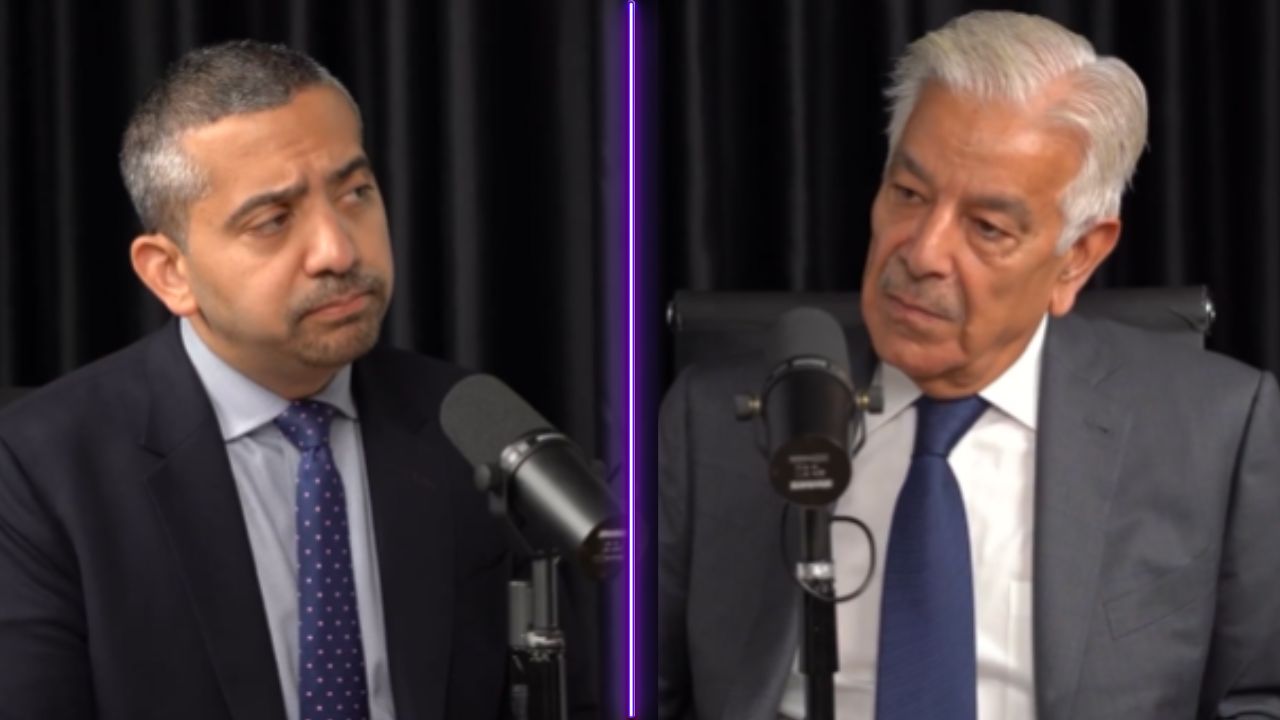


Defence Minister Khawaja Asif has claimed that the incarceration of former premier and Patron in Chief of Pakistan Tehreek-e-Insaf (PTI) Imran Khan is not for “a tit for tat” measure.
During an interview posted on Zeteo on Friday, journalist Mehdi Hassan asked Asif, “Are you banning and cracking down on the PTI because you are worried about how popular they are?” In response, Asif stated that he was not denying the popularity factor.
However, he stated that over the last two and a half years, the popularity [of PTI] has definitely gone down because of the country’s economic recovery. "And things are much more orderly since the last elections.”
The defence czar told the journalist that he had been in prison “for six months without any charge”.
Hasan's question, “If it was unjust to you, is it not unjust to [Imran] Khan?” prompted Asif to say that he was not saying that the imprisonment of Khan “is a tit for tat” measure.
However, Hasan then pointed out that Amnesty International had released a report on Imran’s arrest, while a United Nations group had said that there was no legal basis for Imran’s imprisonment and termed it arbitrary. To that, the defence minister said, “Well, I think they have an opinion with which I disagree.”
“Pakistan has a situation whereby we are trying to recover from a very, very, misrule or bad rule or whatever you can call it — for three-and-a-half years,” Asif noted.
Defence pact with Saudi Arabia
Asif said that the recently signed Strategic Mutual Defence Pact between Pakistan and the Kingdom of Saudi Arabia (KSA) had “formalized” a relationship between the two countries that was previously “a bit transactional”.
The development had come in the wake of Israeli strikes on Qatar’s capital, Doha, on September 09. The signing of the pact was announced in a statement issued from the Prime Minister's Office (PMO) last week, stating that “any aggression against either country shall be considered an act of aggression against both”.
On being asked, “How much of it is a reaction to the Israeli bombing of Qatar?” Asif said, “It is not a reaction to what happened in Qatar because this was being negotiated for quite some time. So it’s not a reaction; perhaps it must have sped it up a bit but that is all. It was already in the offing.”
Hasan then pointed out that Pakistan was the only nuclear power in the Muslim world, noting that the Kingdom had expressed interest in being the second. He also pointed out that Asif had previously stated that nuclear weapons “were not on the radar” for this pact.
“Is Saudi Arabia protected by Pakistan’s nuclear umbrella per this agreement or not?” he asked.
“We have had a very long defence relationship with Saudi Arabia, spanning five or six decades. We had a military presence over there, perhaps more than four or five thousand at the peak and we still have a military presence over there. I think we have just formalised that relationship which was previously a bit transactional,” Asif responded.
“Formalised with or without the nukes?” Hasan probed. Asif said, “I will refrain from going into the details, but it’s a defence pact and defence pacts are normally not discussed publicly.”
Hasan then pointed out that journalist Bob Woodward, who in his 2024 book War, had quoted Saudi Crown Prince Mohammed Bin Salman (MBS) telling a US senator that he could “just buy” a bomb from Pakistan.
“I think that is just sensationalised […] No, I don’t believe that quote,” the minister replied.
When asked by the journalist whether Pakistan’s "strategic" future is with China or the United States (US), the minister, citing the major export of arms from China, stated that the latter country is “reliable and they are our neighbours. We share borders and we share geography.”
'%3e%3crect%20y='0.445312'%20width='48'%20height='48'%20rx='24'%20fill='white'%20fill-opacity='0.5'/%3e%3crect%20x='0.5'%20y='0.945312'%20width='47'%20height='47'%20rx='23.5'%20stroke='%23808080'/%3e%3cpath%20d='M34.625%2024.4453L14%2024.4453'%20stroke='%23808080'%20stroke-width='0.920053'/%3e%3cpath%20d='M23.375%2034.4453L13.375%2024.4453L23.375%2014.4453'%20stroke='%23808080'%20stroke-width='0.920053'/%3e%3c/g%3e%3cdefs%3e%3cfilter%20id='filter0_b_489_44344'%20x='-12'%20y='-11.5547'%20width='72'%20height='72'%20filterUnits='userSpaceOnUse'%20color-interpolation-filters='sRGB'%3e%3cfeFlood%20flood-opacity='0'%20result='BackgroundImageFix'/%3e%3cfeGaussianBlur%20in='BackgroundImageFix'%20stdDeviation='6'/%3e%3cfeComposite%20in2='SourceAlpha'%20operator='in'%20result='effect1_backgroundBlur_489_44344'/%3e%3cfeBlend%20mode='normal'%20in='SourceGraphic'%20in2='effect1_backgroundBlur_489_44344'%20result='shape'/%3e%3c/filter%3e%3c/defs%3e%3c/svg%3e)
'%3e%3crect%20y='0.445312'%20width='48'%20height='48'%20rx='24'%20fill='white'%20fill-opacity='0.5'/%3e%3crect%20x='0.5'%20y='0.945312'%20width='47'%20height='47'%20rx='23.5'%20stroke='%23808080'/%3e%3cpath%20d='M13.375%2024.4453L34%2024.4453'%20stroke='%23808080'%20stroke-width='0.920053'/%3e%3cpath%20d='M24.625%2014.4453L34.625%2024.4453L24.625%2034.4453'%20stroke='%23808080'%20stroke-width='0.920053'/%3e%3c/g%3e%3cdefs%3e%3cfilter%20id='filter0_b_489_44344'%20x='-12'%20y='-11.5547'%20width='72'%20height='72'%20filterUnits='userSpaceOnUse'%20color-interpolation-filters='sRGB'%3e%3cfeFlood%20flood-opacity='0'%20result='BackgroundImageFix'/%3e%3cfeGaussianBlur%20in='BackgroundImageFix'%20stdDeviation='6'/%3e%3cfeComposite%20in2='SourceAlpha'%20operator='in'%20result='effect1_backgroundBlur_489_44344'/%3e%3cfeBlend%20mode='normal'%20in='SourceGraphic'%20in2='effect1_backgroundBlur_489_44344'%20result='shape'/%3e%3c/filter%3e%3c/defs%3e%3c/svg%3e)