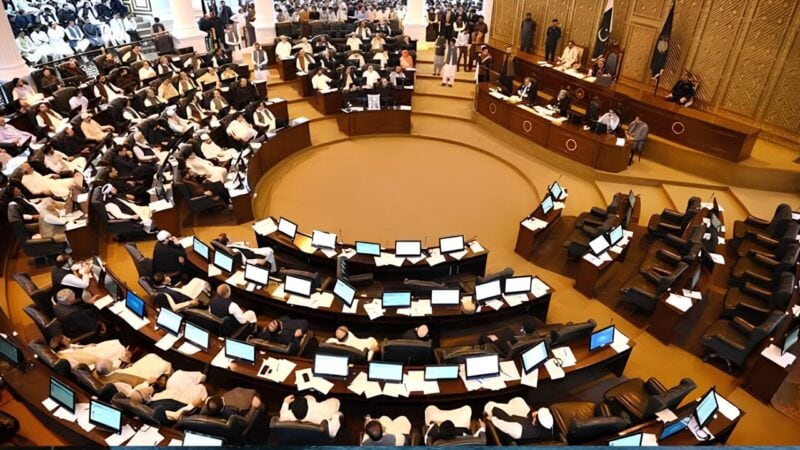
The Khyber Pakhtunkhwa (KP) government has enacted the KP Provincial Assembly (Powers, Immunities and Privileges) Act, 2026, a legislative move that significantly consolidates and expands the authority of provincial lawmakers.
Passed on April 30 and assented to by the Governor on May 6, the Act has drawn scrutiny for remaining largely inaccessible to the public, with neither the text nor the official gazette notifications uploaded to the assembly’s website to date.
The legislation repeals the 1988 law on the same subject, though it retains many foundational provisions while introducing specific expansions to the privileges of Members of the Provincial Assembly (MPAs).
Under Section 8, the Act grants members the power to summon government officers to meetings within their constituencies. Crucially, Section 8(2) makes it mandatory for the summoned official to attend, and Section 8(3) dictates that any failure to appear without “sufficient cause” constitutes a formal breach of privilege.
Legal protections for lawmakers have also been tightened. Section 10 provides members with blanket immunity from preventive detention, superseding other prevailing laws.
Furthermore, Section 11 mandates that authorities must obtain prior permission from the Assembly Speaker before arresting any member on a criminal charge. The Speaker is granted discretionary power under Section 11(2) to demand police reports or initiate inquiries into the facts of a case before any challan is submitted to the court.
Personal entitlements under the Act, detailed largely in Section 14, have been broadened to include the issuance of lifetime official passports for MPAs and their spouses, as well as the provision of assembly identity cards to spouses that must be recognised by law enforcement agencies.
MPAs are now entitled to licences for eight non-prohibited-bore weapons an increase from the four previously allowed, and gain access to VIP airport lounges, club memberships at government rates, and vehicles equipped with tinted or darkened screens.
Members are also provided with Category-B security, which can be upgraded to Category-A based on threat assessments and retained throughout Pakistan, including Azad Jammu and Kashmir and Gilgit-Baltistan.
Alongside these perks, the Act implements rigorous punitive measures. It codifies significant fines and prison terms for those found guilty of breaching assembly privileges, including the publication of “distorted” reports regarding proceedings, the disclosure of confidential committee documents, or the defamation of the assembly’s dignity.