
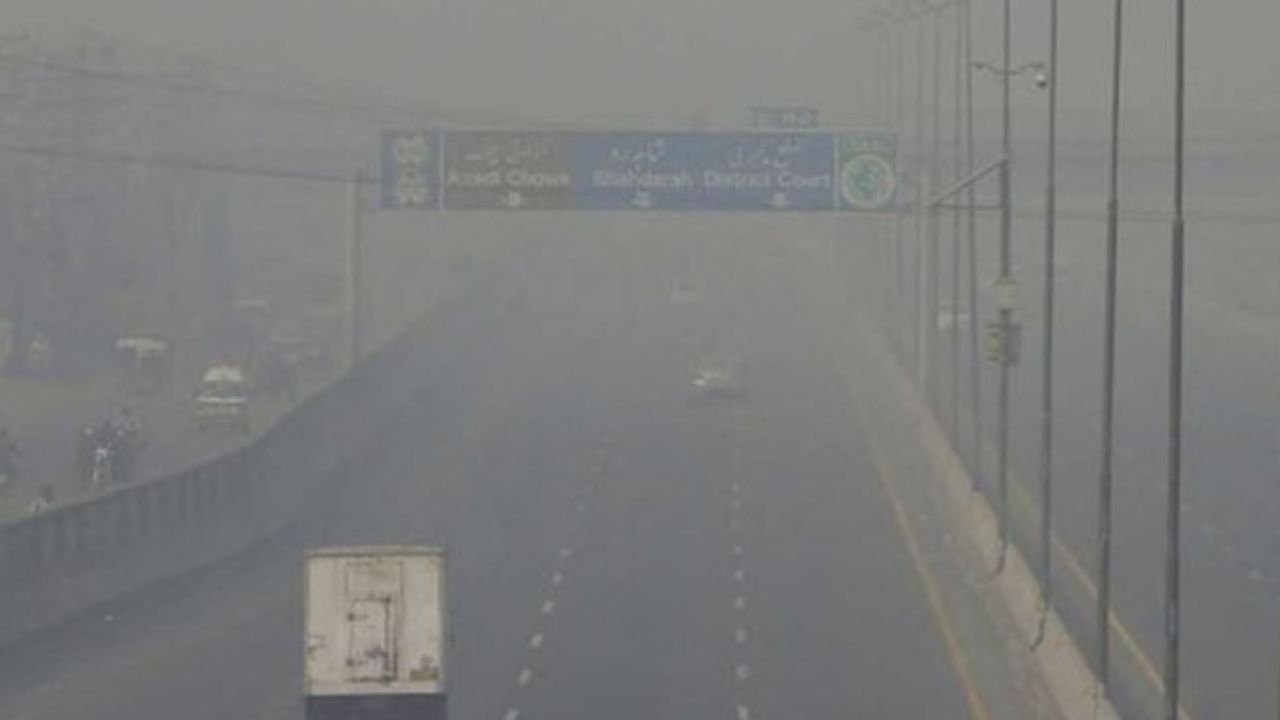


Lahore was ranked as the world’s most polluted major city on Monday morning as dipping temperatures worsened air quality to “very unhealthy” levels, fata from IQAir has shown.
The city's Air Quality Index (AQI⁺) was 297 at around 8 a.m., and PM2.5 levels were 222.5 micrograms per cubic meter, which is almost 44.5 times higher than the WHO's recommended annual limit. Children, the elderly, and those with respiratory diseases are especially at risk from fine particulate matter, which is tiny enough to reach the bloodstream.
Mumbai (182) and New Delhi (287) were also in the top three on the worldwide pollution table. Three Indian cities were in the top five, while other cities in the top 10 were Kolkata (158), Tashkent (158), Jakarta (154), Dhaka (152), and Dubai (152).
The average AQI in Lahore on Sunday was 160, which is considered "unhealthy." The most common pollutant, according to IQAir, was PM2.5, which was 13.7 times higher than the WHO guideline value.
The Lahore Development Authority and Metropolitan Corporation Lahore, among other civic organizations, failed to enforce effective anti-smog measures amid continuous development and construction activities, according to environmental experts, which is why PM2.5 levels remained high.
They called on Chief Minister Maryam Nawaz to immediately halt major construction and infrastructure projects in Lahore and other cities, warning that without urgent steps, “the situation will continue to worsen.”
Meanwhile, Punjab Senior Minister Marriyum Aurangzeb said nine provincial departments had launched a “grand operation” to tackle smog. She claimed that coordinated government efforts and public cooperation had helped bring AQI levels “under control.”
According to Aurangzeb, environmental protection teams were
working in the field, drones were monitoring brick kilns, and daily reports were being released.
She added that smog guns and air quality monitors had been deployed, and for the first time, a unified government strategy was being implemented to manage pollution levels in line with forecasts.
She further said a modern meteorological data centre was identifying high-pollution areas in advance, allowing targeted action in “smog hotspots.” Construction material was being covered, traffic police were restricting heavy vehicles during the day, and multiple agencies including WASA Lahore, LDA, PHA, C&W, and the Agriculture Department had begun enforcement operations and a crackdown on crop residue burning across Punjab.
Lahore's air quality has been steadily declining every winter in the period between October and February, making it one of the most polluted cities in the world. Burning crop residue, sluggish weather, and emissions from automobiles, factories, brick kilns, and construction projects are all contributing factors to this seasonal surge.
Air quality has also gotten worse as a result of trees being cut down for new infrastructure projects.
Temperature inversion is a climatic phenomena that intensifies smog during the winter by trapping pollutants close to the ground.
Lahore's AQI peaked at a dangerous 1,110 on November 14 of last year, according to IQAir, with PM2.5 levels hitting 632 micrograms per cubic meter. The alarming figures led the provincial government to declare a health emergency, close schools, shift university classes online, and impose a construction ban to ease the crisis.
Experts have warned that this year’s PM2.5 concentrations have already surpassed hazardous levels, marking some of the city’s worst readings in five years.
'%3e%3crect%20y='0.445312'%20width='48'%20height='48'%20rx='24'%20fill='white'%20fill-opacity='0.5'/%3e%3crect%20x='0.5'%20y='0.945312'%20width='47'%20height='47'%20rx='23.5'%20stroke='%23808080'/%3e%3cpath%20d='M34.625%2024.4453L14%2024.4453'%20stroke='%23808080'%20stroke-width='0.920053'/%3e%3cpath%20d='M23.375%2034.4453L13.375%2024.4453L23.375%2014.4453'%20stroke='%23808080'%20stroke-width='0.920053'/%3e%3c/g%3e%3cdefs%3e%3cfilter%20id='filter0_b_489_44344'%20x='-12'%20y='-11.5547'%20width='72'%20height='72'%20filterUnits='userSpaceOnUse'%20color-interpolation-filters='sRGB'%3e%3cfeFlood%20flood-opacity='0'%20result='BackgroundImageFix'/%3e%3cfeGaussianBlur%20in='BackgroundImageFix'%20stdDeviation='6'/%3e%3cfeComposite%20in2='SourceAlpha'%20operator='in'%20result='effect1_backgroundBlur_489_44344'/%3e%3cfeBlend%20mode='normal'%20in='SourceGraphic'%20in2='effect1_backgroundBlur_489_44344'%20result='shape'/%3e%3c/filter%3e%3c/defs%3e%3c/svg%3e)
'%3e%3crect%20y='0.445312'%20width='48'%20height='48'%20rx='24'%20fill='white'%20fill-opacity='0.5'/%3e%3crect%20x='0.5'%20y='0.945312'%20width='47'%20height='47'%20rx='23.5'%20stroke='%23808080'/%3e%3cpath%20d='M13.375%2024.4453L34%2024.4453'%20stroke='%23808080'%20stroke-width='0.920053'/%3e%3cpath%20d='M24.625%2014.4453L34.625%2024.4453L24.625%2034.4453'%20stroke='%23808080'%20stroke-width='0.920053'/%3e%3c/g%3e%3cdefs%3e%3cfilter%20id='filter0_b_489_44344'%20x='-12'%20y='-11.5547'%20width='72'%20height='72'%20filterUnits='userSpaceOnUse'%20color-interpolation-filters='sRGB'%3e%3cfeFlood%20flood-opacity='0'%20result='BackgroundImageFix'/%3e%3cfeGaussianBlur%20in='BackgroundImageFix'%20stdDeviation='6'/%3e%3cfeComposite%20in2='SourceAlpha'%20operator='in'%20result='effect1_backgroundBlur_489_44344'/%3e%3cfeBlend%20mode='normal'%20in='SourceGraphic'%20in2='effect1_backgroundBlur_489_44344'%20result='shape'/%3e%3c/filter%3e%3c/defs%3e%3c/svg%3e)