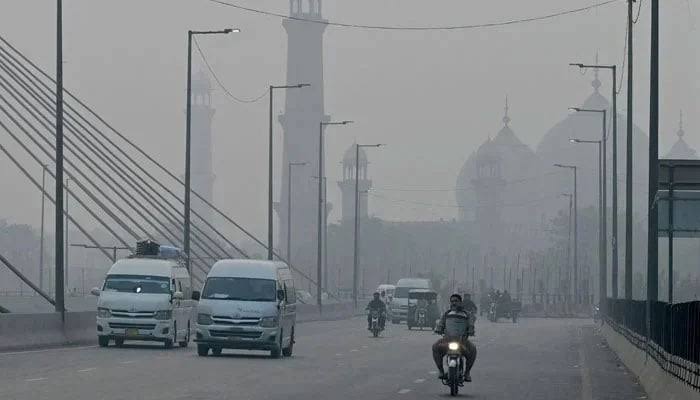
Lahore ranked as the world’s most polluted major city on Monday morning, with an Air Quality Index (AQI) of 535, placing it ahead of Cairo in second position and Delhi in third, as pollution levels in the provincial capital entered the hazardous category.
IQAir recorded Lahore’s AQI at 8am, with PM2.5 concentrations reaching 343 micrograms per cubic metre. The city’s air quality had deteriorated during the early morning, with hourly readings also entering the hazardous range.
The Air Quality Index (AQI) in Lahore crossed 530 on Monday morning, with PM2.5 concentrations reaching 343 micrograms per cubic metre, as the city recorded hazardous air quality amid an increase in agricultural fires across Punjab.
IQAir recorded Lahore’s AQI at 535 at 8am, placing it in the hazardous category. The reading followed early morning deterioration, with hourly measurements also entering the hazardous range.
The rise in pollution was not limited to the provincial capital. Five Punjab cities featured among Pakistan’s six most polluted urban centres in IQAir’s live ranking on Monday morning.
Gujranwala recorded an AQI of 606, followed by Lahore at 509. Faisalabad and Multan both registered 310, while Sialkot recorded 260. Peshawar ranked sixth with an AQI of 216. Subsequent hourly updates placed Gujranwala’s reading at 675 and Lahore’s at 535.
Agricultural fires across Punjab emerged as one of the factors adding to the pollution burden in Lahore and surrounding areas.
An analysis published by environmental monitoring website HamariHawa found that NASA satellites detected 13,241 fire spots in Pakistani Punjab between October 1 and 29, compared with 3,158 in Indian Punjab. The number of detections in Pakistani Punjab was 4.2 times higher.
Around 92 percent of the detected fires in Pakistani Punjab were located on farmland, likely associated with crop-residue burning.
The analysis recorded 6,655 fire spots during the final seven days of October, accounting for around half of the monthly total. October 29 recorded the highest number, with 1,327 detections.
Okara had the highest number of fire spots at 2,144, followed by Gujranwala with 1,011 and Nankana Sahib with 1,003.
Smoke from agricultural fires in the rice-growing areas surrounding Lahore adds to emissions from vehicles, industries and other sources. Weak winds and atmospheric inversions can also prevent pollutants from dispersing, trapping them close to the ground.
Meanwhile, a Pakistan Air Quality Initiative (PAQI) analysis offered a different assessment of Lahore’s air quality during October, when the provincial government described the month as the city’s cleanest October in five years.
PAQI found that average PM2.5 concentrations across 26 monitoring sites declined by 27 percent in October 2026 compared with October last year. However, after adjusting for weather conditions, the improvement stood at just four percent.