
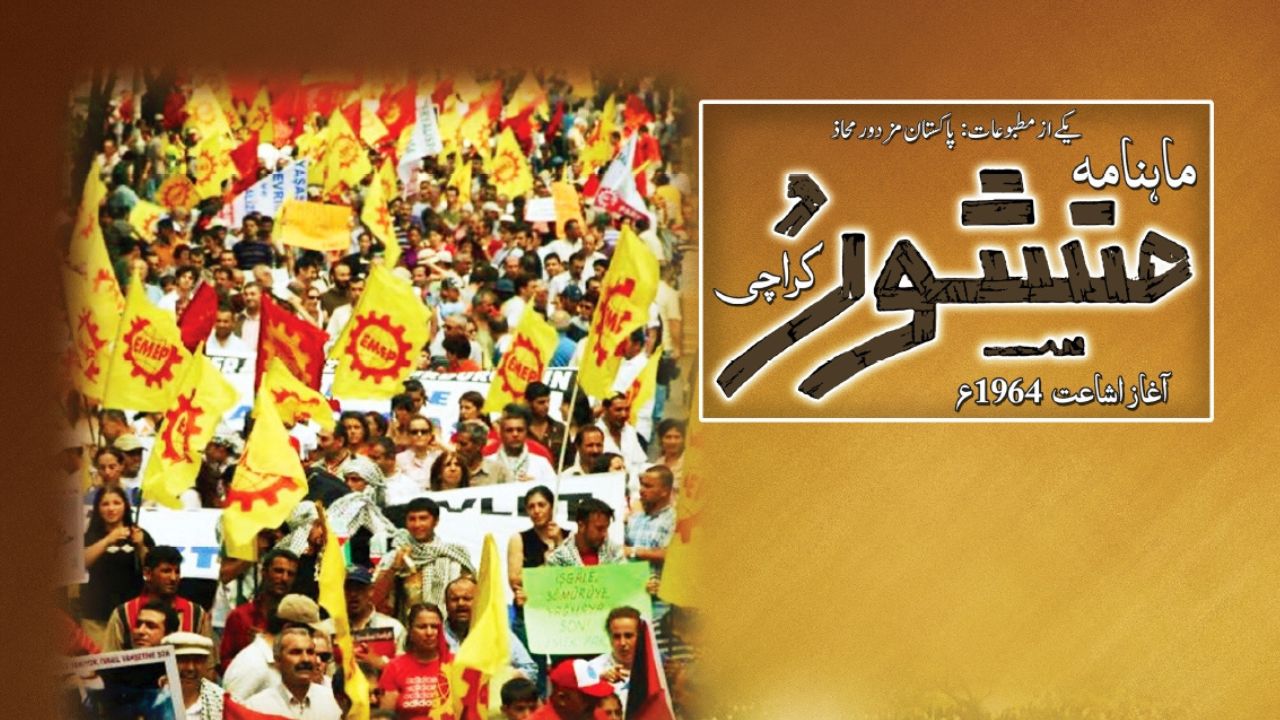


In the ever-changing landscape of Pakistani media, where publications often come and go with the winds of censorship, corporate funding or political shifts, Monthly Manshoor stands tall — not as a relic of the past, but as a stubborn, breathing witness to history. It is, quite literally, the oldest continuously published left-wing magazine in Pakistan. But Manshoor is more than just a magazine. It’s a living testament to ideological resilience, intellectual defiance and an unwavering commitment to socialist thought in a country where such words are often met with suspicion, if not outright hostility.
Born in Struggle, Raised in Shadows
Manshoor didn’t start in some polished newsroom. It was born out of the labour movement — specifically as the publication of the Airways Employees Union, under the leadership of Comrade Tufail Abbas.
This was the Cold War era, when being a communist in Pakistan wasn’t just unfashionable — it was dangerous. With the state hunting reds under every bed, Manshoor served as an underground voice for the Communist Party of Pakistan. Its pages carried the hopes and frustrations of an entire generation of revolutionaries who organized in backrooms, held secret meetings, and distributed literature under cover of darkness.
Among its early torchbearers were legendary figures like Hassan Nasir, who died under torture in the Lahore Fort dungeons during General Ayub Khan’s dictatorship, and comrades like Zaki Abbas, Shafiq and Azhar Abbas, whose lives were intertwined with the communist and labour struggles of the time.
Ideological Evolution: From Moscow to Tirana
In its early days, Manshoor followed the global communist playbook with the Soviet Union as its compass. But the Pakistani left, like the international left, was never a monolith. When the ideological earthquake of the Sino-Soviet split hit in the 1960s, the comrades behind Manshoor pivoted toward Mao Zedong’s China. This Maoist phase was marked by revolutionary zeal and radical clarity.
But revolutions age, and so do ideologies. When China began to soften — opening markets and shaking hands with the West — the Manshoor collective didn’t follow. Instead, their gaze shifted to Albania, then the last stronghold of what they saw as pure Marxist-Leninist thought. Inspired by Enver Hoxha’s hardline anti-revisionist stance, Manshoor embraced Hoxhaism — a rare path, but one they’ve followed with intellectual honesty ever since.
This ideological evolution wasn’t just theoretical. It defined the magazine’s tone, content and political commitments. From that point on, Manshoor became the official organ of the Pakistan Mazdoor Mahaz, a far-left workers’ front that remains firmly rooted in classical Marxist-Leninist principles. Joseph Stalin, for them, isn’t a controversial figure but a symbol of uncompromising leadership.
Surviving Where Others Folded
Through military dictatorships, populist regimes, Islamic radicalisation, and wave after wave of neoliberal reforms, Manshoor never caved. While other leftist publications died quiet deaths — some due to state repression, others due to internal contradictions or lack of readership — Manshoor kept going. Sometimes with just enough resources to scrape by. Often unnoticed by the mainstream. But never silent.
Its pages became a space for critique — of capitalism, imperialism and the Pakistani state’s entanglements with both. It translated Marxist classics, dissected global political shifts, and offered counter-narratives to those promoted by textbooks, TV channels and government think-tanks.
In doing so, it helped nurture generations of politically aware readers — students, workers, unionists and thinkers — who saw in Manshoor not just a magazine, but a political home.
The Present — and the Fight Ahead
Today, Manshoor continues its quiet but firm journey under the leadership of Chief Editor Kamran Abbas, a lifelong leftist deeply rooted in Pakistan’s progressive traditions.
“I believe that without understanding Marxism, one cannot truly understand life, society or the structures that sustain exploitation,” Abbas tells The Current.
Alongside him are Editor Shaukat Ali Chaudhry and Managing Editor Yameen Jatoi, whose recent efforts have helped revive the magazine after a brief hiccup in its publishing.
Their collective is small. The resources are thin. But the commitment? Rock solid.
In a world increasingly shaped by algorithmic distractions, ideological fatigue and a media environment that rarely tolerates nuance, Manshoor’s existence is, in itself, an act of resistance.
It doesn’t chase clicks or trends on X. It doesn’t dilute its message to stay palatable. It just continues to do what it has always done: speak truth to power, offer critical thought and keep the flame of leftist politics alive in Pakistan.
So the next time someone tells you that socialism is dead, or that Pakistan has no space for progressive ideas — point them toward Manshoor. It’s not just surviving. It’s enduring.
And in that endurance lies its quiet, revolutionary power.
'%3e%3crect%20y='0.445312'%20width='48'%20height='48'%20rx='24'%20fill='white'%20fill-opacity='0.5'/%3e%3crect%20x='0.5'%20y='0.945312'%20width='47'%20height='47'%20rx='23.5'%20stroke='%23808080'/%3e%3cpath%20d='M34.625%2024.4453L14%2024.4453'%20stroke='%23808080'%20stroke-width='0.920053'/%3e%3cpath%20d='M23.375%2034.4453L13.375%2024.4453L23.375%2014.4453'%20stroke='%23808080'%20stroke-width='0.920053'/%3e%3c/g%3e%3cdefs%3e%3cfilter%20id='filter0_b_489_44344'%20x='-12'%20y='-11.5547'%20width='72'%20height='72'%20filterUnits='userSpaceOnUse'%20color-interpolation-filters='sRGB'%3e%3cfeFlood%20flood-opacity='0'%20result='BackgroundImageFix'/%3e%3cfeGaussianBlur%20in='BackgroundImageFix'%20stdDeviation='6'/%3e%3cfeComposite%20in2='SourceAlpha'%20operator='in'%20result='effect1_backgroundBlur_489_44344'/%3e%3cfeBlend%20mode='normal'%20in='SourceGraphic'%20in2='effect1_backgroundBlur_489_44344'%20result='shape'/%3e%3c/filter%3e%3c/defs%3e%3c/svg%3e)
'%3e%3crect%20y='0.445312'%20width='48'%20height='48'%20rx='24'%20fill='white'%20fill-opacity='0.5'/%3e%3crect%20x='0.5'%20y='0.945312'%20width='47'%20height='47'%20rx='23.5'%20stroke='%23808080'/%3e%3cpath%20d='M13.375%2024.4453L34%2024.4453'%20stroke='%23808080'%20stroke-width='0.920053'/%3e%3cpath%20d='M24.625%2014.4453L34.625%2024.4453L24.625%2034.4453'%20stroke='%23808080'%20stroke-width='0.920053'/%3e%3c/g%3e%3cdefs%3e%3cfilter%20id='filter0_b_489_44344'%20x='-12'%20y='-11.5547'%20width='72'%20height='72'%20filterUnits='userSpaceOnUse'%20color-interpolation-filters='sRGB'%3e%3cfeFlood%20flood-opacity='0'%20result='BackgroundImageFix'/%3e%3cfeGaussianBlur%20in='BackgroundImageFix'%20stdDeviation='6'/%3e%3cfeComposite%20in2='SourceAlpha'%20operator='in'%20result='effect1_backgroundBlur_489_44344'/%3e%3cfeBlend%20mode='normal'%20in='SourceGraphic'%20in2='effect1_backgroundBlur_489_44344'%20result='shape'/%3e%3c/filter%3e%3c/defs%3e%3c/svg%3e)
