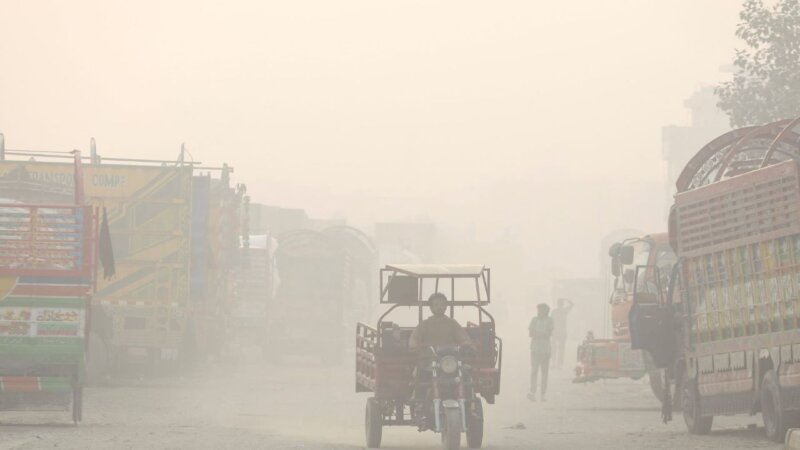
The Punjab government has called for keeping politics out of discussions on smog, environmental protection and public health, stressing that these issues directly affect the lives and health of millions of people.
“Smog is not a political issue. It is a scientific, environmental and public health challenge,” senior minister Marriyum Aurangzeb said at a press conference on Wednesday, as Lahore, Multan and other cities across the province continued to face smog.
Lahore remained at the top of the global ranking of major polluted cities on Wednesday night, with an air quality index (AQI) of 358.
New Delhi, which ranked second with an AQI of 248, also faced pollution levels that overwhelmed air quality monitoring equipment. According to reports, the monitors could not record the full extent of pollution for several hours between Sunday night and Monday after pollutant concentrations exceeded their measurement limits during Diwali fireworks.
Earlier, Aurangzeb had blamed fireworks during Diwali in India for the smog over Punjab. The Punjab Environment Protection Agency (EPA), in its assessment of the Diwali period, also found that air pollution from India had travelled into the province and contributed to higher Particulate Matter (PM) levels.
The agency estimated that air originating in India affected around 50 percent of Punjab during the preceding 24 hours. Its forward-trajectory modelling showed that air released across the border on Diwali night could reach Lahore from Amritsar in two hours, Faisalabad in 12 hours and Multan in around 11 hours.
EPA monitoring stations also recorded differences in pollution levels across Lahore. PM2.5 concentrations at the Wagah Border station increased by 275 percent, with the highest levels recorded between 3am and 4am. Safari Park, in the western part of the city, recorded an increase of 15 percent.
The agency linked the difference to easterly winds carrying pollution from across the border. Its analysis showed that Lahore’s AQI rose from 366 on November 8 to 440 on November 9, reaching its highest level at 9am.
However, the findings did not establish cross-border pollution as the only source, as local emissions and weather conditions also affected air quality.
Smog also forced motorway closures earlier in the week, including the Shamkot-Abdul Hakeem section and heavy traffic movement on the Sher Shah-Multan section towards Khanewal, a motorway police spokesperson told Dawn.
Aurangzeb added that Punjab had lacked an integrated system for smog monitoring and management before 2024.
“Today, under Chief Minister Maryam Nawaz, Punjab has established an evidence-based, technology-driven system that identifies pollution sources, monitors emissions, predicts environmental conditions and ensures immediate enforcement action,” she stated.