
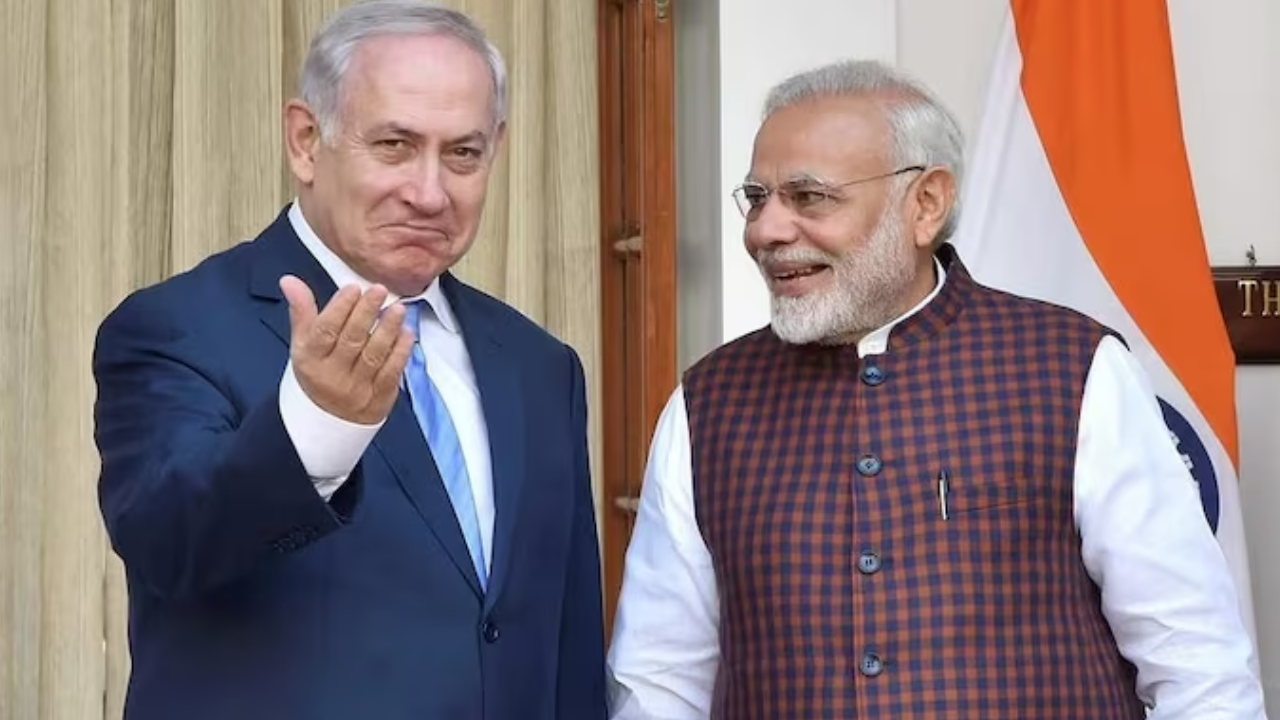


In a move that has sent shockwaves through the diplomatic corridors of the Islamic world, Israeli Prime Minister (PM) Benjamin Netanyahu has unveiled a strategic blueprint for a new regional bloc termed the “Hexagon of Alliances”.
Speaking ahead of his Indian counterpart Narendra Modi’s historic visit to Tel Aviv, Netanyahu described an axis centered on Israel and India, designed to reshape the Middle East by explicitly targeting what he called the “radical” components of the Muslim world.
This “Hexagon” is envisioned as a six-pointed security and economic framework involving Israel, India, Greece and Cyprus along with currently unnamed states in the Arab world, Africa and Asia.
Netanyahu’s framing of the alliance has drawn immediate fire for its sectarian undertones as he characterised the bloc as a necessary shield against a “radical Shia axis” led by Iran and more controversially an “emerging radical Sunni axis”.
“The intention here is to create an axis of nations that see eye-to-eye on the reality, challenges and goals against radicalism,” reports quoted Netanyahu as saying during a cabinet meeting.
While both Netanyahu and Modi, during the latter’s visit, have described their partnership as a “powerful alliance between two global leaders”, signaling a shift from transactional defence deals to a rigid ideological partnership of “great importance”, for many in the Muslim world, the “Hexagon” is viewed less as a security pact and more as a direct challenge to the Muslim Ummah.
This perception has been exacerbated by Israel’s recent diplomatic maneuvers, specifically its December 2025 decision to become the first nation to formally recognise Somaliland as an independent state.
The move was widely condemned by the Organisation of Islamic Cooperation (OIC) as a blatant attempt to fragment a sovereign Muslim nation and secure a strategic foothold in the Red Sea.
Analysts point out that Netanyahu’s “radical Sunni axis” label appears to be a swipe at major regional powers like Turkiye, Saudi Arabia and Egypt, who have recently coordinated diplomatically to condemn Israeli military actions in Gaza and Syria.
The practical feasibility of the Hexagon remains in doubt. Two of the named members, Greece and Cyprus, are signatories to the International Criminal Court (ICC), which has an active arrest warrant for Netanyahu for war crimes.
Legally, should the Israeli PM set foot in these “allied” nations, they would be obligated to arrest him. Furthermore, India’s involvement presents a complex balancing act; while New Delhi seeks Israeli technology and AI collaboration, it remains heavily dependent on energy ties and strategic projects with Iran and the wider Arab world.
In Pakistan, the reaction has been one of total rejection. The Senate has unanimously passed a resolution this week denouncing the anti-Muslim alliance, warning that Netanyahu’s rhetoric seeks to divide the Muslim Ummah on political and ideological grounds.
The resolution has highlighted that such provocative narratives threaten global stability and ignore the growing international isolation of the Israeli government.
As the “Hexagon” takes center stage during Modi's visit, the Middle East finds itself at a crossroads. While Netanyahu pitches a vision of “innovation and stability”, much of the world sees a desperate branding exercise a fantasy world alliance that risks further polarising a region already on the brink.
'%3e%3crect%20y='0.445312'%20width='48'%20height='48'%20rx='24'%20fill='white'%20fill-opacity='0.5'/%3e%3crect%20x='0.5'%20y='0.945312'%20width='47'%20height='47'%20rx='23.5'%20stroke='%23808080'/%3e%3cpath%20d='M34.625%2024.4453L14%2024.4453'%20stroke='%23808080'%20stroke-width='0.920053'/%3e%3cpath%20d='M23.375%2034.4453L13.375%2024.4453L23.375%2014.4453'%20stroke='%23808080'%20stroke-width='0.920053'/%3e%3c/g%3e%3cdefs%3e%3cfilter%20id='filter0_b_489_44344'%20x='-12'%20y='-11.5547'%20width='72'%20height='72'%20filterUnits='userSpaceOnUse'%20color-interpolation-filters='sRGB'%3e%3cfeFlood%20flood-opacity='0'%20result='BackgroundImageFix'/%3e%3cfeGaussianBlur%20in='BackgroundImageFix'%20stdDeviation='6'/%3e%3cfeComposite%20in2='SourceAlpha'%20operator='in'%20result='effect1_backgroundBlur_489_44344'/%3e%3cfeBlend%20mode='normal'%20in='SourceGraphic'%20in2='effect1_backgroundBlur_489_44344'%20result='shape'/%3e%3c/filter%3e%3c/defs%3e%3c/svg%3e)
'%3e%3crect%20y='0.445312'%20width='48'%20height='48'%20rx='24'%20fill='white'%20fill-opacity='0.5'/%3e%3crect%20x='0.5'%20y='0.945312'%20width='47'%20height='47'%20rx='23.5'%20stroke='%23808080'/%3e%3cpath%20d='M13.375%2024.4453L34%2024.4453'%20stroke='%23808080'%20stroke-width='0.920053'/%3e%3cpath%20d='M24.625%2014.4453L34.625%2024.4453L24.625%2034.4453'%20stroke='%23808080'%20stroke-width='0.920053'/%3e%3c/g%3e%3cdefs%3e%3cfilter%20id='filter0_b_489_44344'%20x='-12'%20y='-11.5547'%20width='72'%20height='72'%20filterUnits='userSpaceOnUse'%20color-interpolation-filters='sRGB'%3e%3cfeFlood%20flood-opacity='0'%20result='BackgroundImageFix'/%3e%3cfeGaussianBlur%20in='BackgroundImageFix'%20stdDeviation='6'/%3e%3cfeComposite%20in2='SourceAlpha'%20operator='in'%20result='effect1_backgroundBlur_489_44344'/%3e%3cfeBlend%20mode='normal'%20in='SourceGraphic'%20in2='effect1_backgroundBlur_489_44344'%20result='shape'/%3e%3c/filter%3e%3c/defs%3e%3c/svg%3e)