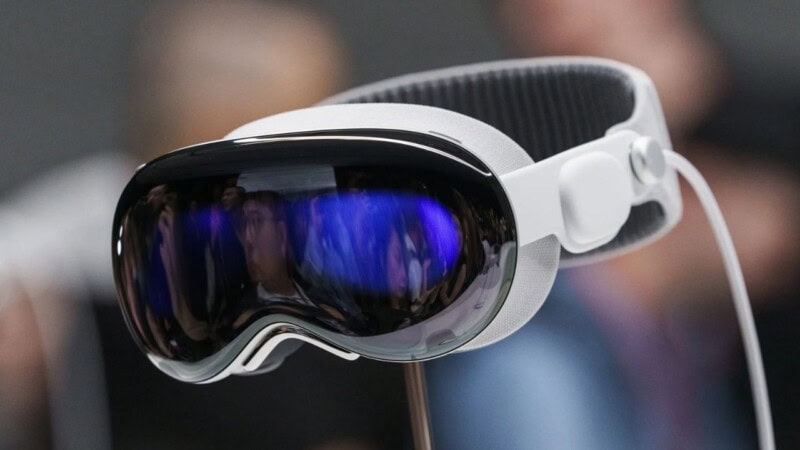
What if you could navigate a digital world solely with your thoughts? No hand gestures, no voice commands; just pure, neural intent.
At 64, Mark – an ALS patient who lost function in his upper limbs due to deteriorating muscle function – became the first person to do just that, thanks to the integration of Synchron’s brain-computer interface (BCI) with the Apple Vision Pro to send texts, play online solitaire and watch immersive Apple TV. More recently, Synchron – an American neurotech company – took this synchronisation even further, adding NVIDIA’s AI Holoscan technology to allow Rodney, another ALS patient, to control digital home appliances without lifting a finger. From turning on the fan to messaging his wife, this technology demonstrates how sci-fi levels of accessibility are now within our reach.
Mark and Rodney’s experience, as well as the growing Apple-Synchron partnership, has highlighted how the Apple Vision Pro is much more than cutting-edge immersive entertainment – it has the potential to open up a world of possibilities in fields of neuroscience. More specifically, this technology can revolutionise neurotherapy by integrating physical and virtual worlds like never before.
Where Virtual Worlds Meet Recovery
The Apple Vision Pro isn’t only found in living rooms – it can now also be found in rehabilitation centres. The use of spatial computing gives this headset the power to simulate real-world environments with intricate detail, making it a powerful tool for neurotherapy. 3D environments can be used to stimulate neural pathways, regain cognitive abilities and practice motor skills. This is a particular game-changer for individuals suffering from strokes, brain injuries or neurological impairments by paving the way to making therapy and treatment more accessible. This looks like recovering from a stroke not just by performing repetitive physical exercises, but by navigating an immersive 3D kitchen to practice reaching, walking and memory recall – all from a hospital bed.
What makes this form of therapy particularly revolutionary is how it taps into neuroplasticity – the brain’s ability to form new neural connections and respond to new life experiences on a cognitive level. The Vision Pro gives therapists the ability to create customizable rehab scenarios to engage specific regions of the brain, allowing for targeted rehab and recovery. It’s no longer just about practising movements and motions – it’s about stimulating the mind to actively re-learn how it responds to different stimuli.
Merging Mind and Machine
What’s truly remarkable about the Apple Vision Pro is its ability to be paired with BCIs. These devices convert electrical nerve impulses from brain activity to commands for external technology. When integrated with the Vision Pro, this technological marvel can give patients full control of their world alone, creating a seamless connection between mind and machine. This means that individuals with neurological impairments or limited mobility can stimulate their neuroplasticity, undergo neurotherapy and develop cognitive abilities all without requiring physical movement. This technology also allows each action to be tracked, studied and adjusted in real-time, creating potential to speed up the rehabilitation process.
For example, Synchron – a private neurotech company – developed a BCI that can be implanted within the human brain through a non-invasive procedure. They partnered with Apple to integrate this BCI with the Apple Vision Pro – creating an opportunity to provide patients with a truly immersive experience. This very partnership allowed 64 year old Mark to control the Vision Pro to send texts, play games and watch Apple TV just by thinking about moving his hands.
Brain Training, Memory Enhancement and More
With research into cognitive therapies already progressing, the Vision Pro’s immersive capabilities serve as a powerful tool for cognitive training and memory enhancement. Its VR integration can be used to help patients practice complex cognitive tasks, such as memory games, problem-solving exercises, and even practising responses in social simulations. Furthermore, the Apple Vision Pro’s ability to create immersive environments can be significantly leveraged by therapists and doctors to create highly personalised experiences that trigger and train specific regions of the brain. Instead of using flashcards or apps on a screen, patients can very literally find themselves in an entirely new yet realistic world that actively trains their brain.
From interactive memory exercises to slow cognitive decline to immersive virtual environments to improve attention span – the possibilities are endless. Throughout such activities, therapists are also able to gather real-time data and metrics, all while the patients are kept engaged and immersed in realistic scenarios. The compact nature of the Vision Pro also makes it easier for patients to become more regular with such exercises and activities – all from the comfort of their own home.
The Road Ahead: What’s Next?
The future of neuroscience and brain training is no longer confi ned to traditional methods – the synergy between neurotherapy, BCIs and the Apple Vision Pro is just the beginning. For individuals dealing with neurological challenges, this integration doesn’t just provide hope – it’s a tangible path to cognitive healing and improvement beyond physical rehabilitation. As spatial computing and neurotechnology continue to evolve, we may soon be able to unlock the full potential of the human brain in ways we’ve only dreamed of.