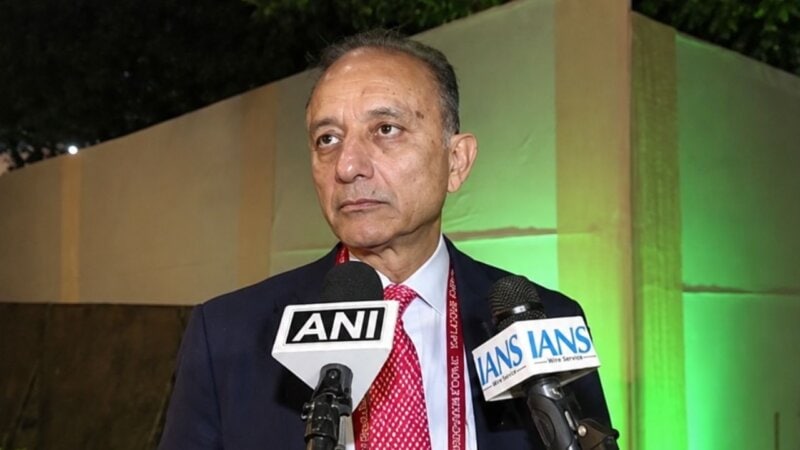
Minister for Climate Change Dr Musadik Malik has said that Pakistan and India must both put evidence on the table when they discuss terrorism, as he arrived in New Delhi to attend the Shanghai Cooperation Organisation’s (SCO) Civilisational Dialogue Forum.
His trip is the first visit to India by a Pakistani minister since Bilawal Bhutto-Zardari attended the SCO meeting in Goa in May 2023. It comes two years after India’s External Affairs Minister Subrahmanyam Jaishankar attended the bloc’s meeting in Islamabad.
Malik told Indian media that Pakistan wants a transparent mechanism on terrorism. “Both sides must bring forward evidence,” he said, adding that such a mechanism “would help restore trust and could lead to viable solutions.”
He said that Pakistan has proposed the idea on several occasions. “We have invited it several times,” he stated. According to Malik, the two sides have discussed sharing evidence bilaterally, at multilateral forums and through a friend both trust, but those talks did not make much progress. He reiterated that Pakistan has told India, “If you have any evidence, give it bilaterally,” yet the evidence never reaches the table.
A reporter asked why Pakistan takes no action against terrorists in its country. Malik pointed to the toll his country has paid. “You already know how many thousands of our people have been martyred,” he remarked.
He said that Pakistan has lost thousands of people in the past year and a half to two years. “Every day we have to carry martyrs on our shoulders,” he stressed, acknowledging that India has also suffered from such incidents.
“I do not want to present any victimhood to you,” he said. He added that Pakistan will do “whatever we have to do to protect our children” and is already doing it.
Malik observed that terrorism no longer divides only India and Pakistan. “Our neighbourhood is a complicated one, and the challenges facing this entire neighbourhood need to be addressed.”
He pointed to problems involving Iran, Central Asia and Afghanistan. He warned that bilateral talks often turn into finger-pointing. “It would be far better to address the problems of the entire region through a structured mechanism and based on concrete evidence,” he said.
Malik repeated that he came to New Delhi for a multilateral forum and refused to move bilateral issues onto that stage. “I do not want to reduce such a big conversation to just a bilateral frame,” he remarked.
A reporter asked whether talks on the Indus treaty would resume. “Right now, this is the larger frame, and it is not a forum for any bilateral talks. Whatever talks happen here will be multilateral.”
Another reporter raised a statement that had gone viral. Malik said he would speak at the forum in the morning. “We will sit with you after that,” he stated.
Malik called the forum a “tremendous opportunity” for multilateral dialogue. “I think cultures and civilisations cut across boundaries, and it is fantastic that we are here and talking about our history, our geography, and our cultures and civilisations. It is a very welcoming sign.”
Asked whether Pakistan-India relations will improve, he observed: “I think all of our relationships will improve. The region is in flux, as you know. The plates underneath geopolitics are shifting very fast.”
The forum brings together representatives from SCO member states to discuss civilisational dialogue and cultural understanding, according to the Foreign Office. Malik is expected to address it formally today.
Pakistan has taken over the rotating chairmanship of the SCO Council of Heads of State for 2026-27. It will host the organisation’s summit in Islamabad in August 2027.