Launched in collaboration with Syed Babar Ali Foundation, the executive training and certification program aims to develop regenerative agriculture leadership for more resilient and sustainable food systems in Pakistan
Nestlé Pakistan, LUMS Rausing Executive Development Centre (REDC) and the Syed Babar Ali Foundation have launched Regenerative Agriculture: Leading the Nestlé Way, a multi-year Executive Training and Certification Program aimed at developing knowledge and leadership in regenerative agriculture and contributing towards more resilient and sustainable food systems in Pakistan.
The initiative is designed to deepen understanding of regenerative agriculture among stakeholders from government, the private sector, financial institutions, academia and media, while helping develop a wider network of advocates who can support the adoption of regenerative farming practices in Pakistan.
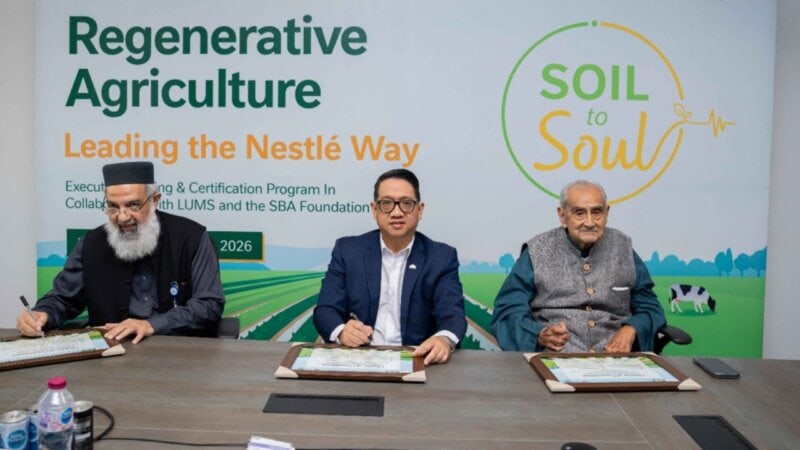
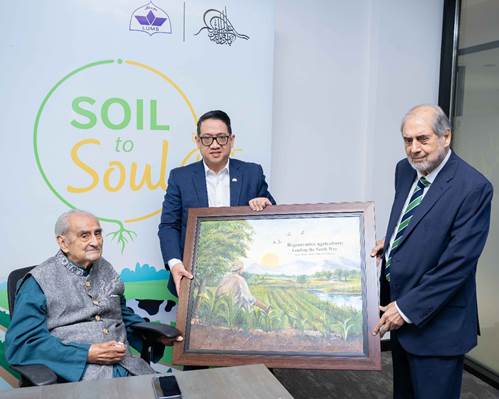
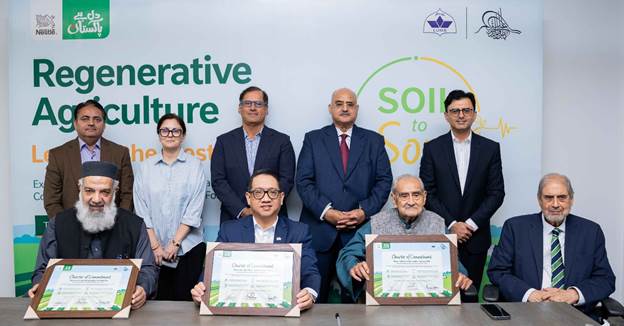
The program was launched as a tribute to Syed Babar Ali’s 100 Years of Impact and was formalized through a charter-signing ceremony between Nestlé Pakistan, LUMS and the Syed Babar Ali Foundation, celebrating his enduring legacy of leadership, service and excellence.
The program comes at a critical time for Pakistan’s agriculture sector, which contributes around 24% to national GDP and employs nearly 37% of the country’s labor force. Against a backdrop of increasing pressures from water scarcity, climate change and rising production costs, Nestlé recognizes the need to build institutional capability to keep Pakistan competitive with other leading agricultural economies around the world.
Speaking at the occasion, Jason Avanceña, CEO and Managing Director, Nestlé Pakistan, said: “At Nestlé, we believe in bringing global best practices closer to our local realities and strengthen capabilities across the value chain. This program is an opportunity to build shared understanding and develop a network of informed advocates who can champion regenerative agriculture and keep Pakistan competitive with other leading agricultural economies around the world. For Nestlé, it is ultimately about creating shared value across our agricultural value chain,” said Jason Avanceña, CEO and Managing Director, Nestlé Pakistan.
Syed Babar Ali said: “I have always believed that the true value of education lies in what we are able to pass on to the generations that follow us. Agriculture remains central to the country, and the challenges facing it require us to equip a new generation of leaders. Regenerative agriculture has an important role to play in that transition. I am pleased that this program focuses on an area highly important to Pakistan’s future, by investing in people who can contribute to a more resilient and sustainable agriculture sector.”
Dr. Tariq M. Jadoon, Provost at LUMS, said: “This program has been designed to move beyond theory by bringing together scientific understanding, business considerations and field exposure. Through areas such as soil health, water stewardship, climate resilience and farm economics, participants will be able to examine regenerative agriculture as an interconnected system and consider how these principles can be applied and scaled in Pakistan.”
The program will have two cohorts each year, with 25 participants per session. The four-day training model combines three days of classroom learning at REDC, LUMS with one day of field-based learning, connecting academic understanding with agricultural realities on the ground.