
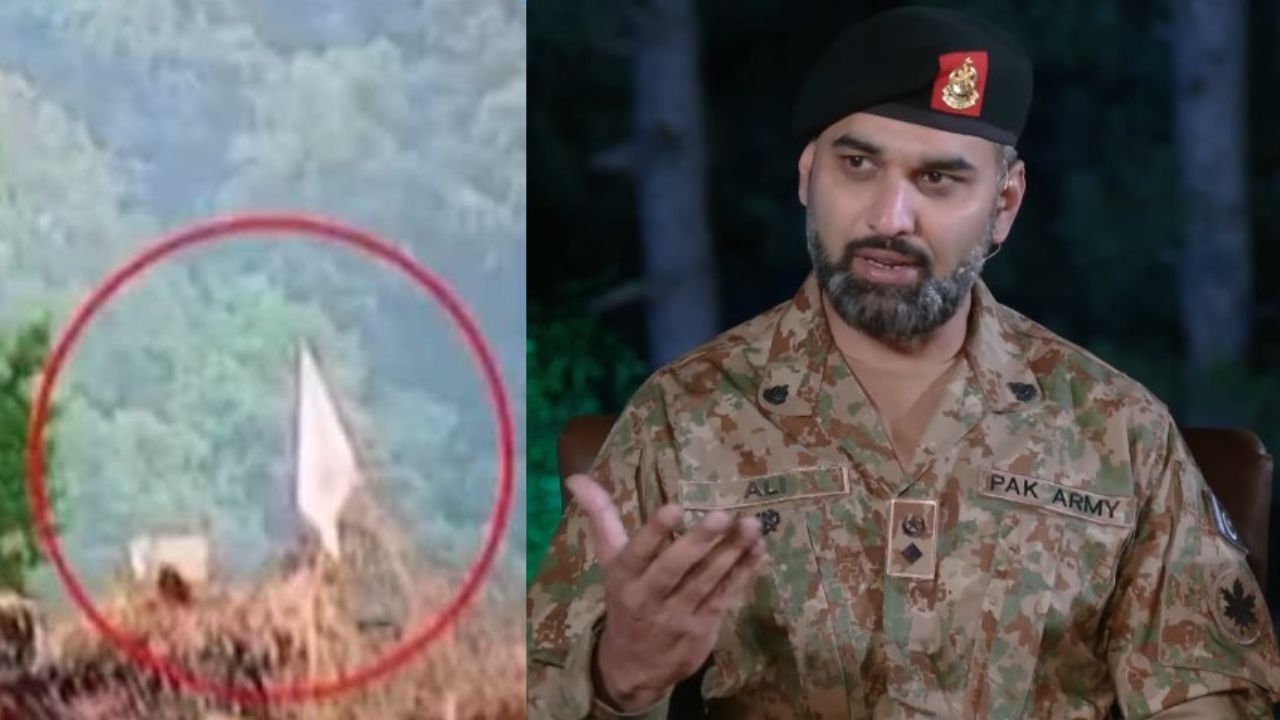


The Eid special episode of Tabish Hashmi's show Hasna Mana Hai, which aired on Sunday, featured Pakistan Army soldiers stationed at the Line of Control (LoC) in Rawalakot, where personnel recounted incidents from last month's Pakistan-India escalation.
Tabish asked Lieutenant Colonel Ali about the time when the Indian Army raised the white flag in response to the Pakistani Army’s punishing fire. Lt Col Ali replied that the Indian Army raised the flag just half an hour after their post was hit.
“When we began punishing fire around 5:30 am, then around 6:00 am, a white flag was raised by the enemy from their posts,” he detailed.
When asked to describe what it meant to raise a white flag at the Line of Control (LOC), Lt. Col. explained that it is a symbol of “peace”, adding that waving a white flag amidst an adversary has other reasons too.
“One of the reasons for raising the white flag is [to indicate] that a post has been effectively hit by the counterpart, leading to casualties and rendering it ineffective. So, it’s a way to give the flag-raiser a respite and pause the war for a while,” he explained, adding that as a professional army that abides by international laws, the Pakistani Army ceased fire.
According to Lt. Col. Ali, at 11 am the same day, the Indian Army opened fire again, prompting the Pakistani forces to target their second post as well. “They raised the [white] flag again,” he added.
Lt. Col. added that the red flag is also used in wars, which means "warning".
He then recounted that following the ceasefire on 11 May, soldiers from the enemy post, located approximately 150 metres from the Pakistani position, requested permission to fetch water after having run short following Pakistan’s retaliatory fire that severely damaged their post.
“We allowed them to get water,” he added.
The show follows the success of Operation Bunyam um Marsoos against India's aggression.
The tension between the two nuclear-armed countries rose following the militant attack in Indian Illegally Occupied Jammu and Kashmir (IIOJK) in Pahalgam on April 22, killing 26 people, including a Nepalese national.
New Delhi blamed Pakistan for orchestrating the attack, without conducting investigations and offering evidence to date.
The tension flared further when the Indian Air Force (IAF), while breaching the sovereignty of Pakistan, launched a missile attack in Bahawalpur, Muridke, and other cities in the Kashmir region on the night of May 6-7. The cowardly act prompted the Pakistan Air Force (PAF) to shoot down multiple fighter jets, including Rafales.
Following the international humiliation, India opened fire at the LOC, killing innocent civilians.
The military standoff ended after the US intervened and brokered the ceasefire between New Delhi and Islamabad on May 10.
'%3e%3crect%20y='0.445312'%20width='48'%20height='48'%20rx='24'%20fill='white'%20fill-opacity='0.5'/%3e%3crect%20x='0.5'%20y='0.945312'%20width='47'%20height='47'%20rx='23.5'%20stroke='%23808080'/%3e%3cpath%20d='M34.625%2024.4453L14%2024.4453'%20stroke='%23808080'%20stroke-width='0.920053'/%3e%3cpath%20d='M23.375%2034.4453L13.375%2024.4453L23.375%2014.4453'%20stroke='%23808080'%20stroke-width='0.920053'/%3e%3c/g%3e%3cdefs%3e%3cfilter%20id='filter0_b_489_44344'%20x='-12'%20y='-11.5547'%20width='72'%20height='72'%20filterUnits='userSpaceOnUse'%20color-interpolation-filters='sRGB'%3e%3cfeFlood%20flood-opacity='0'%20result='BackgroundImageFix'/%3e%3cfeGaussianBlur%20in='BackgroundImageFix'%20stdDeviation='6'/%3e%3cfeComposite%20in2='SourceAlpha'%20operator='in'%20result='effect1_backgroundBlur_489_44344'/%3e%3cfeBlend%20mode='normal'%20in='SourceGraphic'%20in2='effect1_backgroundBlur_489_44344'%20result='shape'/%3e%3c/filter%3e%3c/defs%3e%3c/svg%3e)
'%3e%3crect%20y='0.445312'%20width='48'%20height='48'%20rx='24'%20fill='white'%20fill-opacity='0.5'/%3e%3crect%20x='0.5'%20y='0.945312'%20width='47'%20height='47'%20rx='23.5'%20stroke='%23808080'/%3e%3cpath%20d='M13.375%2024.4453L34%2024.4453'%20stroke='%23808080'%20stroke-width='0.920053'/%3e%3cpath%20d='M24.625%2014.4453L34.625%2024.4453L24.625%2034.4453'%20stroke='%23808080'%20stroke-width='0.920053'/%3e%3c/g%3e%3cdefs%3e%3cfilter%20id='filter0_b_489_44344'%20x='-12'%20y='-11.5547'%20width='72'%20height='72'%20filterUnits='userSpaceOnUse'%20color-interpolation-filters='sRGB'%3e%3cfeFlood%20flood-opacity='0'%20result='BackgroundImageFix'/%3e%3cfeGaussianBlur%20in='BackgroundImageFix'%20stdDeviation='6'/%3e%3cfeComposite%20in2='SourceAlpha'%20operator='in'%20result='effect1_backgroundBlur_489_44344'/%3e%3cfeBlend%20mode='normal'%20in='SourceGraphic'%20in2='effect1_backgroundBlur_489_44344'%20result='shape'/%3e%3c/filter%3e%3c/defs%3e%3c/svg%3e)