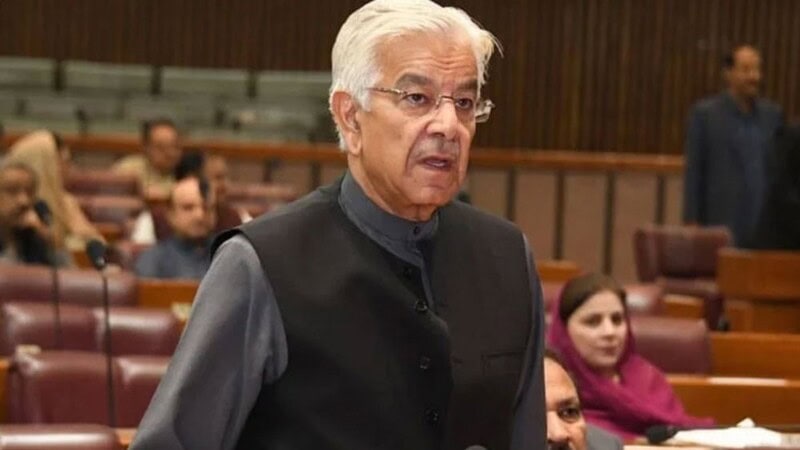
Defence Minister Khawaja Asif on Wednesday warned that Pakistan’s response to any future miscalculation would be “more intense and decisive”, issuing the statement amid growing United States (US) and international analyst warnings that another Pakistan-India crisis may be more likely and harder to contain.
In a televised message marking Marka-i-Haq, Asif said that the 2025 conflict, Operation Bunyan-un-Marsoos, was a defining moment in the country’s military and strategic posture.
“Marka-i-Haq was not just a memorable episode for Pakistan, but a line that we have drawn forever,” he said.
He added that Pakistan exercised restraint during the 2025 escalation but warned against any future adventurism.
“Anyone on the other side of this line should understand that Pakistan exercised tolerance and restraint during the 2025 episode,” he said, adding that any misadventure would not remain limited and “we will decide its course, its beginning and its end”.
Asif said that Pakistan does not seek conflict but rejected the idea of peace without sovereignty.
“Today, our ability to respond in the air, land and water is effective and fast beyond anyone’s imagination,” he said.
“Pakistan always wanted peace, but we don’t want peace devoid of dignity, security and respect for sovereignty. That’s not peace but surrender, and it is completely unacceptable to us,” he said.
He also warned against “dramatics, false flag operations and miscalculations”, saying any future escalation would come at a higher cost.
“It will be equivalent to committing suicide,” he said.
“Pakistan’s nation, armed forces and the state are moving in a unified direction,” he said, adding that the country stood “like bunyan-un-marsoos (a solid fortified wall)”.
His remarks come at a time when US and international analysts are increasingly warning that the post-2025 India-Pakistan security environment remains highly unstable.
In commentary published in The Washington Post, analysts said that another crisis between the two nuclear-armed neighbours is “probably not a question of if, but when”, warning that future confrontations may involve faster-moving military escalation with fewer opportunities for external mediation.
The analysis also cautioned that both sides may now believe a limited conventional war can be managed without crossing the nuclear threshold a conclusion described as potentially dangerous.
Separately, the Congressional Research Service (CRS) highlighted emerging friction points, including water security, noting India’s move to place the Indus Waters Treaty “in abeyance” after the 2025 conflict. It added that Pakistan considers water a “Vital National Interest” and has warned any disruption “will be considered as an Act of War”.
US scholar Elizabeth Threlkeld, writing in Foreign Affairs, warned that future conflicts may escalate more quickly and unpredictably. “That may reduce pressure for deliberate nuclear use, but it increases the risk of inadvertent escalation,” she wrote.
The International Institute for Strategic Studies (IISS) also noted that shifting diplomatic alignments after the 2025 conflict, including increased US engagement with Pakistan and tensions with India over Washington DC’s mediation role, are adding complexity to crisis management.
It noted that “an additional area of tension, from India’s perspective, has resulted from Trump’s claim to have brokered a ceasefire”.