
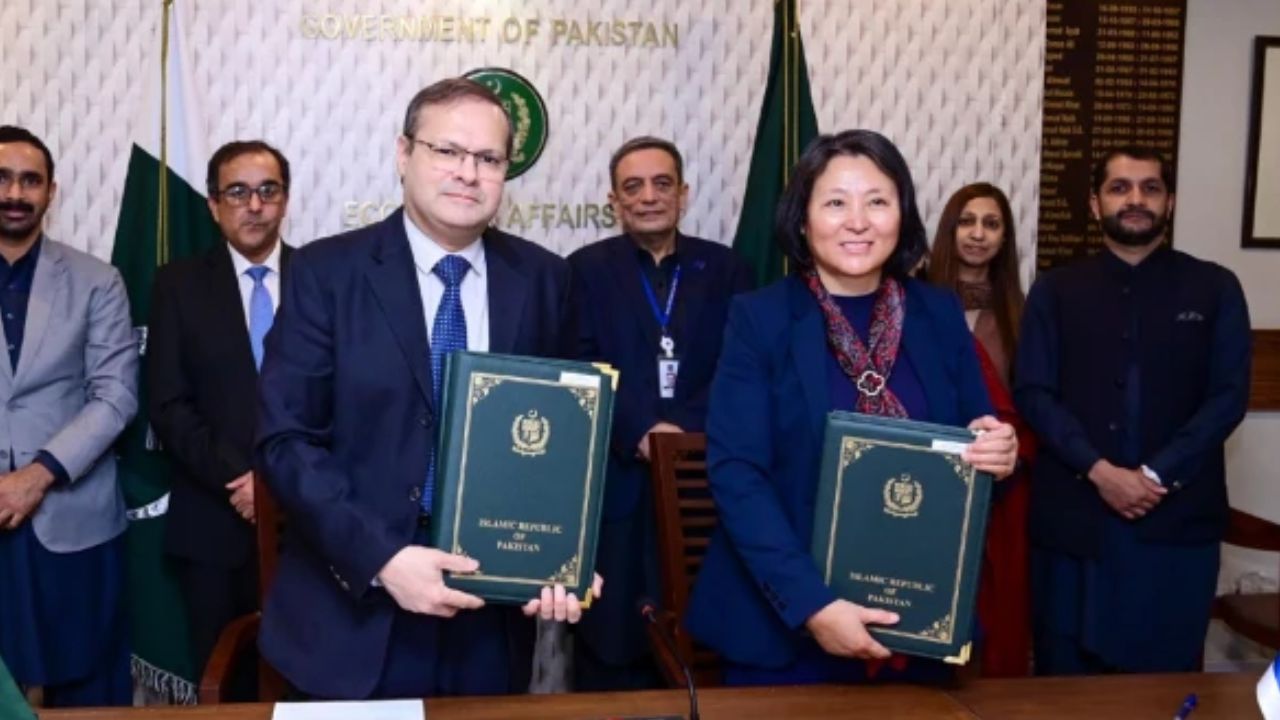


Pakistan and the Asian Development Bank (ADB) have signed two financing agreements worth a combined $730 million to strengthen the country’s power transmission network and push forward reforms in state-owned enterprises (SOEs), officials said on Thursday.
An official statement released after the signing ceremony stated that the agreements include a $400 million program to speed up SOE transformation and a $330 million second power transmission strengthening project.
The initiatives aim to encourage long-overdue governance reforms across important public-sector enterprises, enhance operational efficiency, and relieve pressure on overburdened transmission lines.
ADB Country Director Emma Fan welcomed the latest agreements, praising Pakistan’s commitment to structural reforms and underscoring the strategic importance of investment in the power sector. She said the SOE transformation programme comes at a critical time and would further strengthen reform efforts, according to the statement.
As part of broader efforts to stabilize and modernize the national grid, the ADB approved two loans totaling $330 million last month for the building of a new transmission line connecting Islamabad with Faisalabad, a significant industrial hub in Punjab.
However, analysts warn that until underlying structural concerns are addressed, finance and project design alone might not be sufficient.
The $730 million package, according to Dr. Khalid Waleed of the Sustainable Development Policy Institute (SDPI), is a significant step, but he cautioned that its success will depend on addressing long-standing inefficiencies across SOEs.
He cited the Bi-Annual Report on Federal SOEs for FY2025 from the Ministry of Finance, which reveals cumulative losses of more than Rs5.8 trillion. The National Highway Authority accounts for nearly Rs2 trillion of these losses, largely due to debt-driven expansion and an unsustainable toll-revenue model.
“This is not a sector-specific problem; it is systemic,” Dr Waleed said.
In infrastructure, NHA's rising debt stock reflects asset creation divorced from cash-flow realism. In energy, the situation is arguably worse. Once subsidies are stripped out, power distribution companies (DISCOs) are estimated to be bleeding close to Rs600 billion annually due to high technical losses, poor recoveries, and governance failures, losses that feed directly into circular debt and escalating capacity payment obligations upstream.
Analysts argue that while strengthening transmission infrastructure is necessary, it risks being only a partial solution if distribution-level problems remain unresolved. Dr Waleed likened reforming generation or transmission without fixing distribution to “installing a smart meter on a leaking pipe”.
There have also been complaints that the SOE Transformation Program's current scope may be too limited. While reforming the NHA is seen as a logical starting point, experts say it must go beyond incremental efficiency improvements to include deeper restructuring, such as asset recycling, toll securitisation and concession-based highway operations.
Similarly, analysts argue that energy-sector SOEs particularly DISCOs need to be explicitly incorporated into the reform framework through options such as privatisation, long-term concessions or performance-based management contracts, supported by aggressive loss-reduction targets.
The discussion also touches on Pakistan's more general energy transition challenges. The power industry is dealing with rising capacity payments and growing underutilization of generation assets, which is made worse by rooftop solar's explosive rise. This dynamic is expected to intensify as export-oriented industries seek cleaner power in response to the European Union’s Carbon Border Adjustment Mechanism.
According to experts, ADB should support an energy transition mechanism in addition to grid upgrades. Dr. Waleed proposed that an organized, financially supported early transition of loss-making thermal plants, beginning with the Jamshoro coal power plant sponsored by the ADB, might reduce the strain on circular debt and future capacity payments.
“The transmission project strengthens the backbone of the grid, but it does not resolve the contradiction between surplus capacity and mounting fiscal stress,” he said.
Analysts warn that without politically difficult but economically necessary reforms, the $730 million package risks adding new assets to a system still burdened by losses, debt and weak governance.
'%3e%3crect%20y='0.445312'%20width='48'%20height='48'%20rx='24'%20fill='white'%20fill-opacity='0.5'/%3e%3crect%20x='0.5'%20y='0.945312'%20width='47'%20height='47'%20rx='23.5'%20stroke='%23808080'/%3e%3cpath%20d='M34.625%2024.4453L14%2024.4453'%20stroke='%23808080'%20stroke-width='0.920053'/%3e%3cpath%20d='M23.375%2034.4453L13.375%2024.4453L23.375%2014.4453'%20stroke='%23808080'%20stroke-width='0.920053'/%3e%3c/g%3e%3cdefs%3e%3cfilter%20id='filter0_b_489_44344'%20x='-12'%20y='-11.5547'%20width='72'%20height='72'%20filterUnits='userSpaceOnUse'%20color-interpolation-filters='sRGB'%3e%3cfeFlood%20flood-opacity='0'%20result='BackgroundImageFix'/%3e%3cfeGaussianBlur%20in='BackgroundImageFix'%20stdDeviation='6'/%3e%3cfeComposite%20in2='SourceAlpha'%20operator='in'%20result='effect1_backgroundBlur_489_44344'/%3e%3cfeBlend%20mode='normal'%20in='SourceGraphic'%20in2='effect1_backgroundBlur_489_44344'%20result='shape'/%3e%3c/filter%3e%3c/defs%3e%3c/svg%3e)
'%3e%3crect%20y='0.445312'%20width='48'%20height='48'%20rx='24'%20fill='white'%20fill-opacity='0.5'/%3e%3crect%20x='0.5'%20y='0.945312'%20width='47'%20height='47'%20rx='23.5'%20stroke='%23808080'/%3e%3cpath%20d='M13.375%2024.4453L34%2024.4453'%20stroke='%23808080'%20stroke-width='0.920053'/%3e%3cpath%20d='M24.625%2014.4453L34.625%2024.4453L24.625%2034.4453'%20stroke='%23808080'%20stroke-width='0.920053'/%3e%3c/g%3e%3cdefs%3e%3cfilter%20id='filter0_b_489_44344'%20x='-12'%20y='-11.5547'%20width='72'%20height='72'%20filterUnits='userSpaceOnUse'%20color-interpolation-filters='sRGB'%3e%3cfeFlood%20flood-opacity='0'%20result='BackgroundImageFix'/%3e%3cfeGaussianBlur%20in='BackgroundImageFix'%20stdDeviation='6'/%3e%3cfeComposite%20in2='SourceAlpha'%20operator='in'%20result='effect1_backgroundBlur_489_44344'/%3e%3cfeBlend%20mode='normal'%20in='SourceGraphic'%20in2='effect1_backgroundBlur_489_44344'%20result='shape'/%3e%3c/filter%3e%3c/defs%3e%3c/svg%3e)