
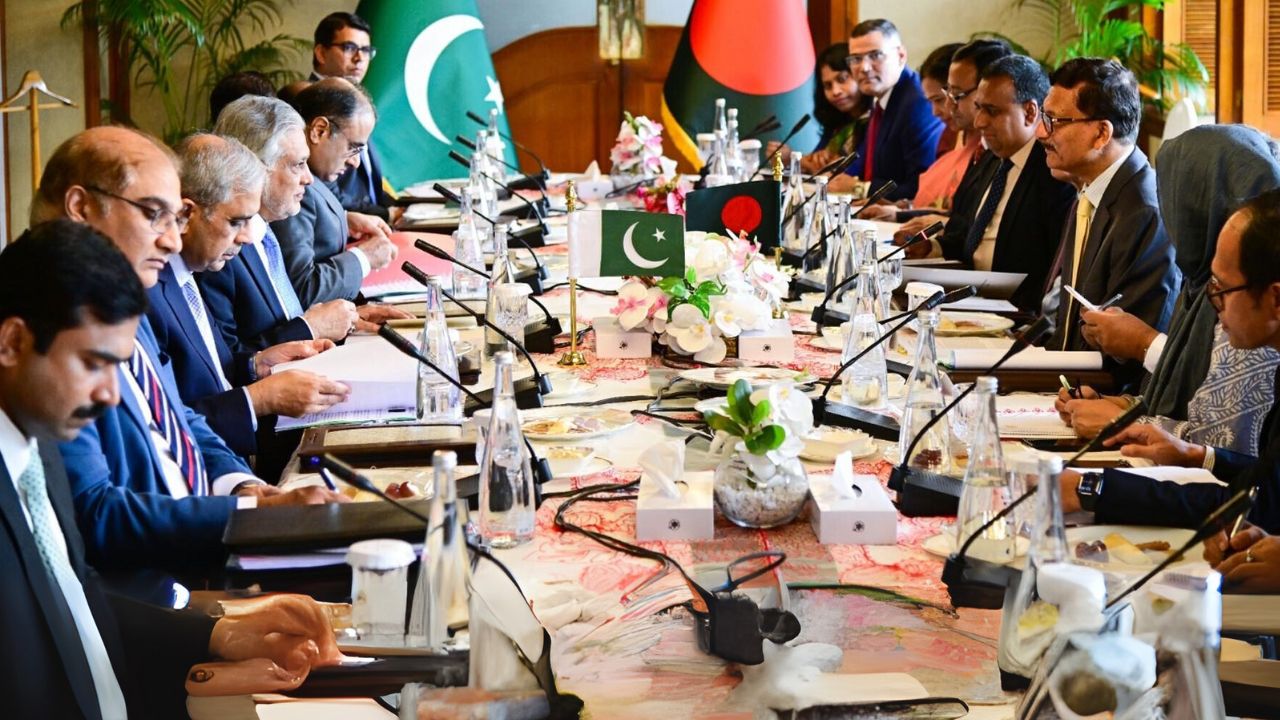


Ishaq Dar, the Deputy Prime Minister and Foreign Minister, concluded a historic visit to Dhaka on Sunday, the first by a Pakistani foreign minister in 13 years, signing six agreements Memorandums of Understanding (MoUs) regarding trade, diplomacy, media, education, and cultural cooperation.
During his stay, Dar met Bangladesh’s Chief Adviser Professor Muhammad Yunus, Foreign Policy Adviser Touhid Hossain, senior political leaders, and trade officials. The visit, widely described as a “milestone,” reflects Islamabad and Dhaka’s renewed efforts to reset relations following years of strained ties.
The agreements signed included visa abolition for diplomatic and official passport holders, MoUs between the two countries’ foreign service academies and think tanks, a media cooperation accord between Associated Press of Pakistan (APP) and Bangladesh Sangbad Sangstha (BSS), a cultural exchange programme for 2025–2028, and the establishment of a joint working group on trade.
In his meeting with Chief Adviser Yunus, Dar conveyed Prime Minister Shehbaz Sharif’s greetings and reiterated Pakistan’s commitment to strengthening bilateral relations. Both sides discussed trade, economic cooperation, youth exchanges, and regional security.
According to the Foreign office, Yunus stressed the importance of revitalising Saarc, saying: “I encourage Saarc, and I see our relationship with Pakistan and other Saarc countries as one of the highest priorities.”
Dar also announced the launch of the "Pakistan-Bangladesh Knowledge Corridor," which will lead to 500 scholarships given by Pakistan to Bangladeshi students over the course of the following five years, with a quarter going to medical school.
Training programmes for 100 Bangladeshi civil servants were also offered, while scholarships under the Pakistan Technical Assistance Programme were raised from five to 25.
The foreign minister met with Dr. Shafiqur Rahman, the emir of Jamaat-e-Islami, and Begum Khaleda Zia, the chairperson of the Bangladesh Nationalist Party.
At Zia's house, Dar recalled her 2006 trip to Pakistan and wished her a speedy recovery. Dar praised Rahman's "lifelong positive contribution in the fields of politics, education, and social welfare" when paying him a visit while he recovered from heart surgery.
Foreign Policy Adviser Touhid Hossain, speaking to reporters after his meeting with Dar, said: “We have raised unresolved issues such as an apology or expression of regret for 1971, claims over assets, and the matter of stranded Pakistani citizens. It would be wrong to expect problems of 54 years to be solved in a single day.”
Dar emphasized, however, that the issue had already been addressed. “As far as unresolved issues are concerned, this matter was first settled in writing in 1974, and this historic document is available to both countries. Later, General Musharraf came here and addressed this matter in a very open and explicit manner,” he told journalists.
He continued: “In my view, once this matter has been settled between brothers, Islam also instructs us to keep our hearts clean. Therefore, we should move forward and work together, because our future is bright. In line with our Islamic teachings, the Quran, and the Sunnah, we must keep our hearts pure and move forward. We are one family, and we must work together to do the best for the people of both countries.”
Dar described his discussions in Dhaka as “excellent,” saying: “There was no disagreement on any matter, which is a very positive sign. We are working together to take economic and trade relations between our two countries to new heights.”
At a reception hosted by Pakistan’s High Commissioner in Dhaka, Dar noted the deep-rooted cultural and religious connections between the two nations. “The relations between the two countries are anchored in centuries-old shared traditions, Islamic heritage, social norms and literary expressions,” he remarked, adding that the people of Pakistan hold “fraternal sentiments” toward the people of Bangladesh.
Both sides agreed to look into measures to improve connectivity and economic cooperation during the visit, which also included discussions with trade and commerce officials. Two decades after its last session, reports in Dhaka indicate that Pakistan and Bangladesh intend to call a new meeting of the long-stalled Joint Economic Commission later this year.
Dar's trip has been hailed as a major turning point in Pakistan-Bangladesh ties, indicating cautious optimism about the future with the signing of new agreements, strengthened political engagement, and commitments for educational and cultural exchanges.
'%3e%3crect%20y='0.445312'%20width='48'%20height='48'%20rx='24'%20fill='white'%20fill-opacity='0.5'/%3e%3crect%20x='0.5'%20y='0.945312'%20width='47'%20height='47'%20rx='23.5'%20stroke='%23808080'/%3e%3cpath%20d='M34.625%2024.4453L14%2024.4453'%20stroke='%23808080'%20stroke-width='0.920053'/%3e%3cpath%20d='M23.375%2034.4453L13.375%2024.4453L23.375%2014.4453'%20stroke='%23808080'%20stroke-width='0.920053'/%3e%3c/g%3e%3cdefs%3e%3cfilter%20id='filter0_b_489_44344'%20x='-12'%20y='-11.5547'%20width='72'%20height='72'%20filterUnits='userSpaceOnUse'%20color-interpolation-filters='sRGB'%3e%3cfeFlood%20flood-opacity='0'%20result='BackgroundImageFix'/%3e%3cfeGaussianBlur%20in='BackgroundImageFix'%20stdDeviation='6'/%3e%3cfeComposite%20in2='SourceAlpha'%20operator='in'%20result='effect1_backgroundBlur_489_44344'/%3e%3cfeBlend%20mode='normal'%20in='SourceGraphic'%20in2='effect1_backgroundBlur_489_44344'%20result='shape'/%3e%3c/filter%3e%3c/defs%3e%3c/svg%3e)
'%3e%3crect%20y='0.445312'%20width='48'%20height='48'%20rx='24'%20fill='white'%20fill-opacity='0.5'/%3e%3crect%20x='0.5'%20y='0.945312'%20width='47'%20height='47'%20rx='23.5'%20stroke='%23808080'/%3e%3cpath%20d='M13.375%2024.4453L34%2024.4453'%20stroke='%23808080'%20stroke-width='0.920053'/%3e%3cpath%20d='M24.625%2014.4453L34.625%2024.4453L24.625%2034.4453'%20stroke='%23808080'%20stroke-width='0.920053'/%3e%3c/g%3e%3cdefs%3e%3cfilter%20id='filter0_b_489_44344'%20x='-12'%20y='-11.5547'%20width='72'%20height='72'%20filterUnits='userSpaceOnUse'%20color-interpolation-filters='sRGB'%3e%3cfeFlood%20flood-opacity='0'%20result='BackgroundImageFix'/%3e%3cfeGaussianBlur%20in='BackgroundImageFix'%20stdDeviation='6'/%3e%3cfeComposite%20in2='SourceAlpha'%20operator='in'%20result='effect1_backgroundBlur_489_44344'/%3e%3cfeBlend%20mode='normal'%20in='SourceGraphic'%20in2='effect1_backgroundBlur_489_44344'%20result='shape'/%3e%3c/filter%3e%3c/defs%3e%3c/svg%3e)