
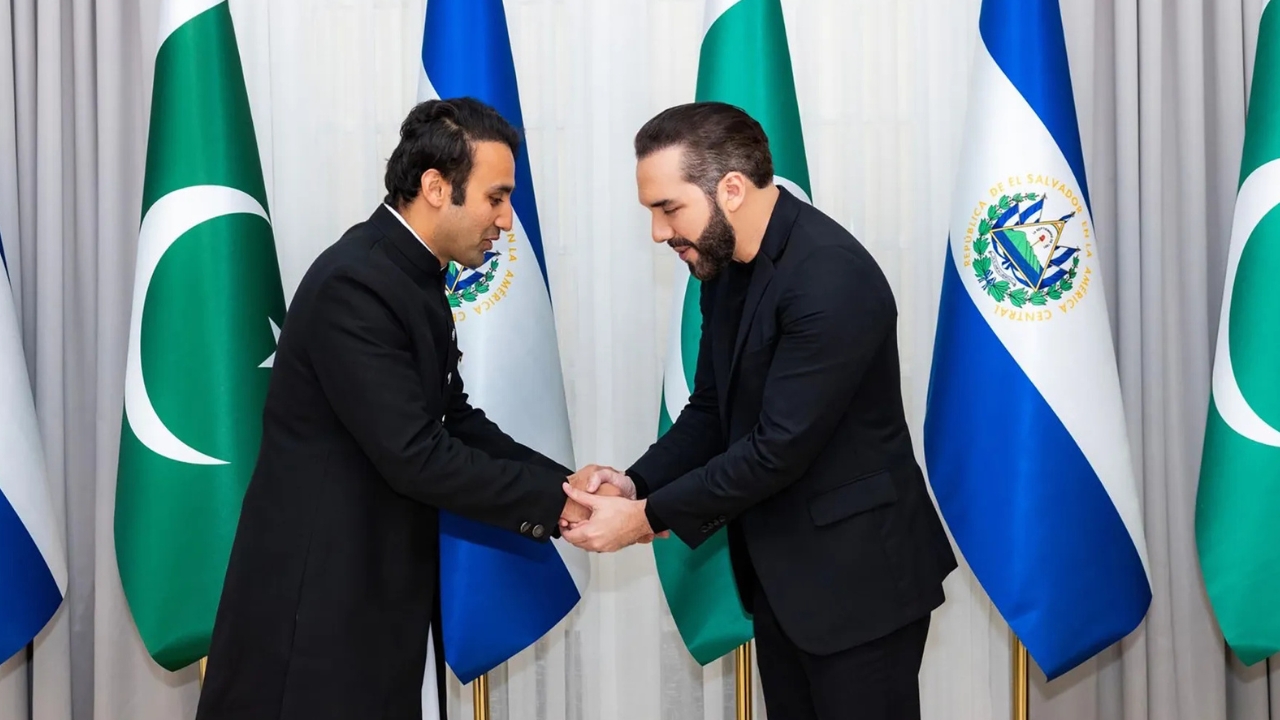


Pakistan plans to partner with El Salvador, the first country to use cryptocurrency as legal tender, to join the digital currency race and work together to promote crypto use, according to reports.
Pakistan Crypto Council’s (PCC) chief executive officer (CEO) Bilal Bin Saqib met with El Salvador’s President Nayib Bukele. According to a statement from Prime Minister Shehbaz Sharif’s office, the two sides discussed forming a partnership to exchange knowledge on digital assets.
Collaboration with El Salvador could yield positive results for Pakistan, as the South American country adopted Bitcoin as legal tender in September 2021. While it rolled back Bitcoin’s status as legal tender in January 2025, Pakistan could benefit from the knowledge El Salvador gained during its three-year “experiment”, regarding the integration of digital assets into the national economy while on an International Monetary Fund (IMF) program.
Like El Salvador, Pakistan remains under the IMF’s Extended Fund Facility (EFF) program. However, while El Salvador has made notable progress in embracing digital assets, Pakistan has only recently stepped into the space with the PCC in March 2025. Given El Salvador’s experience navigating similar economic and technological transitions, Pakistan stands to gain significantly from knowledge sharing and collaboration.
El Salvador’s President has been attempting for years to establish his country as a hub for digital assets. Reports suggest that the issuer of the most renowned stablecoin in the country, Tether Holdings SA, also recently established its headquarters.
Despite being mandated by the IMF to stop acquiring Bitcoin as per a loan agreement, El Salvador continues to purchase the digital asset. Data from reports suggests that the country now boasts an impressive collection of 6,238 Bitcoins in its reserves, valued at approximately $738 million as of publishing.
Pakistan has taken steps to establish itself as a digital asset hub as well, creating the country’s first-ever government-led Strategic Bitcoin Reserve. The PCC’s CEO recently outlined Islamabad’s intentions, indicating that holding digital assets by the state signalled a long-term belief in decentralised finance and was not for speculative purposes.
Islamabad recently allocated 2,000 megawatts of surplus power to crypto mining and to power artificial intelligence data centres. While initial reports suggested that, similar to El Salvador, the IMF disagreed with the aforementioned crypto-related initiative, Pakistan’s Power Division and the IMF jointly rubbished these claims as no formal objection had been logged by the international lender.
'%3e%3crect%20y='0.445312'%20width='48'%20height='48'%20rx='24'%20fill='white'%20fill-opacity='0.5'/%3e%3crect%20x='0.5'%20y='0.945312'%20width='47'%20height='47'%20rx='23.5'%20stroke='%23808080'/%3e%3cpath%20d='M34.625%2024.4453L14%2024.4453'%20stroke='%23808080'%20stroke-width='0.920053'/%3e%3cpath%20d='M23.375%2034.4453L13.375%2024.4453L23.375%2014.4453'%20stroke='%23808080'%20stroke-width='0.920053'/%3e%3c/g%3e%3cdefs%3e%3cfilter%20id='filter0_b_489_44344'%20x='-12'%20y='-11.5547'%20width='72'%20height='72'%20filterUnits='userSpaceOnUse'%20color-interpolation-filters='sRGB'%3e%3cfeFlood%20flood-opacity='0'%20result='BackgroundImageFix'/%3e%3cfeGaussianBlur%20in='BackgroundImageFix'%20stdDeviation='6'/%3e%3cfeComposite%20in2='SourceAlpha'%20operator='in'%20result='effect1_backgroundBlur_489_44344'/%3e%3cfeBlend%20mode='normal'%20in='SourceGraphic'%20in2='effect1_backgroundBlur_489_44344'%20result='shape'/%3e%3c/filter%3e%3c/defs%3e%3c/svg%3e)
'%3e%3crect%20y='0.445312'%20width='48'%20height='48'%20rx='24'%20fill='white'%20fill-opacity='0.5'/%3e%3crect%20x='0.5'%20y='0.945312'%20width='47'%20height='47'%20rx='23.5'%20stroke='%23808080'/%3e%3cpath%20d='M13.375%2024.4453L34%2024.4453'%20stroke='%23808080'%20stroke-width='0.920053'/%3e%3cpath%20d='M24.625%2014.4453L34.625%2024.4453L24.625%2034.4453'%20stroke='%23808080'%20stroke-width='0.920053'/%3e%3c/g%3e%3cdefs%3e%3cfilter%20id='filter0_b_489_44344'%20x='-12'%20y='-11.5547'%20width='72'%20height='72'%20filterUnits='userSpaceOnUse'%20color-interpolation-filters='sRGB'%3e%3cfeFlood%20flood-opacity='0'%20result='BackgroundImageFix'/%3e%3cfeGaussianBlur%20in='BackgroundImageFix'%20stdDeviation='6'/%3e%3cfeComposite%20in2='SourceAlpha'%20operator='in'%20result='effect1_backgroundBlur_489_44344'/%3e%3cfeBlend%20mode='normal'%20in='SourceGraphic'%20in2='effect1_backgroundBlur_489_44344'%20result='shape'/%3e%3c/filter%3e%3c/defs%3e%3c/svg%3e)