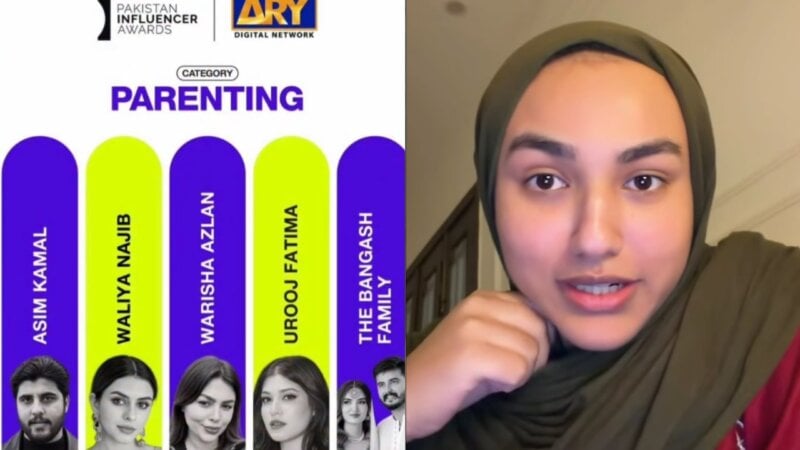
Pakistan Influencer Awards have become the target of intense backlash over its Parenting Creator of the Year category after digital creator Azmyr Raja questioned whether the nominations recognise parenting or reward creators for sharing their children online.
In a video, Raja said that parents can create parenting content while protecting their children’s privacy, arguing that children cannot consent to having their faces, bodies, routines and childhood moments documented for millions of people to view, save and share.
“We live in the age of AI, we live in the age of deepfakes,” Raja said, raising concerns about the risks of making children’s personal lives accessible online.
Raja argued that the category rewards creators for how they present their children online rather than for parenting guidance. Raja pointed to content ranging from children wearing school uniforms with visible logos to a child’s hip appearing during a diaper change in an advertisement.
“The people on this list have done all of this,” Raja said, referring to the nominees and their content.
The Parenting Creator of the Year category features Asim Kamal, Waliya Najib, Warisha Azlan, Urooj Fatima and The Bangash Family.
Raja also challenged the argument that people should not judge parents for sharing their children online, saying that creators with millions of views have a responsibility to consider their children’s privacy.
“Not posting your child online is literally the easiest thing that you can do,” Raja stated.
Raja also questioned the message the awards send to new parents who create content, arguing that presenting such content as an achievement risks encouraging more parents to share their children’s lives online.
Following backlash in the comments section, Pakistan Influencer Awards removed the post announcing the category from its social media accounts. However, the category remained on the awards’ website, where voting continued.
The awards’ website describes the Parenting category as a space for mothers, fathers and family creators who share the realities of raising children. It lists early childhood development, pregnancy and maternal wellness, educational activities, family routines and household management among the areas covered.
The category description also identifies empathy, responsibility, trustworthy guidance, honest representation of family life, respect for children’s privacy and dignity, and community support as criteria for recognition.
The backlash also drew criticism from social media users who questioned what the nominated accounts offered beyond content featuring their children.
One social media user wrote, “An award for exploiting their own babies for social media content and money???”
Another questioned, “Since when did exploiting your own children become an award worthy achievement???”
One person wrote, “How is that influencing anyone I don’t understand? I mean rewarding people for what? For how they play with their child?”
Others questioned whether the content demonstrated parenting guidance. One comment read, “Are they giving homeschooling tips? Kids nutrition ideas? Telling how to build a child’s character? Sharing health tips? What??? Apart from over Sharing their kids photos in nice dresses, what parenting is there?”
However, some users defended the nominees. One post said, “Their life their choice. Why are you triggered?”
Another defended The Bangash Family, writing, “I don’t think The Bangash Family has created any inappropriate baby content. I believe they genuinely deserve to be recognized in the Family and Parenting Awards category.”
One user also highlighted the distinction between sharing family content and the potential consequences of monetising children’s lives, writing that parents could end up hurting their children while trying to make money from parenting content.